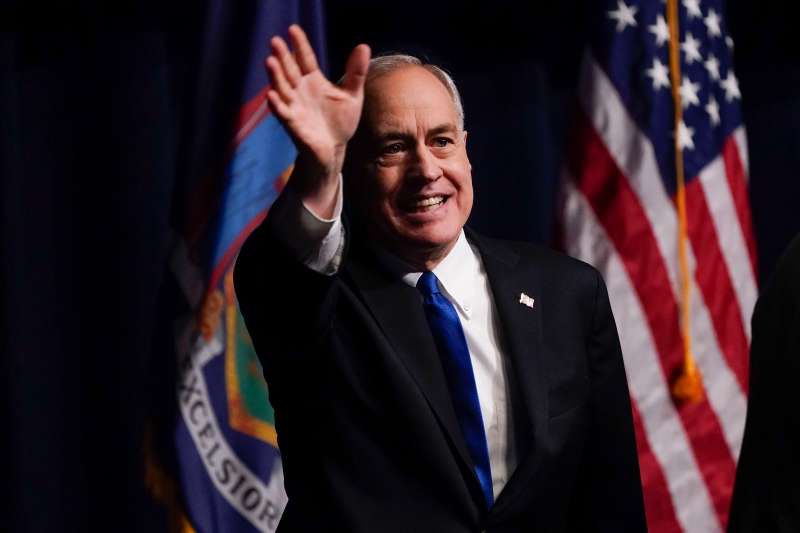
The New York State comptroller oversees nearly $300 billion in public pension money, making the office the third-largest public pension fund in the United States. Most New Yorkers don’t know who holds it, let alone what it does with their money.
An unusually competitive primary on June 23 could change that.
For the first time since 2006, Comptroller Thomas DiNapoli faces a real primary challenge—two of them, in fact, from Drew Warshaw, a former affordable housing nonprofit CEO, and Raj Goyle, a former Kansas state legislator turned New York tech entrepreneur.
The race has become an unexpected referendum on what New York Democrats’ appetite for progressive governance actually means when applied to a near-$300 billion fiduciary role—and whether ambition alone is enough to run one.
The incumbent
DiNapoli has held the office since 2007, winning four terms without significant opposition. His record is, by traditional measures, strong. The fund posted an estimated 11.94% return for the fiscal year ending March 31, 2026—a record high—and an independent fiduciary review released in January found it operates at the highest ethical and professional standards. Every public-sector union whose pensions are at stake has endorsed him, including Gov. Kathy Hochul, Attorney General Letitia James, and major unions including 32BJ Service Employees International Union (SEIU).
“Tom DiNapoli has done a phenomenal job overseeing the New York State Common Retirement Fund and protecting pensions for the public-sector workers who rely on them,” Aaron Ghitelman, DiNapoli’s campaign manager, told Courier New York.
But DiNapoli’s record of quiet, technocratic success may not align with the criteria shaping voter judgment this cycle. Zohran Mamdani’s mayoral win suggests that New York’s Democrats want their officials to use power visibly and aggressively. DiNapoli, by contrast, has run the office as a steady, low-profile steward of the pension fund for nearly two decades.
He declined to appear at a CBS6 debate last week, leaving an empty podium as his two challengers faced off. His campaign did not respond to questions about the decision.
The policy challenger
Drew Warshaw, former co-CEO of Enterprise Community Partners, the largest affordable housing nonprofit in the country, was the first to enter the race, announcing his challenge to DiNapoli in May 2025—four months before Goyle joined.
“Every year I was there, the housing crisis got worse, and every day I went to work, we lost,” Warshaw told Courier New York. “And there’s this person who’s sitting on all this money and all this power—the two things that we need more than anything to address this housing crisis.”
His backers include Make the Road Action, one of New York’s largest immigrant advocacy organizations.
Warshaw’s campaign is built around a sweeping reimagination of what the office can do. He promises to fire the 664 Wall Street investment managers currently overseeing the fund, replace them with low-cost index funds, and redirect the savings toward $20 billion in affordable housing investment—which would be the largest such fund in the country.
He also wants to audit local police departments cooperating with US Immigration and Customs Enforcement (ICE), divest from fossil fuels and Israeli bonds, and deploy the office’s 3,000 auditors as a tool to hold agencies accountable on immigration enforcement.
Warshaw’s central attack on DiNapoli—that his reliance on high-fee Wall Street managers has cost New York taxpayers $59.1 billion over 18 years—comes from a report his own campaign produced, which has not been independently peer-reviewed. DiNapoli’s campaign called it “full of basic math errors.” The most recent fiscal year, in which the fund returned nearly 12%, complicates Warshaw’s underperformance argument, at least in the short term.
Warshaw stands by his numbers. “One human controls $300 billion and no one in the financial world ever thought to quantify his performance until we came along,” he said. “It turns out he’s underperformed by 39%. He made these guys millionaires in the process.”
Warshaw also surfaced an issue that has received little attention in the race: the state’s unclaimed funds pool—or money owed to New Yorkers by banks and insurance companies—has nearly tripled to $20 billion under DiNapoli’s watch. Currently, residents must navigate a state government website and file a claim to recover what they are owed. Warshaw proposes to send the money back automatically.
The challenger from Kansas
Raj Goyle, a former Kansas state legislator and legal tech entrepreneur, has the most high-profile national progressive endorsements in the race—Rep. Ro Khanna (D-Calif.), Rep. Pramila Jayapal (D-Wash.), Zephyr Teachout, Sunrise NYC—as well as the most questions about his record.
In a campaign ad Goyle himself produced while running for Congress in Kansas in 2010, he described his legislative record this way: “In the state house, I voted with Republicans 80% of the time. I was one of the top five Democrats in agreeing with Republicans. And 89% of the legislation I sponsored, I sponsored with Republicans.”
His current campaign website describes the same record differently: “During his four years in the Kansas legislature, Raj voted consistently as a pro-labor, pro-choice, and anti-NRA progressive.”
When asked about the discrepancy, Goyle denied having a conservative voting record and cited endorsements from Planned Parenthood and the AFL-CIO during his Kansas years, which he also told PBS. He noted he had been off social media for 15 years before re-entering public life and framed his progressive evolution as authentic.
“I’ve been fighting [against] pro-life movements [since] I was 15 years old,” he said.
His divestment positions, which include calling for full removal of Israeli bonds and Palantir from the pension fund, have drawn the most attention in the race.
Both challengers’ financial disclosures, however, showed personal Palantir stock holdings as of December 31, 2025—the same company each has called for the pension fund to divest from.
The Working Families Party’s non-endorsement may be the clearest indicator on the progressive lane’s state of play. Goyle did not make it out of the first round of WFP voting, while Warshaw advanced to the second round but ultimately could not clinch it. DiNapoli, who has held the WFP’s endorsement in past cycles, did not win it either. The result was no endorsement.
“I have just an incredible amount of respect for the Working Families Party, having worked with them going back to my campaign finance reform days, more than 20 years ago,” Warshaw said of the decision. “It was incredibly disappointing.”
Goyle, for his part, remained undeterred. “We don’t need a technocrat in this office,” he said. “We need a proven fighter who’s taken on the systems and won.”
The $300 billion question
Beneath the credential fights and competing numbers is a question that will outlast this primary: what does New York do with nearly $300 billion, and who do voters trust to decide?
DiNapoli’s answer has been stability and steady returns, protecting what retirees have earned. His challengers argue that the office has the power to do far more, like lower utility rates, audit agencies cooperating with ICE, redirect pension capital toward housing, and return billions to New Yorkers who are owed it.
“The worst thing for progressives and Democrats, as we’ve learned nationally, is to not use political power,” Goyle said. “Franklin Roosevelt didn’t sit around blaming someone else when he tried to tackle the Great Depression. He enacted the New Deal.”
Warshaw added: “We have that power.”
DiNapoli’s campaign has a different read on both men. “Tom’s opponents lack a track record of public service and have resorted to lying and distorting Tom’s record to try to get attention for their flailing campaigns,” Ghitelman said. “New Yorkers can smell BS—and that’s why voters are going to reject them at the ballot box on Election Day.”