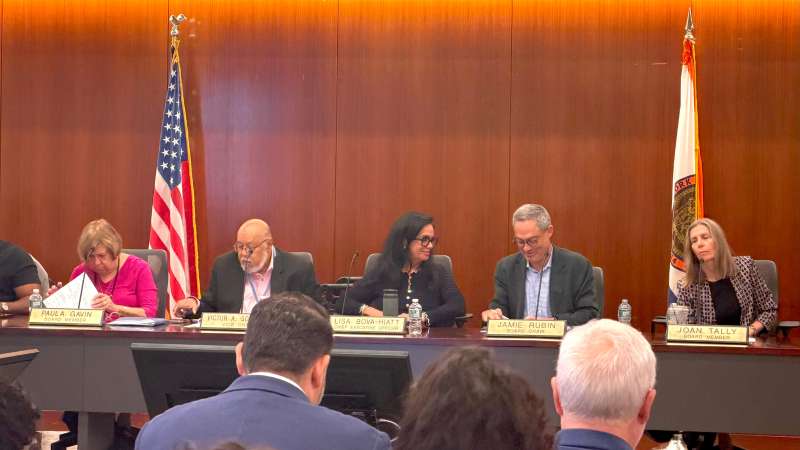
A New York City Housing Authority (NYCHA) board meeting devolved into sustained chants of “No demolition!” Wednesday morning.
Tenants of Fulton Houses and Elliott-Chelsea Houses packed the agency’s Lower Manhattan headquarters to oppose a plan that would tear down their homes and convert them into privately managed, project-based Section 8 housing.
The protest was the first of two coordinated actions the Chelsea Public Housing Coalition planned for Wednesday. Made up of tenants and local advocacy groups, the coalition also scheduled a public hearing that evening at the Theater at City Tech in Brooklyn.
At stake is the fate of approximately 1,763 apartments moving toward conversion or privatization under items on Wednesday’s board calendar, according to NYCHA meeting documents.
Beyond the proposed demolition of Fulton and Elliott-Chelsea Houses, the calendar also authorized converting 11 developments in the Bronx comprising 1,316 units and transferring assistance out of Lincoln, Drew-Hamilton, and Mitchel Houses.
Built between 1947 and 1965, the combined Fulton, Elliott, and Chelsea campus houses nearly 4,500 residents across more than 2,050 apartments, per city redevelopment documents.
‘Not routine’
NYCHA’s board calendar describes the actions as routine authorizations tied to its Permanent Affordability Commitment Together (PACT) program and the city’s Public Housing Preservation Trust.
Tenants and advocates who testified Wednesday rejected said framing.
“NYCHA presents these actions as routine real estate transactions,” said Layla Law-Gisiko, District Leader for Assembly District 75/A, during public comment. “They’re not routine. They will determine who controls public housing and who profits from it.”
Law-Gisiko, an investigative journalist, argued the conversion process known as the Rental Assistance Demonstration (RAD) program upends the founding purpose of public housing
“Public housing was created to remove housing from speculation,” she said. “RAD and PACT reverse that principle. They turn homes into financial vehicles, developments into transactions, and residents into a projected revenue stream.”
She said tenants currently paying flat rents under Section 9 would see costs rise once converted to Section 8 and pointed to the $1.5 billion the city appropriated to Section 8 funding in its most recent budget as money that could have gone toward rehabilitating existing Section 9 housing instead.
“NYCHA could have made significant progress renovating Section 9 homes with that pile of money,” Law-Gisiko said. “Instead, it will go to enrich private developers. This is a failure of fiscal policy. You are the gravediggers of public housing.”
The Chelsea Public Housing Coalition said NYCHA’s draft plan understates the housing capacity the demolition would eliminate, citing internal RAD conversion documents showing a combined 250-bedroom reduction across the first phase of both developments even as NYCHA maintains it is preserving unit counts.
The coalition also raised environmental concerns, saying demolition and excavation on occupied campuses risk exposing residents to contaminated soil and airborne toxins over years of construction. It called on NYCHA to release all environmental and soil-testing records tied to the project.
In a statement to Courier New York, NYCHA pushed back on the coalition’s characterization of the project as a land grab, framing it instead as a resident-informed plan addressing significant capital needs.
“Since 2019, residents have helped outline a plan that addresses over $900 million in mounting physical needs at Fulton and Elliott-Chelsea while maintaining their rights and protections,” the agency said. “The plan puts NYCHA residents first, delivering a more equitable living experience for them, inclusive of the modern amenities and accessibility features enjoyed by their neighbors in Chelsea.”
NYCHA disputed that residents broadly oppose the project, attributing the pushback to “a small group of activists, including some who do not live in NYCHA,” whom the agency said are “spreading misinformation” and attempting to disrupt the relocation process.
The agency said 94% of households will remain in their current apartments until new homes are built, with a small share temporarily relocated within the campuses.
The redevelopment plan calls for rebuilding all 2,056 existing apartments first, with all authorized residents guaranteed a right to a new unit, before construction begins on up to 3,454 additional mixed-income units, including up to 1,038 permanently affordable units. That would bring the project’s total to up to 5,510 units, of which up to 3,094 would be permanently affordable. The new buildings are also planned to include modern amenities for NYCHA residents, new community space for Hudson Guild, programmed outdoor space, and commercial and community-serving retail. Rent is intended to remain permanently affordable, with residents’ existing rights and protections preserved and continued resident engagement throughout the process, according to project documents.
‘This is our home’
Fourteen residents lined at the microphone to pack decades of grievances into their three-minute speaking time.
Doris Ruffin, 68, a resident of Chelsea Addition, said she is undergoing dialysis three times a week while battling cancer.
“I’ve been sick ever since. I can’t do this much longer,” Ruffin said. “I know a lot of you have your own home and don’t really care about us. You get on the news and you say, ‘Yes, let’s tear the building down.’ For what reason? This is our home.”
Jacqueline Lara, a Fulton and Elliott-Chelsea tenant who said she was formerly homeless before moving into public housing, told the board her apartment gave her “stability, security and a place to call home.”
“You can raze buildings, but you cannot replace our community,” Lara said. “You cannot replace the bonds and memories of the residents that have built there for many years.”
Miriam Salles, resident of Fulton Houses, accused Related Companies, the private development partner tied to the project, of pressuring residents to relinquish their Section 9 status. She said she was told she had an appointment to sign a new lease that she never made.
“That is a pressure, and it is harassment,” Salid said. “I want to remain under Section 9. I want my neighbors to remain under Section 9.”
Carol Giardina, 79, a Penn South resident, told the board neighborhood businesses and residents outside NYCHA housing also oppose the plan.
“Everyone I have spoken with about this in the past months is 100% shocked and horrified,” Giardina said, citing bad experiences neighbors have had with Related. “I will stand in front of the bulldozer. These are the last 15 years of my life. Please don’t wreck them, and don’t wreck our neighborhood.”
Tito Delgado, a tenant organizer who said he previously investigated corruption for the US Department of Housing and Urban Development (HUD), was blunt.
“This is about as corrupt as you can get. This is a land grab,” Delgado said. “We’re gonna fight, and we’re gonna fight to the very end. If we have to be arrested, so be it, but we are not leaving our homes.”
Diego Figueroa, a tenant organizer, closed public comment by asking why tenants were the ones testifying at all.
“None of the tenants want to be here. We don’t want to be here asking for no demolition,” Figueroa said. “The board should be answering the questions of the tenants. This should be flipped.”
Figueroa said he watches board members go on television and describe the plan as a hard decision, then pushed back on that word.
“You wanna know what’s hard? Getting bangs on your door at 6 a.m. That’s hard,” he said. “Having to tell your neighbors to fight for their lives while they’re going in and out of the hospital. You know what’s hard? Holding on to the only home that you have left, the home that you wish to die in.”
When public comment ended, tenants in the room refused to quiet down as the board attempted to move into its regular calendar. Chants of “No demolition!” continued for several minutes, followed by “Shame on you!” as officials attempted to deliver quarterly financial reports.