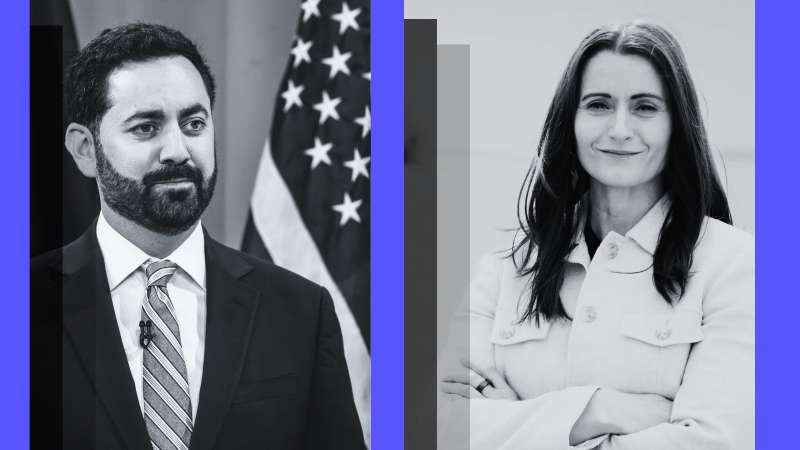
Cait Conley wants New York’s 17th Congressional District to see this race as a choice between two very different résumés.
The Democratic nominee, a decorated Army veteran who spent 16 years on active duty and deployed six times after 9/11 before moving into counterterrorism roles at the National Security Council and the Cybersecurity and Infrastructure Security Agency, swept a crowded five-way primary last month, winning all four counties in the district: Westchester, Putnam, Dutchess, and Rockland, home of her closest rival. She now faces Republican Rep. Mike Lawler in a Hudson Valley seat both parties view as pivotal to control of the House this November.
Lawler enters the general with real institutional advantages. His campaign has raised $7.5 million this cycle and holds $4.2 million cash on hand, more than four times Conley’s $1 million in reserves after a competitive primary, even though her overall fundraising has kept pace with his. He’s also drawn direct support from the top of the party: in May, Trump held a rally at Rockland Community College to endorse him—the first time a sitting president has set foot in the district since Gerald Ford nearly 50 years ago—calling Lawler “fantastic” and touting the State and Local Tax (SALT) deduction increase from the same tax bill Conley has attacked him over.
In an interview with Courier New York, Conley framed her path through the primary as a referendum on who is truly qualified to govern. “For the last 20 years, he’s been a political operative and politician, while I was out there leading America’s sons and daughters in defense of this nation after 9/11,” she said of Lawler, who is roughly her age and grew up about 30 miles away from her. “What I represent is a next generation coming up who is not a politician or political operative, but truly a battle-tested public servant.”
That contrast is also the backbone of her pitch on affordability, the issue she says defines the race. Raised by a single mother who worked for the Postal Service in the Hudson Valley, Conley pointed to working families “struggling to put food on the table, a roof over their heads, [and] afford health care” despite working full-time—sometimes more than one job. She singled out the gap between how the ultrawealthy and ordinary workers are taxed, citing Elon Musk’s effective tax rate as an example.
That comparison holds up. In June, Musk became the world’s first trillionaire when SpaceX’s Nasdaq listing pushed his net worth past $1 trillion, while his company, Tesla, reported $0 in federal income tax on $5.7 billion of U.S. income in 2025—an effective federal tax rate of roughly 0.4%, according to the Institute on Taxation and Economic Policy (ITEP), a nonpartisan tax policy research group.
On housing, Conley’s centerpiece proposal is what she calls an American Public Service Home Loan Program, modeled on VA home loans. Teachers, nurses, and first responders who serve their communities for 10 years would qualify for the same benefits she received as a servicemember, including loans with no down payment required.
Healthcare is where she drew the sharpest line against Lawler. New York’s Essential Plan lost about 450,000 enrollees on July 1 — the fastest coverage loss in the state’s history. The cause was Trump’s “One Big Beautiful Bill” Act, which Lawler voted for twice: it eliminated premium tax credit eligibility for many lawfully present immigrants and cut deeply into Medicaid funding nationally.
Conley cited a district-level estimate of 37,000 people in NY-17 losing coverage specifically. That figure comes from the campaign and hasn’t been independently verified in public reporting, though the statewide 450,000 number is well documented. Lawler has defended the vote. At a Putnam County town hall, he told constituents that “nothing on traditional Medicaid is touched in this bill.”
He said he’d secured protections against per-capita caps, block grants, and hospital cuts, framing the bill’s changes as citizenship verification and work requirements rather than benefit cuts for eligible recipients. Health policy experts say the law is still expected to cause millions of people to lose Medicaid coverage nationwide.Conley’s proposed fix is a Medicare buy-in public option, open regardless of age or employment status, that would let people opt out of private insurance without eliminating employer or union coverage for those who want to keep it.
On immigration, Conley tried to occupy a middle ground increasingly rare in either party: treating “border security as national security” while accusing the Trump administration of targeting Haitian residents with Temporary Protected Status, a group heavily represented in the region’s healthcare workforce as nurses, nursing aides, and home health workers — nationally, healthcare is Haitian Americans’ single largest employment sector. NY-17 is home to one of the largest Haitian communities in the country.
On Israel and Palestine, Conley said she supports a two-state solution while criticizing the Netanyahu government. She reserved her sharpest criticism for how the Trump administration handled the US strikes on Iran, saying it lacked a clear military strategy, exit plan, or congressional authorization. She criticized Lawler for voting multiple times to give Trump “a blank check” on Iran war powers. Lawler explicitly opposed a war-powers resolution restricting the administration’s authority to act against Iran and was not among the handful of House Republicans who broke ranks to support it. He framed his position as a necessary measure to avoid signaling weakness to adversaries.
She also renewed a line of attack over a Trump administration deal paying the French energy company TotalEnergies close to $1 billion to abandon an offshore wind project off Long Island—a deal now the subject of a multistate lawsuit led by New York’s attorney general. Conley mentioned the scrapped project, which was expected to power more than 700,000 homes in New York.
Asked what she’d want NY-17 voters to know that they haven’t already heard, Conley returned to the framing that has defined her campaign from the start: “I’m doing this out of love—love for our community, love for our country… I’m watching the country that I was willing to die for become something I barely recognize.”