New York’s prison watchdog had been warning about conditions at Marcy and Mid-State Correctional Facilities for more than a year before officers killed two men at those prisons within four months of each other.
The Correctional Association of New York (CANY), the independent body the state has deputized to monitor its prisons since 1846, documented “pervasive allegations of racial discrimination, mistreatment by staff, and non-adherence to the requirements of HALT” at Marcy in a 2023 report, including incidents in which incarcerated people were turned away from the mess hall for wearing cornrows or braids. A companion 2023 report on Mid-State, co-located with Marcy, documented “routine—and sometimes racialized—abuse by staff,” physical assaults, and a retaliatory environment.
“A number of issues at Marcy troubled us during our monitoring visit,” CANY Executive Director Jennifer Scaife said at the time. “We are calling upon the State Inspector General and [the Department of Corrections and Community Supervision’s (DOCCS)] Office of Special Investigations to investigate these serious allegations of racial discrimination and violations of human rights.”
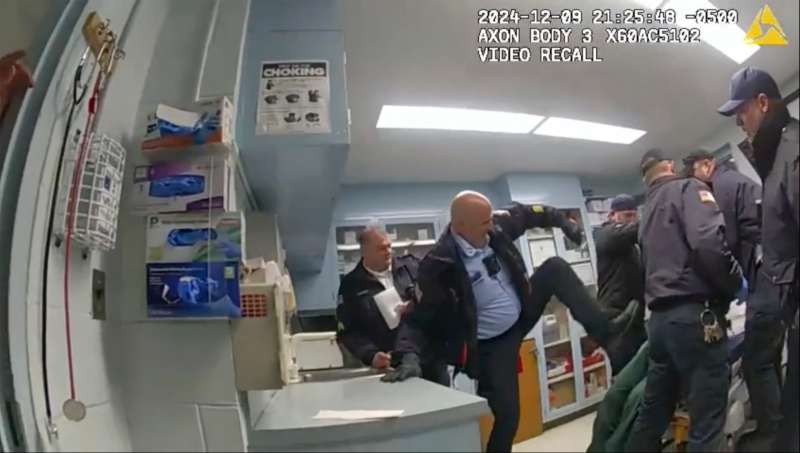
About a year and a half later, guards beat 43-year-old Robert Brooks in the Marcy infirmary on Dec. 9, 2024; he died the next day. Three months after that, officers killed 22-year-old Messiah Nantwi at Mid-State. Within days of Nantwi’s death, CANY said conditions at the facility had only deteriorated further since its 2022 monitoring visit, citing broken and uncharged body cameras, a failure to install more than 1,500 promised surveillance cameras, and “a lack of accountability” it had already reported to DOCCS.
“The Governor and the Legislature must take immediate action to strengthen independent oversight, hold employees accountable for misconduct, and reduce the size of the incarcerated population through all available mechanisms,” Scaife said in the days after Nantwi’s death.
Nobody had acted, in any way that mattered, before then. This summer, a state-commissioned, 277 page independent review by the law firm WilmerHale delivered an official, exhaustively documented confirmation of much of what CANY had already been saying.
“The WilmerHale report really does take a look at a lot of the findings CANY has issued over the last few years, historically, and specifically at Marcy and Mid-State,” Sumeet Sharma, CANY’s director of policy and communications, told Courier New York. “Tragically, these conditions were known and had been reported by the Correctional Association.”
It would not be the first time a New York prison exposed the state’s failures on a national stage. In 1971, an uprising at Attica—over the same overcrowding, abuse, and lack of accountability WilmerHale would find decades later at Marcy and Mid-State—left 43 people dead, most killed by police gunfire when state troopers retook the prison, and forced a national reckoning over prison conditions.
Two killings, four months apart
Body camera footage recorded while the officers believed the camera was off, but wasn’t, captured guards beating, choking, and gagging Brooks while he was handcuffed and compliant. Ten officers were eventually indicted. The last was sentenced in January, closing out a case that saw one officer convicted of murder and sentenced to 25 years to life, while others pleaded guilty to lesser charges or were acquitted.
Nantwi died on March 1, 2025, at Mid-State. He was beaten in his dorm, in a stairwell, and again in an infirmary holding cell. Officers were later convicted—one by guilty plea, another at trial—of planting a weapon in his cell and coordinating a false account of what happened as part of a staged cover-up.
His estate has since filed a federal lawsuit against DOCCS Commissioner Daniel Martuscello III and Mid-State’s superintendent, alleging at least 18 officers beat him or stood by without intervening. The last officer in that case to be sentenced, Thomas Eck, received nine months in county jail this month.
Onondaga County DA William Fitzpatrick, the special prosecutor in both cases, has voiced support for a new “Duty to Intervene Act” that would make it a felony for an officer to fail to stop a colleague from beating someone. “I would suggest that a legacy for Mr. Brooks and Mr. Nantwi would be the passage of the Duty to Intervene Act,” he said.
Nantwi was killed in the middle of an illegal strike by correction officers that spread to 38 of the state’s 42 facilities in early 2025, prompting Gov. Kathy Hochul (D) to deploy thousands of National Guard members. Hochul commissioned the WilmerHale review in the aftermath, sending investigators to interview hundreds of current and former staff, incarcerated people, and community partners, and to comb through internal DOCCS records most New Yorkers will never see.
‘Goon squads’ and a culture of silence
What they found reads less like an aberration and more like a system operating as designed.
Investigators documented informal cliques of officers that staff described as routinely using excessive force, with nicknames like the “Beat Down Squad,” the “Cowboys,” and the “Red Apple Crew.” More than 40 former officers acknowledged these groups existed, and some officers involved in killing Brooks and Nantwi were reportedly known members.
The report describes an entrenched “us versus them” mentality, reinforced by a culture that punishes restraint: officers who treat incarcerated people humanely risk being branded “inmate lovers.” One officer told investigators, “There’s been a goon squad at every prison I’ve been in.”
Reported use-of-force incidents statewide more than tripled over the past decade, from around 6,000 in 2016 to roughly 22,000 in 2025, even as the incarcerated population kept declining. Use of pepper spray and other chemicals rose nearly 40-fold since 2015. A mandatory training video gave officers just 43 seconds of instruction on the “duty to intervene.” Defense attorneys for officers charged in Brooks’ killing cited the short amount of training time devoted to the topic in court.
A system that cannot fire its own
In excessive-force arbitrations from 2023 through 2024, not a single termination was upheld; arbitrators repeatedly downgraded firings to fines as low as $1,000.
Officers have, in at least one instance, fundraised among colleagues to cover their own discipline fines. Both Brooks and Nantwi were killed by officers with prior misconduct histories that never resulted in real consequences—what the report calls “missed warning signs.”
“In 2025 alone, DOCCS received nearly 1,200 excessive force complaints, and fewer than 50 were substantiated,” State Sen. Julia Salazar (D-Brooklyn) and Assemblywoman Michaelle Solages (D-Elmont) said in a joint statement. “Of the abuse cases that went to arbitration in recent years, not one termination was upheld. That is not accountability.”
Salazar has introduced legislation, S1671, that would allow the DOCCS commissioner to fire officers for serious misconduct without arbitration standing in the way—one of the report’s priority recommendations, though it would require legislative action and changes to the union’s contract.
The response so far
DOCCS still tracks use-of-force reports, grievances, and medical records largely on paper, with no centralized way to catch patterns before they turn deadly. Superintendents are supposed to review use-of-force reports within 10 days; that happened on time just 26.4% of the time at Marcy and 4.7% at Mid-State. The recordkeeping is so informal that, per New York Focus, one deputy superintendent tracked incarcerated people’s programming through twice-daily emails.
Cameras were supposed to help. Hochul accelerated some $400 million for fixed cameras after Brooks’ death, on top of a decade of spending that had already run past $600 million. Only 12 of DOCCS’s dozens of facilities have full coverage today. And even where cameras exist, investigators found officers obstructing their view to get around use-of-force rules.
“Even with that additional funding, the department still has yet to begin the process of installing cameras in about two-thirds of the facilities,” Sharma said, tracing the delay to the same staffing crisis behind much of the report: a 31.8% officer vacancy rate that leaves DOCCS without enough people to even escort the contractors who need to assess what needs fixing.
Salazar and Solages named their path forward: S1671, plus the Fair and Timely Parole Act, the Elder Parole Act, the Second Look Act, and the Earned Time Act. Their caucus would review the report’s 57 recommendations in detail, they said.
In a statement to New York Focus, DOCCS said it had already implemented several of the report’s recommendations and planned to take up most of the rest, pointing to a 42% drop in excessive-force allegations in 2025 compared with 2024. It released the statement at the start of a long holiday weekend, four days after the report’s publication—a tactic New York Focus noted is a common way for agencies to limit attention on unflattering news.
“DOCCS is reactive,” one retired officer told investigators. “They only do anything when something gets fucked up.”
NYSCOPBA, the officers’ union, told a different story. “Instead of listening to the correction officers who work inside these facilities every day, DOCCS and New York State policymakers dismissed their concerns,” union president Chris Summers said in a statement to Courier New York. “New Yorkers deserve more than carefully timed press releases issued over a holiday weekend.”
But Summers’ statement does not address the report’s findings about officer conduct itself; it puts the blame on understaffing, not the culture investigators say officers built and protected from within.
Will anything change?
A companion report from Amend at UC San Francisco frames staff burnout as “the primary challenge” facing DOCCS—a softer read than WilmerHale’s. Ryan Shanahan, chief research officer at the Vera Institute of Justice, doesn’t see the two reports as competing.
“Amend’s report takes a public health approach to addressing prison harms by focusing on leadership,” Shanahan told Courier New York. “Morale and accountability go hand in hand.” What New York uncovered isn’t unusual, she added: “What’s devastatingly common is that it takes a tragedy to bring them to light.”
WilmerHale’s 57 recommendations are split into priority, short-term, and long-term tiers. “The priority recommendations speak to changes in departmental policy that can be done fairly immediately,” Sharma said.
But expanding the commissioner’s firing authority “would need support from the governor and Legislature—a change in law or in the collective bargaining agreement.”
Sharma saved his sharpest warning for last: “This was a one-time report, limited to two facilities. What’s needed is continued independent oversight—from CANY, from the State Commission of Correction, from the Inspector General’s office. And DOCCS needs help—from other state agencies, from outside experts, from community-based organizations.”
CANY told the state this in 2023. It said so again after Nantwi died. It took a 277-page report and two deaths for New York to confirm what its own watchdog had already put on the record.
As one officer told WilmerHale’s investigators: “It took them from 1971, Attica, ‘til now, more than 50 years, for them to do a serious evaluation.”