Farms across New York’s 19th Congressional District are facing a compounding disaster after a slow-moving storm dumped record rainfall across the Capital Region and Catskills this week, just as growers were beginning to recover from an unusually destructive spring freeze.
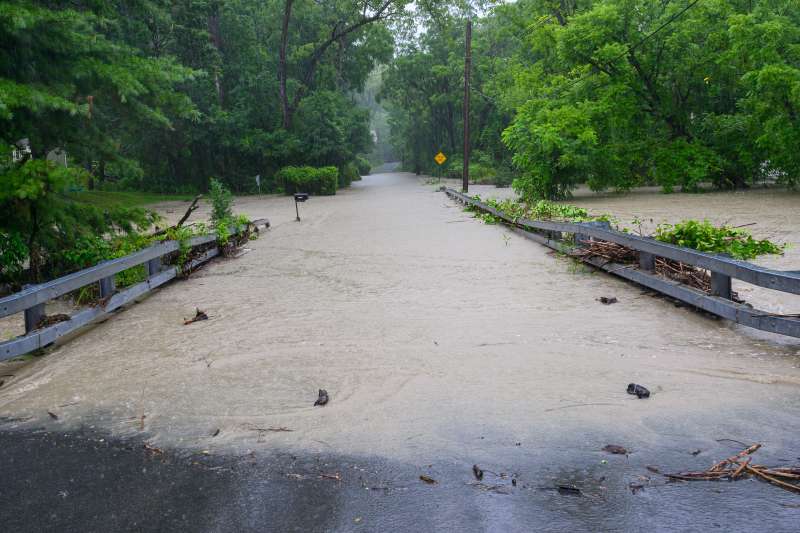
From Tuesday to Thursday, days of heavy rain drenched eastern New York in what meteorologists are calling one of the most significant regional rainfall events since Tropical Storm Irene in 2011.
A New York State Mesonet station, or site that tracks weather data, in Schodack, in Rensselaer County, recorded about 11 inches of rain in 24 hours, shattering the previous statewide record of roughly 9.4 inches from August 2024. Albany International Airport saw its second-wettest day on record, behind only a 1999 storm tied to Hurricane Floyd.
The flooding triggered water rescues and local states of emergency across the district. In Sullivan County, the towns of Callicoon, Fremont, and Rockland declared states of emergencies as crews evacuated residents in Livingston Manor and swift-water rescue teams responded in Hortonville, North Branch, and Cooks Falls. In Rensselaer County, floodwaters collapsed a centuries-old grain mill in Castleton-on-Hudson.
This week’s flooding piles onto an already brutal year for growers. In April, a hard freeze damaged fruiting buds and shoots across apple, grape, stone fruit, and strawberry crops throughout upstate New York, with the state Department of Agriculture and Markets estimating losses ranging from 15% to 100% depending on the crop and location. Statewide losses topped $30 million. At Saunderskill Farms in Accord, an Ulster County orchard family that has run for generations, the freeze wiped out nearly half the apple crop.
The disaster is also colliding with a labor squeeze. US Immigration and Customs Enforcement (ICE) and US Border Patrol agents have ramped up arrests of immigrant farmworkers elsewhere in upstate New York in recent weeks, stalking workers at a Rochester-area tomato greenhouse and previously staging an armed raid at a Syracuse-area food plant—part of a national enforcement push that’s left growers already scrambling for labor before this week’s flooding hit.
Just a day before the storm hit, the US Department of Agriculture (USDA) approved a disaster declaration covering 32 New York counties—including Broome, Cortland, and Tompkins in the 19th Congressional District—over the spring freeze losses.
US Rep. Josh Riley (D-N.Y.) said he pushed Agriculture Secretary Brooke Rollins directly for the designation, raising Saunderskill’s case during a June 4 House Agriculture Committee hearing and later visiting the farm.
“After April’s freeze, growers across Upstate New York told me they were facing catastrophic losses,” Riley said in a statement. “These growers deserve support to recover, rebuild, and stay afloat until the next growing season.”
The declaration gives eligible farm operators in the affected counties eight months to apply for low-interest emergency loans through their local USDA Farm Service Agency office, which can be used to cover production costs, replace damaged equipment, and meet living expenses. Riley’s office said he also obtained provisions in the House-passed Farm Bill aimed at strengthening crop insurance and disaster assistance for specialty crop growers going forward.
It is not immediately clear whether this week’s flooding, which struck after the spring-freeze declaration was already in motion, will trigger its own separate disaster designation. State agriculture officials are directing farmers with new flood-related losses to document the damage through the department’s disaster-damage portal, in addition to contacting their local Farm Service Agency office.
Scientists caution that no formal attribution study has been done yet on this specific storm, but the broader pattern fits what researchers have been documenting for years: A warmer atmosphere holds more moisture, fueling heavier bursts of rain in shorter windows. The Northeast has seen the largest regional increase in extreme precipitation in the country, with rainfall from the heaviest 1% of days up 60% since 1958, per federal climate research.