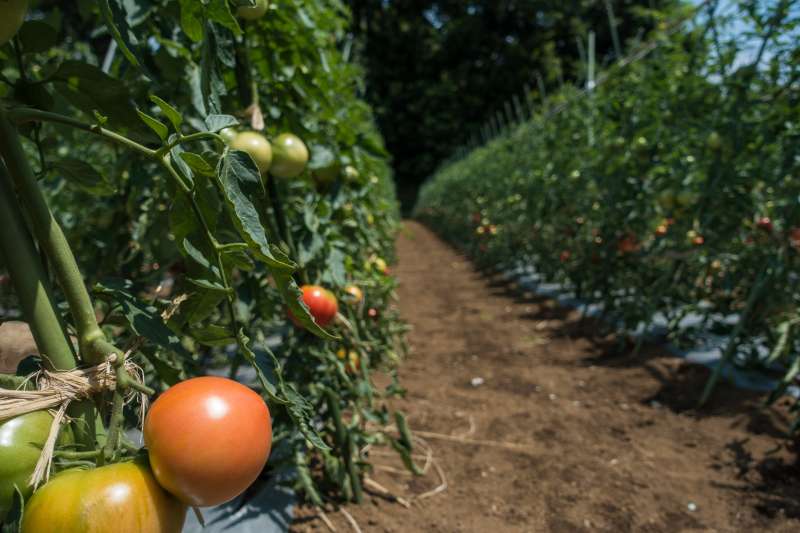
US Immigration and Customs Enforcement (ICE) and US Border Patrol agents have been stalking workers at a tomato greenhouse outside Rochester—waiting in unmarked cars in the parking lot before dawn, showing up at the motel where many of the workers stay.
Since mid-June, they have arrested at least six people near the Sungrow tomato greenhouse and packing plant in Ontario, New York, with one worker describing to New York Focus: “They were like alligators. They swooped in and devoured them.”
The arrests are part of a broader surge as ICE pushes its national arrest target to 2,000 people per day, while Temporary Protected Status lapsed for Haitian and Syrian nationals statewide this week.
At Sungrow, agents have trailed cars from the parking lot and, in one case, pointed a gun at a US citizen’s chest before lowering it once she was identified. One worker, deported to Guatemala despite 15 months on the job, described agents threatening to break his car window when he hesitated to get out. Fewer than half the plant’s roughly 120 workers showed up for their next shift on July 9; the rest had fled.
‘They’re trying to pick people off’
Immigrant rights advocates interviewed by New York Focus described a marked jump in enforcement activity since late May. One of them, Melina Ivanchikova of the Finger Lakes Rapid Response Network, said the tactics look calculated to avoid the kind of backlash ICE faced last year.
In September 2025, 60 armed agents stormed the Nutrition Bar Confectioners plant in Cato, a village near Syracuse, prying open doors and a bathroom stall. They herded roughly 160 workers into a lunchroom and detained at least 57 of them, according to the New York Civil Liberties Union (NYCLU). Some were deported within 72 hours and children were separated from parents on the first day of the school year. A federal judge subsequently ruled the raid unconstitutional.
“Maybe they’re trying to just pick people off in a way that won’t cause a ruckus,” she said.
The NYCLU fought to unseal the warrants agents used and found they authorized nothing close to what happened. One was an administrative warrant, which cannot be used to seize people. The other, a so-called “Blackie’s warrant,” permits only “consensual” questioning—a standard that collapses when armed agents arrest anyone who stays silent or asks for a lawyer, as they did in Cato. Neither warrant named more than a handful of the people ultimately detained.
A federal judge has already agreed. In December, US District Court Judge Brenda K. Sannes ruled that worker Argentina Juarez-Lopez had been subjected to an unconstitutional seizure and suppressed the evidence against her, leading prosecutors to drop her case. Of the 57 people detained in Cato, only five were ever criminally charged for re-entering the US—none for a violent offense.
Sheriffs pick a side
Cato’s legal reckoning hasn’t slowed local cooperation with federal agents elsewhere in the region. New York’s attorney general has ordered county sheriffs to end 287(g) agreements—deals that deputize local police to enforce immigration law—by an Aug. 25 deadline. But sheriffs in Madison and Steuben counties, both within the same stretch of upstate New York, have said they’ll keep working with ICE regardless or are waiting on further guidance from the county.
“I’m still going to work with ICE,” Madison County’s sheriff said, while Steuben County’s sheriff said the cooperation makes the county “safer.”
Sungrow workers now travel in unmarked cars, take alternate routes, and avoid leaving their motel except for shifts. “It’s literally like Jason Bourne-type mode,” Anthony Rosas, a driver for a labor contractor, told New York Focus. “You gotta be on the lookout.”