The New York state Legislature has passed a one-year moratorium on new hyperscale data center construction, halting the development of massive facilities statewide.
The Responsible Data Center Development Act (SB10642/A.11560), sponsored by state Sen. Kristen Gonzalez (D-Queens), would freeze new permits for data centers consuming 20 megawatts or more of power, require a comprehensive environmental impact study, set renewable energy and labor standards for the industry, and mandate that developers fund community benefit projects wherever they build.
It passed both chambers on Thursday before the close of the legislative session.
If Gov. Kathy Hochul (D) signs it, New York would be the first state in the country to enact a complete temporary halt on data center development. Maine’s legislature passed a similar moratorium in April, but its governor vetoed it.
Behind every AI chatbot and cloud app is a warehouse-sized facility running thousands of servers around the clock, consuming as much electricity as 2,000 homes and millions of gallons of water each year just to keep from overheating, according to a 2025 University of Michigan policy report.
The facilities are also notoriously loud, with noise levels ranging from 80 to 95 decibels on-site. The sound they emit is comparable to heavy city traffic or a lawnmower.
Nationally, data centers already account for more than 4% of all electricity consumption in the United States—a share that could triple to 12% by 2028.
New York’s grid operator has already estimated that by 2030, the demand from data centers could increase by 1,600 megawatts of power, driven largely by surging demand from new large energy users like data centers. More than 1.3 million New York households were already behind on their utility bills last year.
In Genesee County, a Dallas-based company is advancing a proposed 250-megawatt facility in wetlands adjacent to the Tonawanda Seneca Nation. Along the Hudson in Orangeburg, a separate expansion plan has drawn fierce opposition from residents worried about a nearby drinking water reservoir that serves tens of thousands of New Jersey residents.
Gonzalez, in a statement shared with Courier New York, called the vote a turning point. “For too long Big Tech has benefited from under-regulation, writing their own rules on large scale data center development with little accountability or transparency on local impacts,” she said. “Technology should improve peoples’ lives, not drive up our energy bills or exhaust our natural resources.”
She told Courier New York last month that the stakes couldn’t be higher. “New York is in an energy crisis,” Gonzalez said. “We’re at the point where we cannot keep up with the current demand on our energy grid, and the [Public Service Commission] has said that we are on the brink of rolling blackouts.”
State Sen. Lea Webb (D-Binghamton) told Courier New York last month that the industry’s march into rural communities follows a familiar and troubling pattern. “Large AI corporations often target rural communities and communities of color who are desperate for economic development due to years of systemic under-investment,” Webb said.
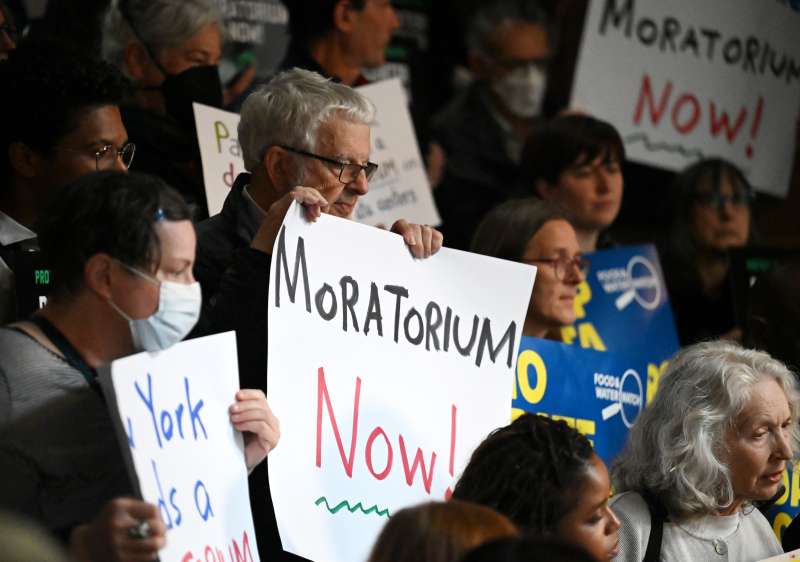
The bill is a compromise. Advocates initially sought a three-year ban; what passed is a one-year pause that also layers in new environmental, labor, and community protections. It garnered 63 memos of support from organizations including Food & Water Watch, NY Renews, and the Working Families Party, and at least a dozen states are now considering similar legislation.
Opponents of the bill argue it would chill investment and cost jobs. Smythe Anderson, executive director of the Digital Power Network, a coalition of bitcoin miners and digital infrastructure companies, told Gothamist: “There’s already protections, and you already have to go through a lot of permitting review processes to build any infrastructure of this size. So a moratorium is just a signal to folks saying, you know, we’re not open for business here in New York.”
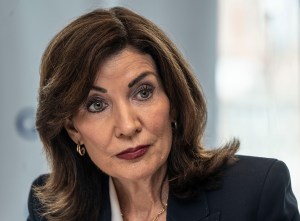
Hochul has not yet committed to signing the legislation. At a Brooklyn event on Wednesday, she signaled cautious openness, according to Gothamist. “I will look at this one-year moratorium in the context of also knowing that the status quo can’t continue,” she said.
“Gov. Hochul must sign this hyperscale data center moratorium immediately,” Food & Water Watch’s New York state Director Laura Shindell said in a statement shared with Courier New York. “Every day she waits will further endanger our communities.”