Immigrant communities across New York are bracing for a new wave of federal enforcement this week as Temporary Protected Status (TPS) lapses for thousands of Haitian and Syrian nationals. The change strips recipients of the legal right to work and live in the US, exposing them to arrest by US Immigration and Customs Enforcement (ICE) agents.
TPS is a humanitarian designation Congress created in 1990, letting the Department of Homeland Security (DHS) grant work permits and deportation protection to people already living in the US from countries facing war, natural disaster or other crises.
Haiti has held the designation since the 2010 earthquake, Syria since its civil war began in 2012. It’s meant as a temporary stopgap, rather than a path to a green card, and holders must reapply each time the designation comes up for renewal. Losing it strips both protections at once: without another legal option, such as asylum or a family-based visa, holders become immediately subject to deportation.
Haiti’s TPS designation expired Monday after a federal appeal judge’s brief extension ran out. Work authorization tied to Syria’s TPS designation, meanwhile, lapsed the same day. Both deadlines follow a 6-3 Supreme Court ruling in June clearing the way for the Trump administration to terminate the protections—a decision that has sent fear rippling through Haitian and Syrian communities across New York.
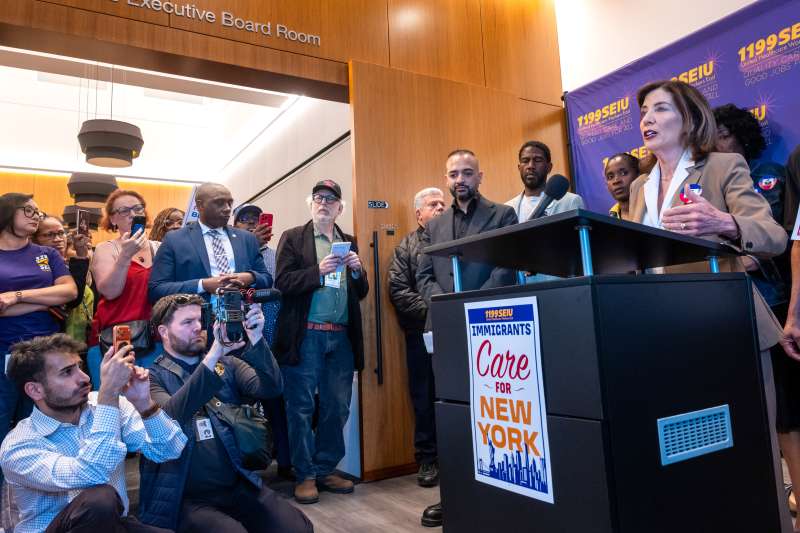
Gov. Kathy Hochul (D) was among those who showed up. At a June 25 rally with union members and immigrant advocates in Manhattan, she pointed to a law she signed into the state budget in May that bans masked ICE agents and shields “sensitive locations”—be they hospitals, schools, or churches—from warrantless enforcement. “This is New York. We fight back. We defend our people,” Hochul said.can
Some 40,000 Haitian TPS holders live in New York, including about 5,400 in New York City, concentrated in Queens and Brooklyn. An estimated 25,000 are in the workforce, filling critical roles as nursing assistants and home health aides, in transportation, food service and construction, contributing about $1.1 billion per year in economic activity.
With protections gone, community members now face immediate exposure to ICE enforcement, plus the loss of jobs and stability for families that often include US-citizen children.
Ahead of that vote, Reps. Ayanna Pressley (D-Mass.) and Laura Gillen (D-Rockville Centre)urged senators to pass legislation extending Haiti TPS, warning that forcing people back amid the country’s ongoing violence and instability is “tantamount to a death sentence.”
Their push failed days later: Sen. Ed Markey (D-Mass.), who introduced the companion bill with Sen. Lisa Blunt Rochester (D-Del.), tried to pass it by unanimous consent on July 23, but Sen. Eric Schmitt (R-Mo.) objected and blocked it, leaving Haiti’s TPS protections to expire as scheduled.
Gillen, who represents Nassau County and part of Queens, introduced H.R. 1689, a bipartisan bill that passed the House 224-204 in April after Pressley forced a floor vote through a discharge petition.
“The Senate must respond to the Supreme Court’s harmful decision to terminate TPS for hardworking, taxpaying, law-abiding Haitian members of our community and pass our bipartisan bill immediately,” Gillen said in a statement.
The Salvadoran community might be next. Their TPS designation—in place since 2001—does not expire until September, and the Trump administration missed a July 11 deadline to announce whether it would extend or terminate the designation, triggering an automatic six-month extension under federal law. But with 13 other countries’ TPS designations already ended under this administration, immigration attorneys and organizers like the Glen Cove Rapid Response Network are bracing for the same outcome.
Rep. Tom Suozzi (D-Glen Cove) has pressed the Trump administration to extend protections for roughly 200,000 Salvadorans nationwide, including an estimated 60,000 in the New York metro area, many of whom have lived and worked in the US for more than two decades.
“Those folks … have their own businesses. They own their own homes. Their kids went to school with my kids,” Suozzi said, recalling Salvadoran immigrants he met as Glen Cove’s mayor in the 1990s.
Jose Urias, a Salvadoran TPS holder who owns a Massachusetts real estate and construction business employing more than 50 people, said the uncertainty is already threatening the livelihood he’s built here. Several other Salvadoran TPS holders declined to appear publicly at a recent news conference, fearing exposure to ICE.
That fear is compounded by a lack of transparency from federal agents, said Nabil Azamy of the Glen Cove Rapid Response Network. “ICE has consistently evaded public scrutiny by concealing who it takes, where they are held and when they are removed.”
For now, both communities remain in limbo—no longer protected, and waiting to see whether Congress acts before enforcement catches up with them.