Updated Thu., Jun. 25, 2026: This story has been updated to include a statement from Gov. Hochul’s office.
For eight years, Lai Yee Chan, 71, worked 24-hour shifts caring for a single elderly stroke patient at the Chinese-American Planning Council, turning his body every two hours through the night to prevent bedsores and rarely sleeping herself. Despite retiring years ago, she still cannot sleep through the night.
“Whenever I heard a sound, I would immediately wake up in distress thinking my patient was calling for me,” Chan said Thursday outside City Hall. “My health has been seriously damaged and destroyed by the 24-hour workday.”
Chan’s nervous system, medical experts say, never recovered.
Her testimony helped move five United Nations bodies to act. In April, the UN’s Working Group on Discrimination Against Women and Girls—alongside four special rapporteurs covering migrants’ rights, extreme poverty, contemporary forms of slavery and trafficking in persons—submitted a letter to the US government declaring that New York City’s government-subsidized 24-hour home care workday system constitutes torture, potential forced labor, and a violation of international human rights law.
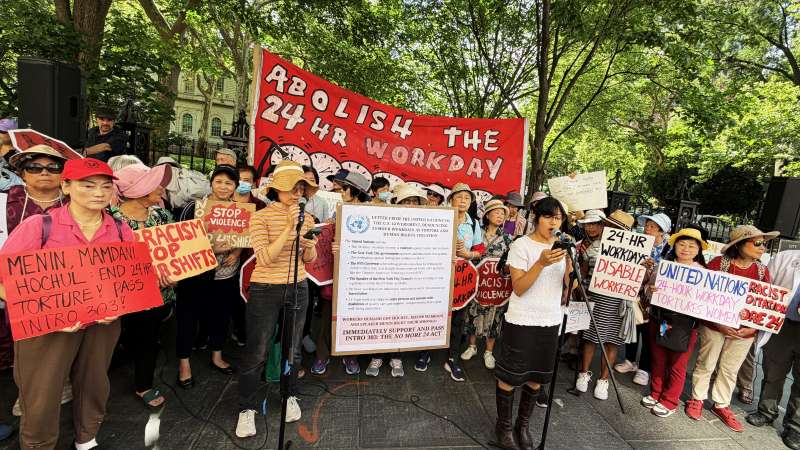
On Thursday, members of the Ain’t I a Woman?! campaign revealed the letter at a press conference outside City Hall, calling on Democratic Gov. Kathy Hochul, NYC Mayor Zohran Mamdani (D), and City Council Speaker Julie Menin (D) to immediately pass Intro. 303, the No More 24 Act, which would ban shifts longer than 12 hours for home care workers.
New York’s elected leaders have not yet responded in kind.
The world is watching
The letter, dated April 22, states that the 24-hour workday system amounts to treatment that violates the international prohibition against “torture or cruel, inhuman, or degrading treatment” and calls on the US government to immediately halt the alleged violations. Under UN protocol, the communication becomes public 60 days after submission—a window that has now closed.
“The UN declares that the 24-hour workday constitutes violence against home care workers,” said Sabina Gonzalez, a member of the Ain’t I a Woman?! campaign. “The letter points out that the city council speaker’s refusal to bring the bill to a vote, combined with the governor’s continued funding of home care agencies that violate the law, constitutes a violation of international human rights law and discrimination against immigrant women.”
Paid for 13, working 24
The city’s estimated 200,000 home care workers, which comprise 89% women and 71% immigrants predominantly from the Dominican Republic, China, Jamaica, and Haiti, are legally required to remain in patients’ homes for 24-hour shifts but are paid for only 13 of those hours, with three hours set aside for meals and eight for sleep. Workers and medical professionals say the sleep provision is a fiction.
“The legal excuse that allows the 24-hour shift to be done is obviously a lie. It always has been a lie,” said Dr. Steve Auerbach of Health Justice for New York, a healthcare advocacy coalition, who monitored workers’ health during their April hunger strike outside of City Hall. “I just heard testimony from one of the workers today that absolutely meets the criteria for PTSD. Doing home care work caused PTSD.”
Auerbach said the system harms not only workers but the patients they care for. A sleep-deprived worker caring for a stroke patient who needs to be repositioned every two hours cannot safely provide that care—with potentially fatal consequences. He noted that the majority of 24-hour home care in New York City and state is already delivered on split shifts.
“There is absolutely zero excuse for continuing any 24-hour shifts,” he added.
The fight to end 24-hour shifts spans more than a decade. Intro. 303, introduced by Council Member Christopher Marte (D-Manhattan) in January, would split overnight care into two 12-hour shifts and cap weekly hours at 56. The bill gained 16 co-sponsors and appeared headed for a vote in March before Mamdani’s administration intervened behind the scenes to block its passage, according to reporting by Documented.
Mamdani, who as a state assemblymember fasted alongside taxi drivers during their 2021 hunger strike, proposed amending the bill’s language so workers could opt into 24-hour shifts rather than banning them outright.
Hochul separately threatened to withhold Medicaid funding if the bill passed, according to Documented. By mid-May, five co-sponsors had withdrawn their support.
The bill’s path has been challenging to pass because home care funding flows through New York State Medicaid, rather than the City Council. Critics, including the Legal Aid Society and several disability rights advocates, argue that without guaranteed state funding for split shifts, which are estimated at $460 million annually, the bill risks eliminating 24-hour care entirely, leaving thousands of disabled New Yorkers without coverage.
Marte disputed that framing. “Today, most agencies no longer assign 24-hour shifts, and we have not seen the industry collapse or a Medicaid funding crisis,” he said.
Workers staged a weeklong hunger strike in April, where 15 elderly immigrant women camped outside City Hall in the cold and rain, many managing diabetes, cancer and high blood pressure. Menin promised a vote by May 14. It did not happen.
At Thursday’s press conference Marte invoked Mamdani’s own rhetoric against him.
“For the past two years, our mayor constantly said we’re an international city, and we have to respect international law,” Marte said. “But now the United Nations has declared that this practice violates not just one, not just two, but almost half a dozen violations of international law. Are we gonna turn a blind eye?”
Yolanda Zhang of the Ain’t I a Woman?! Campaign, said: “In the most progressive city in the world, private health insurance companies are making unprecedented profit by killing women of color.”
Workers say they will return to City Hall next Wednesday if Menin does not act.
As the press conference drew to a close, the women workers joined together in song, their hand-painted signs held aloft. The messages were blunt: “Stop racist violence.” “24-hour workday disables workers.” “United Nations: 24-hour workday tortures women.”
A spokesperson for Gov. Hochul did not address the UN letter or Intro. 303 directly.
“Our home care workers play an invaluable role in the lives of New Yorkers, and that is why Governor Hochul has made unprecedented investments in home care wages, increasing the minimum wage for home care aides, and securing $13 billion for home care wage increases since 2023,” said Nicolette Simmonds, a deputy press secretary for the governor. “Gov. Hochul is committed to ensuring our workers receive any wages they are owed.”
Neither Mamdani’s nor Menin’s offices responded to Courier New York’s requests for comment.