Reporting by Emily Barnes, New York State Team/Rockland-Westchester Journal News
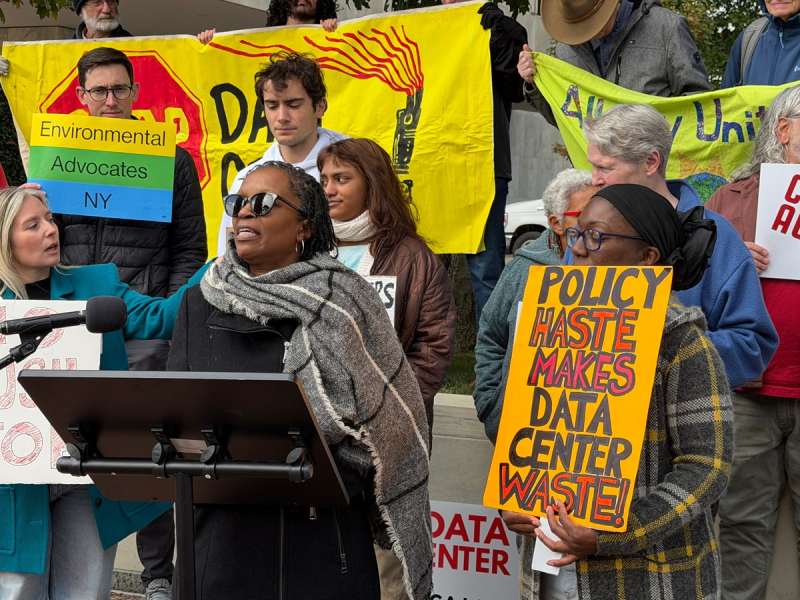
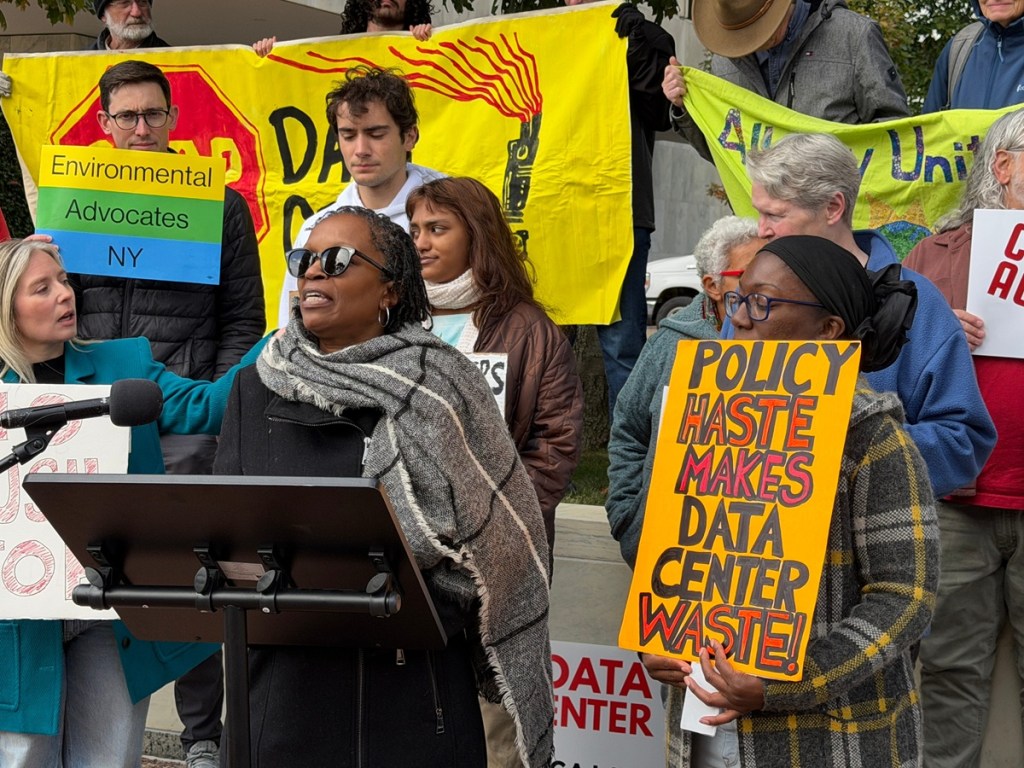
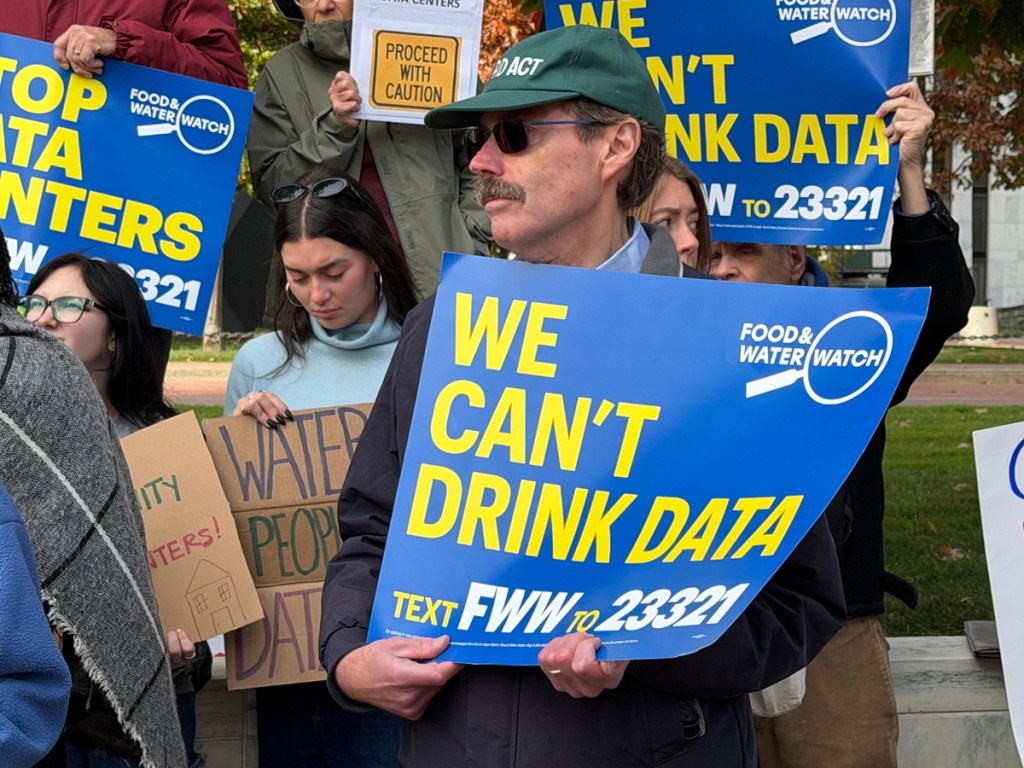
As New York state officials and artificial intelligence industry experts gathered in Albany on Wednesday, Oct. 28, to discuss allowing new large data centers to be built in New York, a couple dozen environmental activists rallied outside to push for the state to slow down and expand that review process.
The meeting was part of Gov. Kathy Hochul’s executive order in July that temporarily banned new construction of large New York data centers. That measure called for the state’s Public Service Commission (PSC), which regulates and oversees the state’s utilities, to review the impacts of data centers in New York.
The additional task was combined with a matter the PSC was already looking into as of February of this year: Are there revisions that can be made to the state’s existing approach of connecting new large electric load customers to the state’s energy grid?
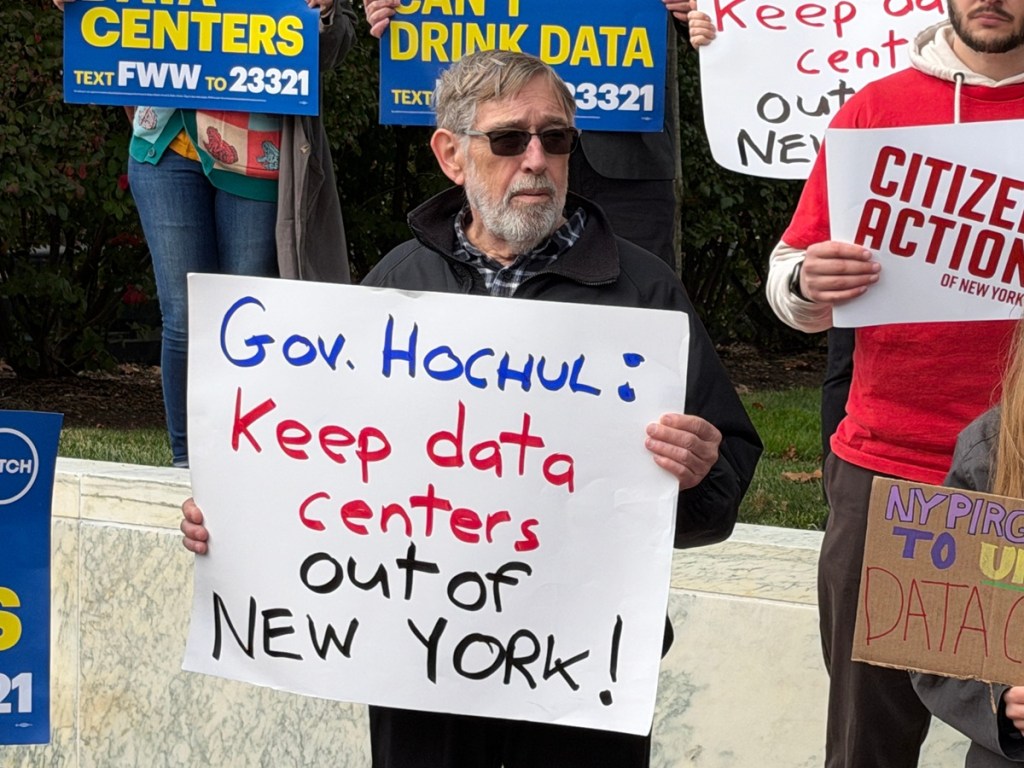
On Wednesday, the PSC held a technical conference as part of this process to help its members better understand what they need to review. And while the environmentalists outside the meeting said they support the data center moratorium Hochul put in place, they’re raising alarm over what’s happened since.
“Today’s technical conference is only about how data centers connect to the energy grid,” said Renee Vogelsang, New York director of Frack Action. “They’re not fully looking into the depths of how AI data centers suck up all of our energy, raise our electricity bills, waste our water or harm the climate and environment.”
“These are the reasons why New Yorkers overwhelmingly oppose data centers,” Vogelsang added, “and many of these impacts are not included in the draft scoping plan that sets the agenda for the environmental review process.”
Here’s the latest in New York’s discussion about data centers.
Why New York is taking a closer look at data centers
According to Hochul’s office, state environmental permits for data centers that can use 50 or more megawatts of power are temporarily paused for up to a year to better understand how New York ratepayers, as well as the environment, energy grid and communities will be impacted statewide.
As of August, nearly 14 gigawatts of large electric load customer requests were in the New York Independent System Operator’s interconnection queue, with more than eight gigawatts entering the queue in 2025 alone, according to the PSC. Data centers accounted for 88% of those waiting to be connected to the state’s energy grid.
When Hochul asked the PSC to take a closer look at large data centers in New York, it sparked the need for a generic environmental impact statement, or GEIS. The PSC says that is fitting “when an agency action would affect a wide range of resources or geographical areas,” as it allows the lead agency — in this case the PSC — “to identify and broadly analyze the cumulative impacts of a group of actions or combination of impacts from a single action.”
The PSC took the first step in that process — adopting a draft scope — on Sept. 17. The draft scope outlined that the GEIS will examine local and statewide impacts of large electric loads, including data centers, as well as potential benefits.
Additionally, the GEIS will analyze whether and how the loads will impact the state’s Climate Leadership and Community Protection Act goals and discuss potential alternative policies.
“Interconnection reforms constitute a statewide program that aims to support the state’s clean energy goals, contribute to statewide electric system reliability, and protect other ratepayers from incurring incremental costs,” the PSC outlined in their draft scope document.
Why environmental activists are pushing back on New York data centers
Members of several environmental activist groups in New York are taking issue with how the state is assessing whether large data centers should get the green light, calling it a “rush job.”
The public was initially given 30 days to comment on the draft scoping document released in September — a timeframe that’s since been extended two additional weeks to Nov. 4 after pushback from several state lawmakers. That combined with an absence of any scheduled public hearings is problematic, the groups say.
“It’s almost like it was designed to leave the public out,” Vogelsang said.
The state, however, says there will be another public comment period later on in the process and the state Department of Public Services expects to hold several public hearings during that time as well, all of which will inform the final GEIS.
Additionally, the environmental groups suggest the draft scope leaves out major concerns, such as the effect on already rising electric bills, air pollution, water consumption, local communities and Indigenous Nations, noise levels and land. However, all of those elements, are included in the document.
“The text of the Draft Scope explicitly proposes impact categories to be addressed within the GEIS,” DPS spokesperson Kim Mashke said in a statement. “That list, which will be considered by the Commission in determination of the final scope, currently includes impacts to air, water, noise, odor, light, local communities, and potential impacts of data centers’ and other large electric load customers’ energy use in the statewide energy system.”
“In addition to the GEIS development process directed by the Governor’s Executive Order, the Public Service Commission’s ongoing Energize NY proceeding is simultaneously considering the potential ratepayer impacts of large load interconnections with the goal of insulating ratepayers from the cost impacts of these facilities,” Mashke added.
And the governor’s office stressed that they expect DPS to “fully meet the terms of the Governor’s executive order,” according to a statement from senior communications advisor on energy and environment Ken Lovett.
What reforms will the state consider adopting?
As for reforms to the interconnecting of large electric loads to New York’s energy grid, the PSC may consider the following, according to the document:
- Employ capacity-based charges
- Require large load customers to procure their own dedicated generation or storage resources
- Use grid flexibility or curtailment policies
- Modify tariff and cost recovery rules to protect against financial risk
- Provide thermal energy storage and other beneficial uses of waste heat
The PSC says they will also take a “no action” option into consideration, which is what would happen if no governmental action is taken.
“Hyperscale data centers are an innovative technology,” says Kathy Nolan, president of the New York chapter of Physicians for Social Responsibility. “That means they’re new, we don’t fully understand them, we don’t know the full range of their harms to us as individuals, to our communities and to the planet.”
Nolan and others compared the state’s current evaluation of the effects of data centers to the state’s deep dive on the effects of hydraulic fracturing, or fracking, which ultimately led to a ban of the practice in 2014.
“From the harms we already know to the harms we’re beginning to see and need to outline and detail more, we have to bring a process that invites not only the public, but also scientists and public health experts, environmentalists to really get a handle on how much the risk (is), whether or when they can be contained and what procedures and mechanisms we need to have to do that, including saying no,” Nolan said.
Emily Barnes covers state government for the USA TODAY Network-New York with a focus on how policy and laws impact New Yorkers’ taxes, communities and jobs. Follow her on Instagram or X @byemilybarnes. Get in touch at ebarnes@usatodayco.com.
This article originally appeared on Rockland/Westchester Journal News.
Related: NY repaired 1 million potholes in 2026. See how many in your region