He is a Brooklyn father of two, one of them a US citizen. He was detained at a routine Immigration and Customs Enforcement (ICE) check-in in New York about a week and a half ago and transported to Delaney Hall, the privately-run immigration detention center in Newark. His family hasn’t been able to reach him since. His name is being withheld to protect his identity.
On Wednesday, Peter Melck Kuttel, a detention coordinator at Saint Peter’s Church in Midtown Manhattan, stood outside Delaney Hall’s gates, working with attorneys to secure the man legal representation and waiting to learn whether he was safe.
Kuttel is one of dozens of advocates, organizers, and elected officials who have gathered outside the facility this week as detainees inside enter day five of a hunger and labor strike—and as tensions between protesters and federal agents continue to escalate.
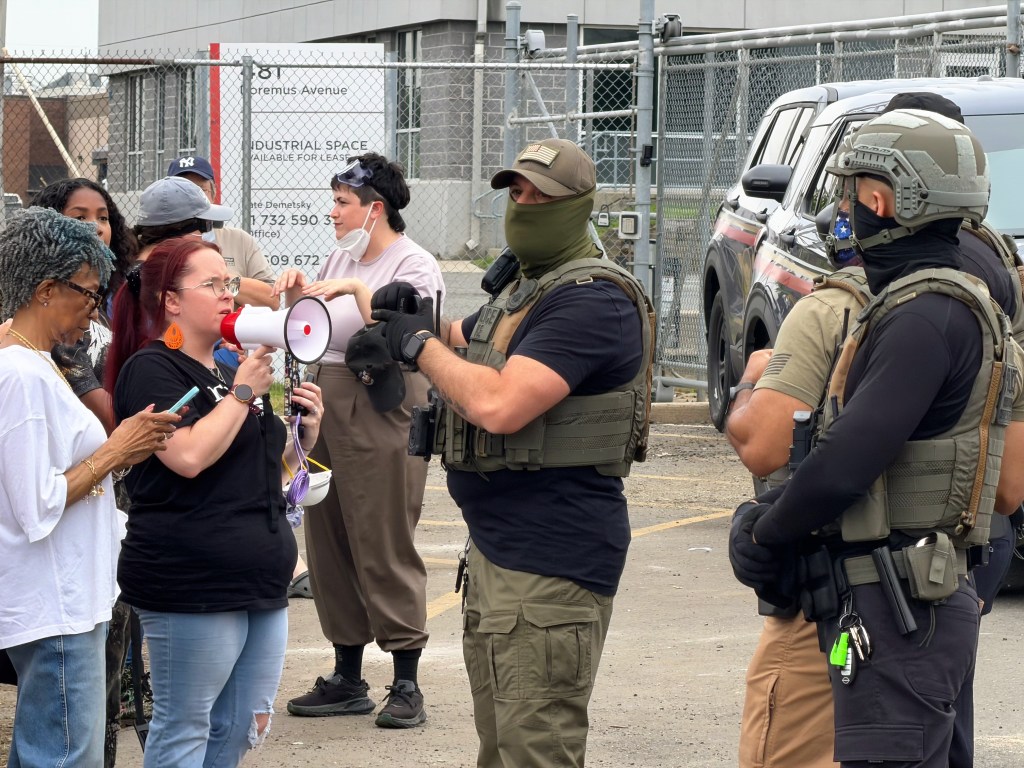
US Reps. Dan Goldman (D-Manhattan) and Jerry Nadler (D-Manhattan) arrived Wednesday afternoon to conduct a congressional oversight visit, drawn by mounting reports of squalid conditions inside: sewage backing up into living areas, brown water from the taps, asbestos in the walls, worms in the food, and inadequate medical care. In December, a detainee named Jean Wilson Brutus died less than 24 hours after arriving at the facility.
Goldman had to sue the federal government to get through the door. After being blocked repeatedly from conducting unannounced oversight visits to ICE facilities, he and eleven colleagues took the Trump administration to court. On December 17, US District Court Judge Jia Cobb ruled in their favor, temporarily restoring lawmakers’ right to inspect detention facilities without prior notice.
Goldman has since visited 26 Federal Plaza in lower Manhattan—a major ICE processing hub where New Yorkers detained at street-level arrests or check-ins are often held before being transferred to facilities like Delaney Hall—and the Metropolitan Detention Center (MDC) in Brooklyn’s Sunset Park. New York immigrants caught in the federal crackdown are also being held at the Orange County Correctional Facility.
Delaney Hall was Goldman’s next stop.
“The stories that we’ve heard out of here are horrific, and unfortunately consistent with what we’ve been hearing across the country,” Goldman told reporters outside the facility before entering. “ICE continues to blatantly lie about the conditions in all of these detention facilities.”
Nadler, who is retiring from Congress at the end of his term said: “Congress members have a statutory right to go in. We’ll see whether they obey that statutory right.”
Federal agents allowed the two congressmen inside. No media was permitted to enter.
‘We are doing this to demand freedom’
Delaney Hall is a 1,000-bed facility operated by private prison company GEO Group on Newark’s Doremus Avenue. It sits just 11 miles from Lower Manhattan. The facility closed in 2017 and sat vacant until February 2025, when the Trump administration awarded GEO Group a 15-year, $1 billion contract to reopen it. The city of Newark sued GEO Group in April 2025, alleging the company opened the facility without securing the necessary permits and inspections. The case is currently in mediation.
The hunger and labor strike began May 22, when roughly 300 detainees announced they were refusing meals and walking off their $1-a-day jobs inside the facility. Their demands, relayed through phone calls to loved ones gathered outside, were specific: an immediate meeting with New Jersey Gov. Mikie Sherrill; the release of vulnerable detainees, including the elderly, the young, and those with serious medical conditions; a full investigation into operations at the facility; and an end to what detainees described as coercive pressure to sign deportation and voluntary departure documents.
“We are not striking to demand better treatment and conditions,” the detainees said in a statement. “We are doing this to demand freedom.”
“To fix the conditions here is not enough,” Murad Awawdeh, president and CEO of the New York Immigration Coalition, told Courier New York outside the facility Wednesday. “They need to shut this facility down. They’re using it as a warehouse of human bodies.”
“We have New Yorkers who are detained here,” Awawdeh added. “We have been bearing witness to the atrocities.”
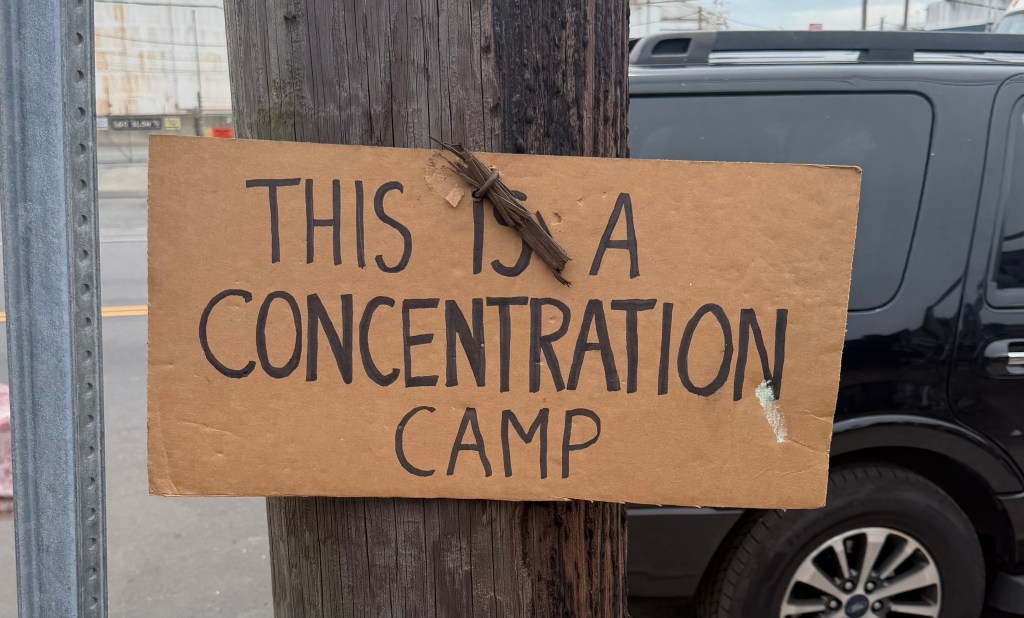
Over Memorial Day weekend, the situation outside Delaney Hall turned volatile. US Sen. Andy Kim (D-NJ) visited the facility Monday after personally calling Department of Homeland Security (DHS) Secretary Markwayne Mullin to secure entry—access that Gov. Sherrill, who arrived the same day, was flatly denied.
When Kim exited, he found an armed standoff: ICE had deployed an armored vehicle and a line of agents against protesters gathered outside. He tried to position himself between the two sides to de-escalate, offering ICE a compromis—protesters would step back if advocates could inspect vehicles leaving the facility. ICE rejected it and pushed through.
Agents fired pepper balls into the crowd, hitting Kim and his state director. Inside, Kim had spoken to a woman who told him she had a miscarriage at the facility and received no medical support.
“Instead of engaging about the poor conditions, ICE sent in an armored vehicle and a line of armed agents that only poured gasoline on the fire,” Kim said in a statement. “What I witnessed and experienced today was shameful. Delaney Hall is a failure.”
On Tuesday, Gov. Sherrill addressed the incident at a press conference. “When you pepper-spray a United States senator, you are not working to keep people safe,” she said. “That’s just another reason that Delaney Hall needs to close.”
The Trump administration has insisted there is “NO hunger strike at Delaney Hall” and “no subprime conditions.”
New York shows up
The Brooklyn father’s case reflects a broader pattern. ICE check-ins are one of the most common ways New Yorkers end up at Delaney Hall. So are street-level arrests in the Bronx and Harlem, and check-ins at 26 Federal Plaza, where long lines form as early as 7 a.m. most mornings and where people can be taken into custody with little warning and even less recourse.
Kuttel has made the trip to Delaney Hall before, to pick up people being released. He described what that process looks like in practice: a detainee released under a court order, held two and a half hours past his release time, then deposited at the gate in single-digit wind chill without a phone, with instructions that a pay phone was a mile down the road. When he approached the gate to ask where the man was, no one could tell him.
Outside the facility on Wednesday, truck drivers hauling freight down Doremus Avenue laid on their horns as they passed the crowd. Protesters pumped their fists and cheered back.
Seng Muhammad, 48, has been organizing with the New York Immigrant Coalition for seven years. He drove out from Manhattan, where he normally leads coalition actions at Wall Street and Washington Square Park, to stand outside the facility in Newark. For Muhammad, a Black man, the struggle is familiar.
“Black people have been oppressed for how many years?” he said. “So, if you come from that, to what they’re facing—it’s nothing new. It’s just they’re doing it boldly now, and they don’t care.”
Goldman and Nadler’s visit added New York’s congressional weight to a confrontation that had already drawn Sherrill, Kim, and a week’s worth of national attention.
Outside, the horns kept sounding. Inside, a Brooklyn father waited.