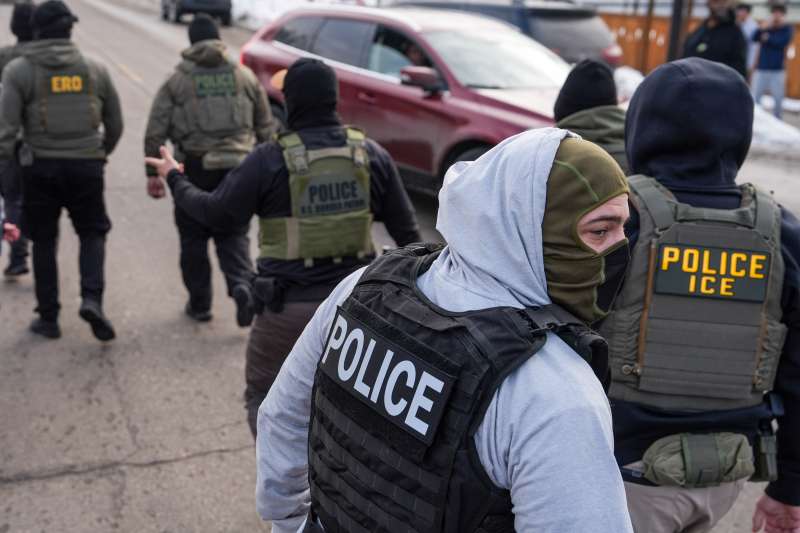
Masked, unmarked federal agents have pulled people off New York streets in immigration raids in the month since the Trump administration ramped up enforcement. After Monday, a federal judge cleared them to continue with impunity.
A federal judge blocked New York’s law requiring US Immigration and Customs Enforcement agents to ditch their masks and show identification, ruling the state overstepped its authority to regulate federal agents. The same decision also left standing a tougher measure that cuts off local police cooperation with the agency entirely.
US District Judge Mae D’Agostino’s preliminary injunction puts a hold on the state’s Face Covering and Identification Acts, the mask law Gov. Kathy Hochul (D) signed in late May in response to that pattern.
It’s the fourth such law to fall in federal court this year, after similar rulings against mask bans and requirements that masked agents identify themselves in Virginia, Pennsylvania, and California.
D’Agostino, in a 51-page ruling, credited the state’s intentions: New York, she wrote, “appears to be well-intentioned in its pursuit of transparent policing.” But she treated it as a jurisdictional question rather than one of intent.
“The issue now before the Court is about constitutionality—not transparency or preferable policy decisions,” she wrote, siding with the US Justice Department, which had shown a likelihood of winning its argument that the mask law violates the Constitution’s supremacy clause—the rule that bars states from regulating federal agencies.
She even conceded the state might be onto something. “[New York] may be correct that federal immigration officers wearing masks and not displaying viable identification creates certain dangerous situations that the face covering and identification acts remedy,” she wrote. That question, she said, simply wasn’t hers to decide.
The cooperation ban survives
The Justice Department wanted both halves of the law struck down—the mask rules and New York’s ban on 287(g) agreements. It only got one.
D’Agostino rejected the government’s bid to also void the 287(g) ban, letting it stand as “an appropriate means of furthering New York’s legitimate interests in protecting public welfare and choosing how state and local resources are expended.”
Hochul and Attorney General Letitia James (D) said as much in a statement Monday, calling the ban “legal” and insisting that “local law enforcement should be focused on local matters, and New York taxpayers should not have to foot the bill for any collaboration with ICE.”
12 counties on the clock
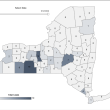
A total of 12 New York law enforcement agencies held 287(g) agreements with ICE as of July 24—though federal court filings put the number at 14, likely reflecting a couple that lapsed since the case was filed.
Either way, the state says they must all be terminated by Aug. 25, per termination letters sent in late July. The agreements let local officers flag immigrants booked into county jails and hold them past their release date so ICE can pick them up—exactly the handoff the new law is meant to end.
Rensselaer County has had one of those agreements since 2018. Nassau County has two, covering both its police department and sheriff’s office, signed by County Executive Bruce Blakeman in Feb. 2025.
Nassau already knows the stakes of the situation. Last September, Santos Banegas Reyes, a 42-year-old Honduran father, was arrested by ICE and found dead in his cell at the Nassau County jail less than a day later—in one of 50 beds the county sets aside for federal detainees under a separate ICE contract. ICE said he died of liver failure complicated by alcoholism but his family, said he showed no signs of illness..
Rensselaer and Nassau are both pushing back. Rensselaer County Executive Steve McLaughlin, a Republican, said in a Facebook video on July 29 that he’s keeping the sheriff’s ICE partnership running, casting it as protection against “Tren de Aragua or MS-13 or any other vicious, violent gang intent on doing your family harm.”
“This is a line in the sand for us,” he said. “We will not yield.”
Blakeman has struck a similar posture, defending Nassau’s agreements and signaling that he’d rather fight the state in court than end them.
‘We will not abide’
Across the street from ICE’s New York City headquarters at 26 Federal Plaza on Tuesday, elected officials and immigrant-rights advocates condemned the ruling that would let agents remain masked, NY1 reported.
“Nowhere in America should we have secret masked police, unidentifiable, unaccountable, not engaging in due process to our fellow immigrants and New Yorkers,” State Assemblymember Tony Simone (D-Manhattan) said. Simone sponsored the state’s “Mandating End of Lawless Tactics,” or MELT Act, which underlies the mask and identification requirements.
“You know there is no statute of limitations,” he added. “There will be a day after Donald Trump and Stephen Miller where they will be held responsible for breaking the law.”
The ruling may not matter much in practice.
The Department of Homeland Security said flatly that it will ignore the mask law regardless of what the courts decide, telling New York outlets after the legislation was signed “To be crystal clear: we will not abide by unconstitutional bans. The Supremacy Clause makes it clear that New York’s sanctuary politicians do not control federal law enforcement.”
Masked agents have kept working the city’s streets since the law briefly took effect in May.
For the law’s supporters, the fight was never really about fabric. “Anonymity isn’t officer safety; it’s impunity. And New Yorkers are living with those consequences every single day,” New York Immigration Coalition President Murad Awawdeh said at the gathering.
Simone said he plans to meet with Hochul and James to discuss next steps, including a possible appeal.
‘Totally outrageous’
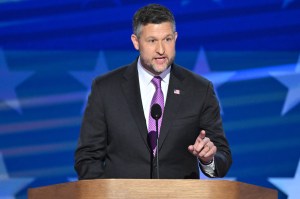
State Sen. Pat Fahy, the Albany Democrat who sponsored the masking restrictions, told Gothamist the ruling may be appealed. “We always knew there was a constitutional debate on this,” Fahy said. “But either way, we know that the push from us, along with others, has been effective in sending the message that this was totally outrageous, the actions of ICE.”
At a July 21 hearing, D’Agostino held up photos of masked agents from the bench and, per Gothamist’s reporting, called ICE “a double-secret force I’m not so sure that the founders of the Constitution had in mind.”
She ruled for the federal government anyway.
The fight over ICE’s presence in New York has already bled into the race to reelect Hochul. She faces Blakeman himself in November—the same county executive now under state order to sever Nassau’s ICE ties by month’s end, and who says he’d rather see the state in court than comply.