Reporting by Cara Dolan Berry, Utica Observer Dispatch
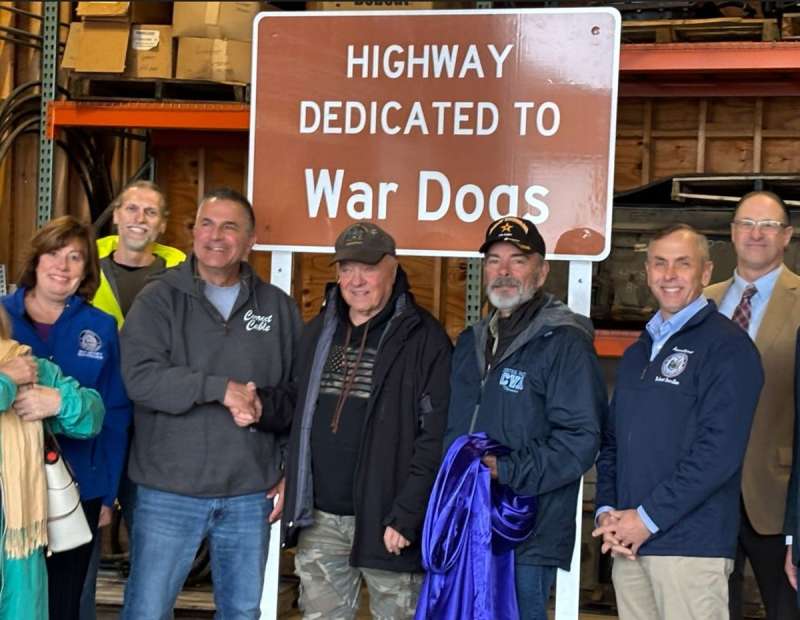
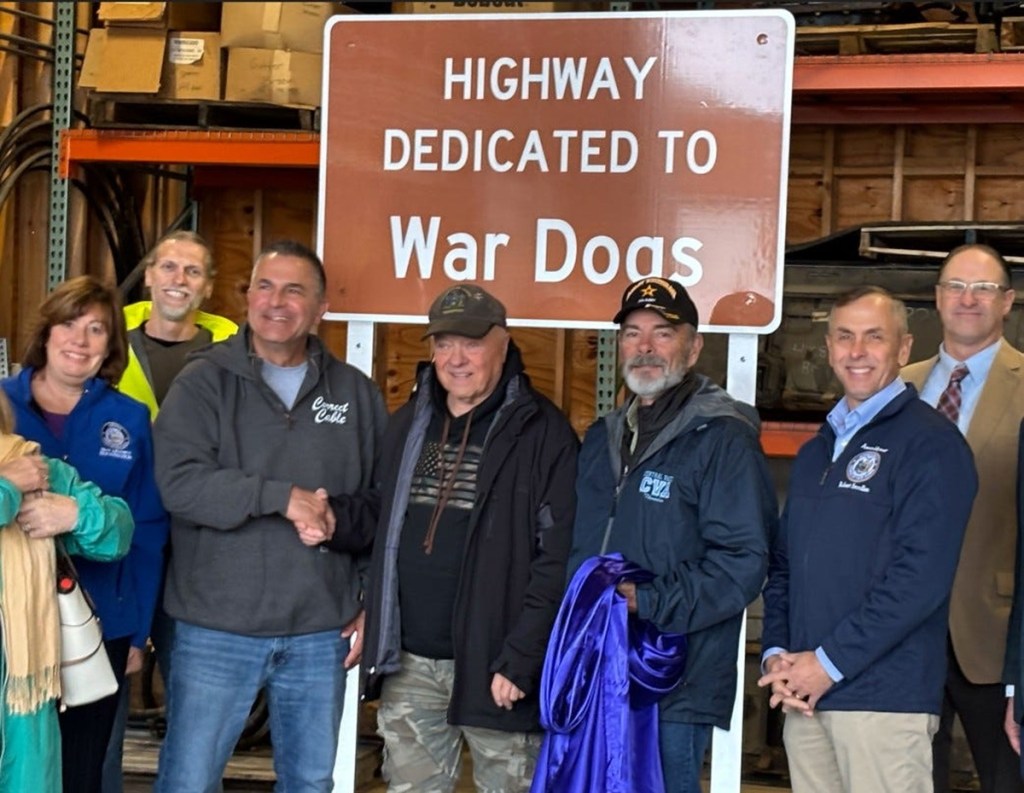
Highway Markers unveiled Nov. 12 in Herkimer will remind travelers along NY State Route 28 from its intersection with Canal Access Road to its intersection with State Route 5 in the village that they are driving along the “War Dog Memorial Highway.”
The strip of highway was named to honor United States military service dogs – “War Dogs” – and their human handlers.
The ceremony at the New York State Department of Transportation (NYSDOT) facility in the Village of Herkimer follows the passionate advocacy of Democratic Herkimer County Legislator/Guardians of Freedom gofmemorial.org Founder John Brezinski to dedicate a highway to military working dogs and their handlers.
The memorial particularly honors Marine Sergeant Adam Cann – who died in combat in Iraq in 2006 – and his military working dog, Bruno.
Gov. Kathy Hochul’s August enactment of A.11290, the bi-partisan bill co-sponsored by NYS Assembly members Marianne Buttenschon, D-Marcy, and Robert Smullen, R-Goversville, together with NYS Senator Matthew Walcyzk, R-49, dedicating that part of Rt. 28 to Cann, Bruno, and thecountry’s canine soldiers and their handlers.
“It has been an honor to help champion this effort, and I am thankful to Assemblyman Smullen and Senator Walczyk for introducing this legislation,” said Buttenschon in a statement. “I was proud to sponsor this legislation, alongside Assemblyman Robert Smullen, to dedicate this bridge not just to the memory of elite handlers, but to the silent and fierce heroism of our nation’s military war dogs.”
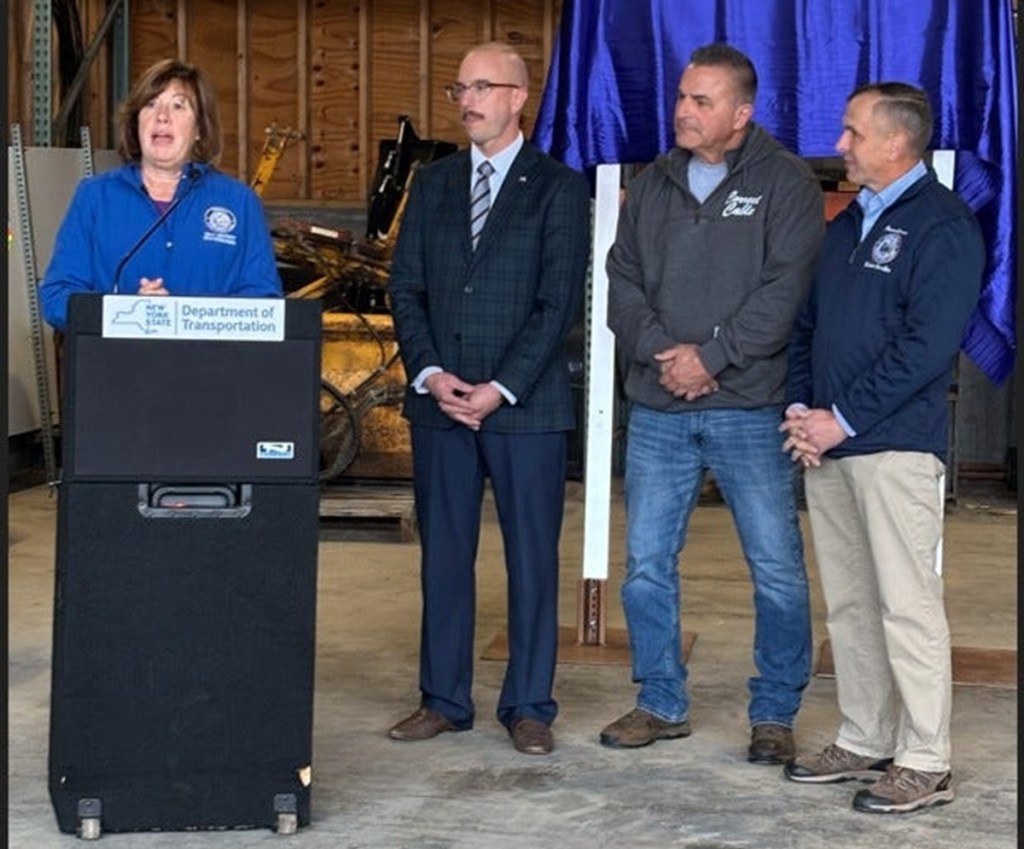
The legislators were joined by NYSDOT Region 2 Director Matthew Howard and team members to celebrate the signage and support the marking the stretch of Herkimer County state highway honoring the service of “War Dogs.”
“There’s an extraordinary bond between Military Working Dogs and their handlers. I have seen that bond up close while deployed,” shared Smullen – a United States Marine Corps Col. who served 24 years, including three tours in Afghanistan – in his remarks, according to a statement.
“These dogs save lives, and they deserve to be remembered right here in Herkimer.”
History of ‘war dogs’ in the U.S. Military
Since the American Revolutionary War through World War I, but officially since 1942, when canines were specifically trained for service in World War II, War Dogs have served as scouts, sentries, and protectors, quietly shaping battlefield outcomes, by “consistently providing a tactical advantage through their unmatched sensory abilities and adaptability.”
Among the American dogs of that war, according to a Nov. 12 statement released by Buttenschon, was Stubby, a stray smuggled aboard a ship bound for France by recruit John Robert Conroy who served with the 102nd Infantry, 26th (Yankee) Division, warned soldiers of gas attacks and incoming artillery shells, and was later promoted to Sergeant.
The Great War also left an indelible mark on the Marine Corps, which adopted the English bulldog as its mascot in the years that followed. Since 1957, the bulldog mascot at Marine Barracks Washington has been named Chesty, after Lieutenant General Lewis “Chesty” Puller, the most decorated Marine in American History.
The idea of a formal military dog program to took hold in March 1942, when Dogs for Defense, a civilian group, was founded and asked families to donate their pets to the war effort. In just over a year, more than 11,000 dogs had been acquired for training.
Within a decade, dog teams were serving in Korea, where they patrolled at night and detected enemy positions, and in Vietnam, where an estimated 4,000 dogs and 9,000 handlers served, and the bond between handler and dog became part of the fabric of the war.
In all military conflicts that followed, Military Working Dogs and their handlers carried on that legacy, bravely safeguarding the lives of U.S. troops who served with them.
Legacy of Marine Corps Sgt. Adam Cann and Military Working Dog, Bruno
Among those who carried that legacy was Cann.
Cann, trained as a K-9 handler, was paired with a Military Working Dog named Bruno at Camp Pendleton before deploying to Iraq. On January 5, 2006, while serving in Ramadi, Cann volunteered for duty on what was his day off. When Bruno alerted to a suicide bomber in a crowd, Cann told fellow handlers who were married with children to stand down, as he advanced on the man and caused a device to detonate early.
The blast killed Cann, age 23, together with an Army Lt. Col. And 35 Ramadi civilians, and wounded Bruno, who is said to have refused to leave Cann’s side after the explosion. Cann, the first Military Working Dog handler killed in action since the Viet Nam War, saved the lives of all of his fellow Marines that day.
Bruno recovered and, as Cann was posthumously, was awarded the Purple Heart and went on to serve in assisting in the training of future Military Working Dog handlers at Camp Pendleton.
Sergeant Cann’s story reached Herkimer County through Brezinski.
War Dog Memorial Highway, marker follow installation of Herkimer monument
A bronze monument, created by sculptor Lena Toritch, was installed just off Thruway Exit 30 and unveiled in Oct ’23 before a crowd of over 300 family members, friends, veterans, and local dignitaries.
Brezinski reflected in a statement, “It has long been a goal of mine to find a way to properly honor our four-legged soldiers, and the dedication of this stretch of State Route 28 as the ‘War Dog Memorial Highway’ … will bring further deserved attention to the countless military working dogs who have paid the ultimate sacrifice in the protection of the servicemen and women with which they valiantly served.”
Brezinski concluded, “these dogs are heroes…”
This article originally appeared on Observer-Dispatch.
Related: What comes next for New York data centers amid environmentalist pushback