Reporting by Chris McKenna, New York State Team / Rockland/Westchester Journal News
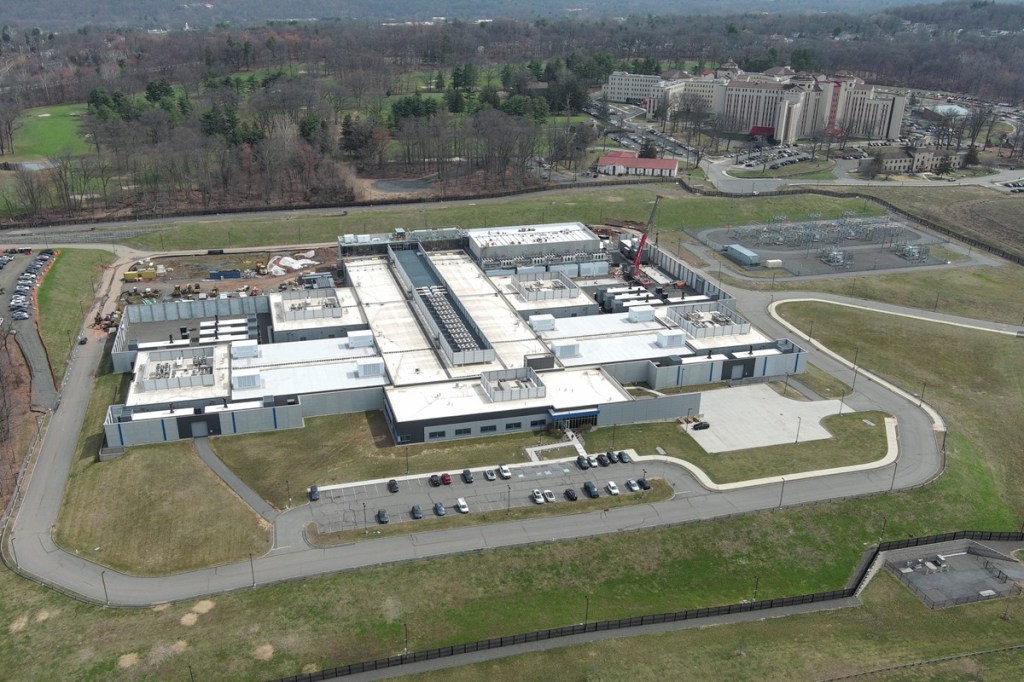
The sprawling data center that JPMorgan Chase built on an abandoned piece of the Rockland Psychiatric Center campus in Orangeburg came with striking government subsidies that face new criticism from a government watchdog.
The bank would be spared up to $112 million in sales tax, paying nothing to the state or county for its equipment purchases for 20 years. Signing off on that break was the Rockland County Industrial Development Agency, which also approved a 20-year reduction in property taxes that so far had saved the company $1.8 million through 2025.
The public subsidies that JPMorgan Chase and other companies received for a cluster of data centers in Rockland County have again come under scrutiny in a pair of new reports by Reinvent Albany, a government watchdog group.
Reinvent Albany criticized those tax breaks in prior reports and has now dug deeper into what it views as a lax and unnecessary award of corporate benefits by Rockland’s economic development arm.
It’s not just the large amounts of the tax incentives, the latest reports argue. It’s the absence of a detailed rationale for them. And the county’s willingness to later grant extensions, giving the companies more time to claim their exemptions. And its agreeing to hoist the breaks when project costs rose.
“Regardless of the size, we would like to see a better process,” Alex Camarda, a senior policy advisor for Reinvent Albany, said of Rockland’s tax breaks in an exclusive interview with the USA TODAY Network before the release of his group’s reports.
They come as New York is reviewing its approach to data centers after a mounting public outcry against huge ones emerging now to serve the artificial intelligence boom. Facing a strain on the state’s power grid, Gov. Kathy Hochul paused the rush in July by ordering the country’s first statewide moratorium on large-scale data centers. And she has pledged to pursue a ban on tax breaks for data centers — the very subsidies that Reinvent Albany is criticizing.
Little effort to justify tax breaks for data centers in Rockland County
The Rockland IDA and its counterparts in other counties and cities are empowered to waive or reduce taxes on businesses as incentives for them to build or expand their operations. The idea is to dangle financial bait to keep them from shifting their plans to another state or county where they could build or operate with lower costs.
Reinvent Albany takes a dim view in general of giving subsidies to businesses that may not need them. But in the case of the data centers, that skepticism is compounded by the few jobs they create and their detrimental effects. Chief among those drawbacks is the vast amounts of electricity that data centers use to run computer systems 24 hours a day.
The most basic problem in Reinvent Albany’s telling is that too little justification is demanded up front.
Out of nine applications studied for one of its new reports, most of the companies seeking to build, expand or occupy data centers in Orangeburg failed to describe how their projects would benefit the community. Only one — Bloomberg, which built the first of the area’s data centers starting in 2013 — provided a cost-benefit analysis to show a payoff for the taxes that would be given up.
A few applicants mentioned other states where they might locate if Rockland refused tax breaks, but none offered any comparison to what was being offered in alternative locations.
“The IDAs are set up to give away this money, and I don’t think they get much opposition,” Camarda said.
Extending the time, raising the benefits
The group’s second report questioned the IDA’s accommodations for data center projects after the initial approvals of their tax benefits.
That included giving them more time to make tax-free equipment purchases when they asked. DataBank, for instance, was initially given two years to claim $7.8 million in sales tax exemptions, but then got another three years after saying the town’s approval process had delayed its construction plans, according to the IDA’s resolution.
Morgan Stanley, in another example, got a four-year extension on its waiver of $7.3 million in sales tax.
The longest timeframe of all was given to JPMorganChase, which was initially given a 15-year sales tax exemption instead of the three years recommended in the IDA’s guidelines. That was stretched even longer, to 20 years, when a second stage of the project was approved and the total amount of waived sales tax ballooned to $112 million.
The report also criticizes the IDA’s upping its benefits after the initial approvals. It did so for Morgan Stanley in February for this year after the company expanded its plans and its expected costs skyrocketed. The IDA agreed to spare the company $19.3 million in sales tax, rather than $7.3 million.
All told, the data center builders and tenants have been granted $223 million in tax breaks. In return, according to the reports, they have promised a total of 282 permanent jobs.
Responses from the IDA and JPMorganChase
Steven Porath, the IDA’s executive director, counters that time extensions are fairly common for companies receiving tax benefits, and aren’t unique to data centers. And in the case of JPMorganChase, he said, that 20-year timeframe was justified by something that is unique to data centers — the continuous purchases made to update those operations after their initial construction.
“That was the window of capital investment that they were approved for,” Porath told the USA TODAY Network in an interview on Tuesday, Nov. 17.
As for the applications, Porath said no cost-benefit analysis was required because his agency does its own analysis for each project, with the understanding that those agency findings are more credible than what an applicant may claim.
He also said that as part of their “due diligence,” the IDA’s staff and board draws out more information from companies than what their applications alone show. That includes asking them about what they would do if they were denied benefits.
“An application itself does not tell the full story,” he said.
Porath said he welcomed the scrutiny of watchdog groups and greater public involvement in IDA decisions. But he stood by the data center tax breaks highlighted in Reinvent Albany’s reports, arguing they were responsible and made in the best interests of the county’s economic development.
“The IDA is very diligent in determining if we give benefits or not,” he said.
In a statement to the USA TODAY Network, JPMorganChase cast its data center as a boon for Orangetown, saying it revived a blighted property that the town previously had bought from the state and then had difficulty redeveloping. The bank paid $7.5 million for 60 acres in 2017 and proceeded to demolish more than 30 abandoned buildings on the psychiatric center campus.
Its resulting data center now employs 70 people and has returned the property to the local tax rolls, company spokesman Michael Fusco said in a statement.
“We turned a long-stalled Brownfield site into an active, tax-generating site — investing more than $80 million in environmental remediation and creating hundreds of local construction jobs during the development,” Fusco wrote.
Chris McKenna covers government and politics for The Journal News and USA TODAY Network. Reach him at CMcKenna@usatodayco.com.
This article originally appeared on Rockland/Westchester Journal News.
Related: Should Rochester’s new state park be called Ga’sgöhsagöh?