This story was originally published by New York Focus, a nonprofit newsroom covering New York politics and government. Sign up for Staying Focused, their newsletter on New York politics.
An off-duty police officer stuffed a sock into a woman’s mouth. Another got into a fight with his wife that led to her breaking a finger. A third punched a car window, trashed his house, and left out loaded guns when he thought his wife was cheating on him.
None of the officers seem to have faced criminal charges. Instead, they were disciplined by their employer, the New York State Police, with punishments ranging from work probation to two weeks of suspension plus probation.
New York Focus recently published an investigation into how New York’s second-largest police force handles domestic violence allegations against its officers. Based on three decades of previously unreleased disciplinary files, it showed that the State Police have minimized credible accusations.
The findings alarmed experts, who argue that police should be held to a higher standard than civilians when accused of violence. “This person has a gun,” one said. “They have a badge, and they can use that authority.”
Here are the key takeaways.
The State Police have handed down token punishments for domestic violence.
New York Focus reviewed the disciplinary records of 18 employees who faced allegations of domestic violence that the State Police substantiated. Seven of them faced censure and five days or less of suspension or lost vacation. (Some of those were also put on work probation.) Another five employees faced 10–30 days of suspension or lost vacation. Three faced censure alone or no consequences at all. Some of the officers were disciplined for multiple domestic incidents.
The only employee in the records who was fired after a domestic incident was arrested out of state. His incident prompted an internal investigation that uncovered a pattern of other malfeasance, including evading tolls and drinking and having sex on the job.
A spokesperson for the State Police said the department has “zero tolerance” for domestic violence. “Every allegation of domestic violence is taken seriously and subject to a thorough and impartial investigation,” they said in a statement. The way police handle domestic complaints has changed over the years, the spokesperson added, pointing to recent cases not contained in the 18 officers’ disciplinary files where troopers have been arrested for domestic violence.
One expert argued that the files expose the State Police “ignoring, enabling,” and “excusing” their officers’ domestic violence. Survivors who spoke with New York Focus felt similarly.
“It makes you feel like you don’t have anybody protecting you,” one said.
The State Police have criminally investigated their own colleagues, against typical practice.
The agency investigated their own employees in at least eight domestic incidents outlined in the records.
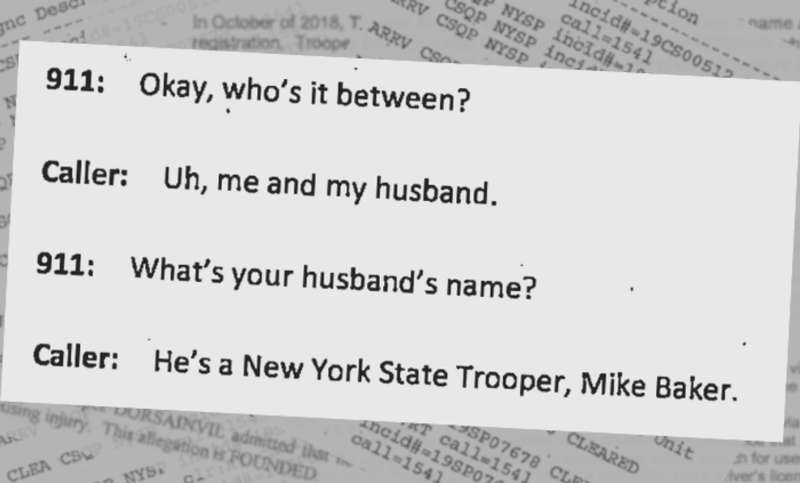
“I want the police here … State Police please, only,” trooper Michael Baker told a dispatcher while his wife was on her own call with 911. It was the seventh time she’d called the police on Baker, according to the records. In response to her previous call, five of Baker’s colleagues came to the scene where local police were responding and took charge.
One expert told New York Focus that it’s fairly typical for departments to refer such investigations to outside agencies, and another questioned whether officers can be trusted to objectively investigate their coworkers.
“We understand why a criminal investigation involving one of our own members raises questions about impartiality,” the State Police spokesperson said. “Criminal investigations involving members meet the same standards of thoroughness and objectivity as any other criminal investigation.”
Baker was never arrested or charged. The State Police determined that he escalated an argument, misled dispatchers, failed to report previous domestic incidents, and repeatedly used police resources to gather information on his wife’s “male acquaintances.” He received five days of suspension and six months of work probation.
State Police officers and staff used police information systems to track or pester survivors.
Several State Police employees in the disciplinary files used their access to police information systems to follow or pester survivors. In 2018, Baker asked a trooper to run the name and license plate of one of his wife’s male acquaintances through a police database. Over the next few months, he twice ran the plates of cars parked near where his wife was living.
State Police dispatcher Margaret Slater was criminally charged for allegedly stalking a man and his partner and trespassing on the man’s property, among other offenses. She also used her access to state systems to retrieve the partner’s Department of Motor Vehicles files. (The criminal charges were later dismissed, but the department suspended her for 91 days and put her on a year of work probation.)
[Related: How We Obtained 10,000 Police Disciplinary Records](NEED URL)
Nine years later, Slater followed the partner of another man she had been seeing in her car and called two on-duty State Police employees to run her license plate. In interviews with New York Focus, Slater said she did nothing wrong, but that she also wasn’t totally innocent. State Police higher-ups would call in license plates for personal reasons all the time, she alleged.
For this and other violations, the State Police punished Slater with a year of work probation and 10 days of suspension.
“I make it up in overtime,” she told New York Focus. “It was like, ‘Hey, I just got a week’s vacation.’”
This story was originally published by New York Focus. Read the original here.