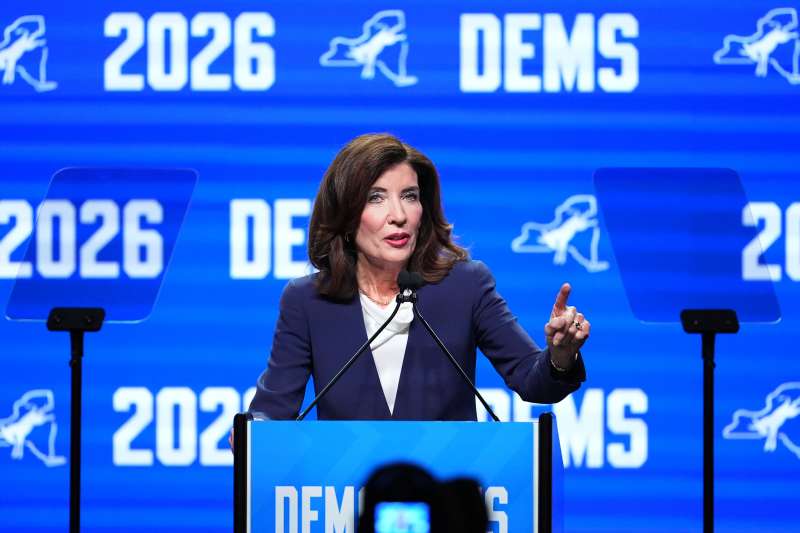
Gov. Kathy Hochul (D) announced last week that she is reconsidering whether New York still needs the redistricting weapon Democrats forged to counter President Donald Trump’s gerrymandering campaign, now that the GOP’s gambit has failed to save the party’s House majority.
Hochul, fresh off her reelection earlier this month, stopped short of committing to the next step.
“The political landscape has changed,” she said at a press conference at her Manhattan office. She plans to confer with state legislative leaders and with Hakeem Jeffries, who is poised to become House speaker after Democrats flipped the chamber.
Why did New York Democrats want to redraw the map?
Last summer, Trump pressed Republican-led states to redraw their congressional districts mid-decade to stave off losses in the 2026 midterms. Texas moved first. In August 2025, Gov. Greg Abbott signed a map engineered to create five more GOP-friendly seats. By this June, eight states had enacted new lines that Republicans believed could net them as many as 16 additional seats.
The Supreme Court heightened Democrats’ alarm in April. Its 6-3 ruling in Louisiana v. Callais narrowed the Voting Rights Act, and New York Democrats cited the decision as further reason to act.
Albany responded in June. The Assembly approved a constitutional amendment 91-47 and the state Senate passed it 38-22, Bloomberg Government reported. Hochul framed the measure as giving New Yorkers “the power to fight back against attempts by Donald Trump and his allies to rig our elections.” Jeffries hailed the vote as a forceful rejoinder to Republican gerrymandering. A redrawn map could have imperiled as many as four of New York’s Republican-held House seats.
What would the amendment do?
The measure would allow New York to redraw its congressional districts before the 2030 census and give state lawmakers greater sway over the process.
It would also strike the constitutional ban on drawing districts to favor or disfavor a party or incumbent, scrap a compactness requirement, and curtail the courts’ role in resolving challenges to new maps.
Taken together, those changes would dismantle much of the redistricting overhaul New York voters approved in 2014, which created the state’s Independent Redistricting Commission.
Democrats have collided with those protections before. In 2022, the Legislature adopted a congressional map that courts later struck down as an unconstitutional partisan gerrymander, after it stretched one Long Island district across the Sound into Westchester County and snaked another from Manhattan into Brooklyn.
How did Trump’s redistricting push fare?
The push fell short of its central goal.
The Associated Press called the House for Democrats early on Nov. 4, after the party crossed the 218-seat threshold.
In several states, Democrats overcame the new lines. In Texas, Democratic US Reps. Henry Cuellar and Vicente Gonzalez both won reelection in Rio Grande Valley districts reconfigured to unseat them, and Democrats ousted Republican US Rep. Monica De La Cruz. In Florida, Democratic US Reps. Jared Moskowitz and Kathy Castor held their seats. Missouri’s new map was blocked in court and then rejected by voters, and California’s retaliatory Democratic map flipped Republican-held seats.
Former Attorney General Eric Holder, who chairs the National Democratic Redistricting Committee, said the Trump plan “was systematically dismantled.”
That verdict may be premature. A preliminary New York Times analysis estimates Republicans still netted four to seven seats from the new maps, and it found the effort backfired, narrowly, only in North Carolina. Those gains simply proved too modest to withstand the Democratic wave.
The Times also found that partisan gerrymandering more broadly still cost Democrats dearly. Had every map been drawn on a nonpartisan basis, the paper estimates, Democrats might have approached a veto-proof two-thirds House majority, with close to 20 more seats in Texas, Florida, and Georgia alone. That finding lends weight to Hochul’s contention that the redrawn lines will outlast this election.
In New York, Democrat Cait Conley defeated US Rep. Mike Lawler in the Hudson Valley. Lawler had been one of the amendment’s most vocal critics and accused Democrats of a naked power grab when it passed in June.
When could voters weigh in?
The amendment must clear the Legislature a second time before it reaches the ballot.
Lawmakers could take it up again in 2027, and if it passes, voters could decide as soon as November 2027. Approval would open the door to new congressional maps for the 2028 elections, though lawmakers would still have to choose whether to redraw them.
Why do Republicans oppose it?
Former US Rep. John Faso, a Republican redistricting strategist who has helped lead opposition to the amendment, contends it would gut the anti-gerrymandering protections voters endorsed in 2014 and free lawmakers to disregard county, town, and municipal boundaries.
He accused Democrats of rewriting the rules for partisan advantage. He added that he had also opposed Republican mid-decade redraws, and he urged both parties to win elections on the merits instead.
Other Republicans in Albany have made similar arguments. After the June vote, state Sen. Jim Tedisco denounced partisan redistricting by either party and urged the state to preserve its independent process, and state Sen. George Borrello argued that Democrats were waging a fight on behalf of out-of-state interests. The GOP also has a track record here. Republicans spent millions to defeat a Democratic-backed redistricting amendment in 2021, which voters rejected.
Is a redraw still worth it for Democrats?
Jeffrey Wice, a redistricting expert at New York Law School, said Democrats now face a markedly different calculus than they did in June.
Republican redraws in Texas, North Carolina, and Florida fell well short of what the GOP had hoped, he noted. Democrats must now weigh whether another costly, bruising fight is worth waging after their stronger-than-expected gains. He also cautioned that the national landscape could shift again before 2028.
Other blue states are still forging ahead. Maryland voters approved Question 3 on Nov. 3, a constitutional amendment that clears the way for Democratic lawmakers there to redraw the state’s congressional map before 2028. Yet even in Maryland, the measure’s sponsor has suggested a redraw may prove unnecessary in light of the midterm results.