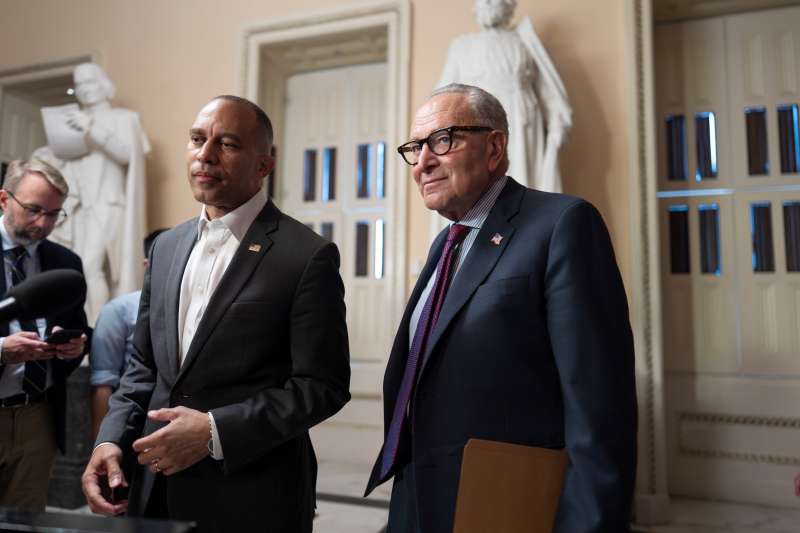
New York’s progressive stars are drawing a sharp line between the state’s two most powerful Democrats.
Rep. Alexandria Ocasio-Cortez of the 14th District, which spans parts of the Bronx and Queens, has backed House Minority Leader Hakeem Jeffries for speaker, as have Rep.-elect Brad Lander, who won the 10th District spanning Lower Manhattan and parts of Brooklyn, and New York City Mayor Zohran Mamdani.
Toward Senate Minority Leader Chuck Schumer, they’ve been far cooler.
The divide places New York’s left at the center of two leadership fights now consuming Washington. Jeffries lives about a mile from Schumer’s Park Slope home, and Democrats’ midterm sweep has put both men in line for their chambers’ top jobs.
Jeffries, who has never held the gavel, is expected to become the next speaker when the new Congress convenes Jan. 3. Schumer, who has led Senate Democrats since 2017, is fending off senators-elect vowing to vote against him.
Behind Jeffries
Lander, who beat Jeffries-backed Rep. Dan Goldman in the 10th District’s June primary, told NOTUS, “I look forward to voting for Hakeem to be the speaker of the House.”
Ocasio-Cortez has endorsed Jeffries for speaker, according to The Wall Street Journal. Sketching the role on a whiteboard during an Instagram Live on Monday, she described the speaker’s job as both legislative and political. She said the legislative portion consisted of running a whip operation—”knowing how all of your members are going to vote on a given bill.” Meanwhile, a speaker’s political job “is about keeping your majority […] and the extension of that political job is fundraising,” Ocasio-Cortez said.
Mamdani reaffirmed his support for Jeffries’ speakership bid in August. Asked by NBC News last week whether he’d urge Democrats to support Jeffries, the mayor stood firm: “I’ve been clear about where I stand, and I think that’s all they need to hear from me on that.”
Cooler on Schumer
At an NY-1 primary debate, Lander, whose district includes Schumer’s home, was asked whether he’d support the senator’s potential 2028 reelection. “I think it’s time for new leadership in the Democratic Party,” he said.
Ocasio-Cortez called Schumer’s March 2025 vote to advance a Republican funding bill “a tremendous mistake,” and she has long been floated as a potential 2028 primary challenger to him.
Jeffries has stood by his fellow Brooklynite. After eight members of the Senate Democratic caucus broke ranks to end last year’s government shutdown, Jeffries was asked whether Schumer was still effective and should stay in leadership. “Yes and yes,” he said.
Holdouts at home
Jeffries’ support among New York progressives has limits.
Two democratic socialists—Rep.-elect Claire Valdez, who will represent the 7th District, spanning parts of Brooklyn and Queens, and Rep.-elect Darializa Avila Chevalier, who unseated Rep. Adriano Espaillat in the Upper Manhattan-based 13th District—remain uncommitted.
Mamdani, who endorsed both, has declined to pressure them. “I’m not here to make decisions for others,” he said after the election.
A national backlash
House Democrats are being bombarded with calls and emails urging them to reject Jeffries, much of it spurred by a Change.org petition that has topped 920,000 signatures.
His ties to the American Israel Public Affairs Committee (AIPAC), which publicly congratulated him after the election, and his acceptance of corporate PAC money have long rankled the left. The final Economist/YouGov poll before Election Day found 26% of registered voters approved of his performance, while 47% disapproved.
Schumer’s wider rebellion
Opposition to Schumer is more widespread, and much of it sits inside the caucus that will decide his fate.
Senators-elect Peggy Flanagan of Minnesota, Troy Jackson of Maine, Abdul El-Sayed of Michigan, Juliana Stratton of Illinois, and Adam Hamilton of Kansas have all said they won’t support Schumer. Hamilton told CNN that Schumer “is seen as a more divisive figure by many people.” Critics fault Schumer for doing too little to block President Donald Trump’s cabinet confirmations and for backing a Republican bill to end last year’s shutdown without winning concessions.
On Monday, Maryland Sen. Chris Van Hollen signaled he’s open to running for majority leader, making him the only potential challenger to surface. Michigan Senator-elect Abdul El-Sayed has already said he’d back him, and Van Hollen has urged colleagues to withhold commitments until Schumer lays out his vision.
On that same day, the 600,000-member International Association of Machinists and Aerospace Workers sent Schumer a letter saying it’s time for “a new generation to lead Senate Democrats,” a rare rebuke from organized labor, one of the party’s core constituencies.
Why the paths diverge
In March 2025, Jeffries wrangled all but one House Democrat to oppose the Republican funding patch that Schumer then helped advance, cementing Jeffries’ standing as a reliable vote-counter.
Jeffries also controls the party’s fundraising apparatus through the Democratic Congressional Campaign Committee, and many incoming members hail from battleground districts where he campaigned or raised money for them.
Most members of the Bloc, a coalition of incoming left-wing House Democrats, have declined to commit to Jeffries, Axios reported, and they’re pressing him to prioritize Medicare for All, a data center moratorium, and withdrawing aid from Israel. Valdez and Chevalier are members of the Bloc, while Lander has been described as “Bloc-adjacent.”
That pressure, however, only goes so far. With no viable alternative and a majority of more than 250 seats, Jeffries can absorb defections, so holdouts are more likely to bargain for concessions, like committee seats or a floor vote, than to block him.
What comes next
House Democrats will choose their nominee behind closed doors on Nov. 18 ahead of the full House vote on Jan. 3, 2027. No challenger has surfaced. Schumer needs a majority of his caucus to support him in a secret-ballot vote. This will require at least 28 members, or 29 if Democrats win two Senate races that have yet to be called in Alaska and Mississippi.
For Jeffries, the question is what concessions holdouts can extract. For Schumer, it’s whether a challenger steps forward at all.
Jeffries’ and Schumer’s offices did not respond to Courier New York’s requests for comment.