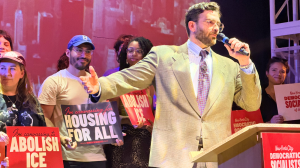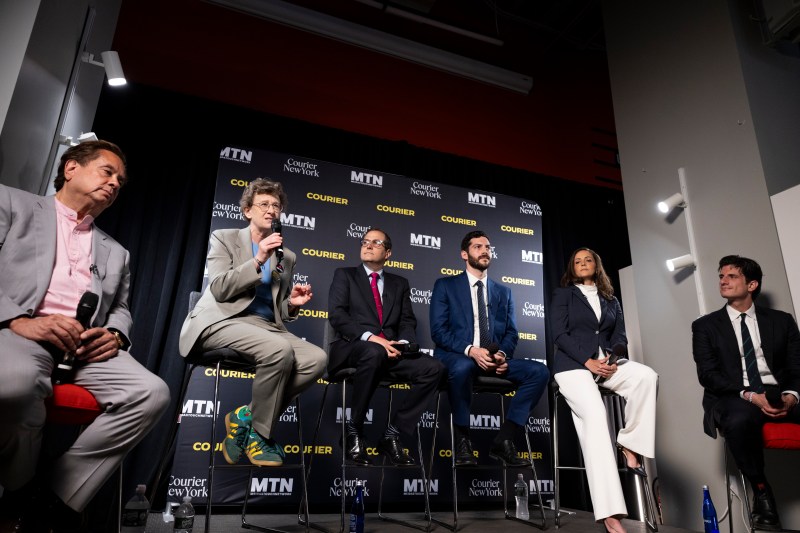
The last debate before the June 23 primary put all six major Democratic candidates in New York’s 12th Congressional District on one stage Wednesday night. While the evening covered everything from the Iran war to broken NYCHA elevators, the loudest fight was over money.
Hosted by Courier Newsroom and MeidasTouch at P&T Knitwear on the Lower East Side and live-streamed on YouTube, the debate was emceed by award-winning journalist Don Lemon and featured a moderator panel that included longtime Today Show anchor Katie Couric, COURIER Newsroom founder and publisher Tara McGowan, immigration reporter Eileen Grench of Documented, immigration attorney Michael Foote, Chai Dingari of More Perfect Union, Rachel Janfaza of The Up and Up, and me, representing Courier New York.
It was also the first debate to include all six major Democratic candidates: Assemblymember Alex Bores (D-73), attorney George Conway, Assemblymember Micah Lasher (D-69), Jack Schlossberg, civil rights attorney Laura Dunn, and public health expert Dr. Nina Schwalbe—the last two of whom had been excluded from previous debates that set their fields based on fundraising thresholds and polling.
Breaking news in the room
The debate opened against a backdrop of breaking news. Hours earlier, the United States had launched fresh airstrikes on Iran after Tehran downed an American military helicopter, the latest escalation in a war now in its fourth month.
Asked about the war and how they would navigate ending it as members of Congress—given that the president had dismissed congressional efforts to stop it—all six candidates opposed continued military action, though the sharpness of their responses varied.
Schwalbe called the war illegal and said Democratic leadership had failed by not speaking out sooner. Lasher called it “wrong and reckless.” Conway said it was “stupid and unlawful” from the start. Bores said Trump “dove headfirst into this war of choice” and called for troops to come home immediately. Schlossberg said Trump had “left Iran in a better negotiating position than when we started.”
Dunn went the furthest, arguing the war had been requested by Israel, that AIPAC money had corrupted both parties, and that Democrats must stop partnering with Israel on security and intelligence. “We cannot combine our military with them, we cannot combine our intelligence with them,” she said.
The outsider war
The night’s most explosive exchange came over campaign finance and quickly became something more personal: a battle over who on the stage had the right to claim the mantle of the people.
In her question to the candidates, Couric noted that the race was on track to be one of the most expensive in history, with tens of millions of dollars in outside super PAC spending flooding in—including, she noted, up to $5 million from former Mayor Michael Bloomberg in support of Lasher’s campaign.
Bores, who has made AI regulation the centerpiece of his campaign, argued he was the race’s most targeted candidate—the victim of a $10 million spending campaign by a super PAC called Leading the Future, funded by Trump mega-donors opposed to tech regulation. He said he had offered every candidate a “People’s Pledge” to reject super PAC spending at the start of the race and heard nothing back.
“They’re all benefiting from that super PAC,” Bores said. “They’re happy to look the other way at Trump money coming into this race.”
His rivals were not having it. Schlossberg accused Bores of being backed by Anthropic and crypto billionaire Chris Larsen—who he said had donated $5 million to Trump’s campaign and was funding MAGA candidates across the country. “It is not about what I own,” Schlossberg said. “It is about who owns me.”
Lasher defended Bloomberg’s support was categorically different from tech and crypto money, arguing a former mayor who knows the district is not the same as an industry with a Washington agenda. Pressed on the distinction, he said super PAC spending was “enormously unhealthy for our democracy”—but maintained the motivations behind it matter.
Dunn refused to litigate the competing super PAC claims. “I’m sitting on a stage with millionaires who are backed by billionaires,” she said. “It shouldn’t matter how much you fundraise. It should matter what your ideas are, what your experience is, and what your policy vision is for New York City.”
Schwalbe made it math. “For every $5 million they spend on ads, 2,000 New Yorkers could have SNAP benefits,” she said.
The attacks turned personal when Dunn accused Bores of profiting from his time at Palantir—whose technology has been used in federal immigration enforcement—and accused Lasher of launching his political career with what she called a racist cartoon targeting a Latino politician.
The issues
On immigration, all six candidates said they supported abolishing ICE. Grench opened her question by noting that Border Czar Tom Homan had announced plans to send more agents to New York City, and that ICE had reportedly defied a federal court order banning civil arrests inside Manhattan immigration courthouses.
Foote, an immigration attorney who represents migrants in detention, asked the candidates what they would do upon receiving handwritten letters from 535 children detained in for-profit detention centers in Texas.
Lasher said Democrats must use every available tool to stall funding for what he called “abject cruelty.” Bores said he would contact every detained child’s family and fight to end private prison contracts. Schlossberg said he would write back to all 535. Dunn called for members of Congress to physically surround Delaney Hall—the New Jersey detention facility where over 300 detainees are on an ongoing hunger and labor strike—and refuse to let ICE agents in or out until everyone is released.
On affordability, candidates largely agreed on the need for more housing, stronger tenant protections, and federal investment in public housing, though they differed on emphasis. Schwalbe drew the night’s most vivid image, describing a man on kidney dialysis who lives on the 17th floor of a New York City Housing Authority (NYCHA) building with a broken elevator.
“The disrepair of NYCHA housing is a man-made failure and a political choice,” she said.
Schlossberg pushed back on what he called the Democratic habit of “huge, vague abstractions,” promoting a renter’s tax deduction and a plan to redirect Trump’s ballroom security funding toward an expanded child tax credit. Bores called for federal housing grants, repeal of the Faircloth Amendment—a 1998 federal law that effectively caps the construction of new public housing units—to unlock NYCHA resources, and a readjusted area median income calculation that determines what counts as affordable in New York. Lasher pitched what he called a “new deal for a new generation,” centered on a first job guarantee, first home assistance, and paid family leave.
On AI and the future of work, Bores argued that Congress needed someone who was “as comfortable on the command line as they are on the picket line”—he would be only the second Democrat in Congress with a computer science degree, he said. Schlossberg countered that Bores’ plan to regulate AI amounted to handing the industry a national equity stake in exchange for “a five cent coupon.” Lasher proposed a first job guarantee tied to paid national service. Conway said he was open to partial government ownership of AI. Schwalbe called for an American Job Corps.
McGowan, who moderated the Epstein files segment, noted that New York State has yet to launch a single investigation since the release of the files, despite the fact that Epstein’s primary Manhattan home sits in the 12th district. Dunn, a sexual assault survivor who has campaigned alongside Epstein and Trump survivors, said: “It must be the leading cause of whoever wins this race to ensure justice for each and every survivor.”
The debate closed with the Knicks on everyone’s mind. “Tip-off is happening now,” Lemon said, “and as New Yorkers, we need to go.”
Early voting begins Saturday, June 13. The primary is June 23.