When the box arrived at Bloomy Cheese & Provisions in Dobbs Ferry, the UPS driver wouldn’t hand it over.
Jessica Galen had ordered roughly $600 worth of Japanese drink stirrers and tabletop goods months earlier: small, whimsical items she’d picked out at a wholesale show in New York City for her holiday inventory. UPS was demanding nearly $500 in tariff fees, brokerage charges, and other costs Galen had no way to anticipate when she’d placed the order.
She refused the shipment. Weeks of phone calls to UPS and the Japanese vendor followed. Eventually the small artisan producer in Japan told her they couldn’t help further, citing too many other American clients in the same position. The shipment never reached her. The Japanese company, Galen suspects, may never sell to a US buyer again.
“It’s just one of the things that happened to me,” Galen said. “Not to mention, probably three or four small producers… that have just hung it up in the last year because of the chaos.”
Galen’s story is one of many like it playing out across the Hudson Valley, where small business owners say President Trump’s tariff policies—backed repeatedly by US Rep. Mike Lawler (R-Pearl River)—have created more than a year of vanishing margins, lost inventory, and impossible planning. Galen’s Dobbs Ferry shop, and her home, sit in the neighboring 16th District, but her customers, suppliers, and her own political organizing cross directly into the 17th, which Lawler represents.
The squeeze is national. The average small-business importer has paid $306,000 more in tariffs since Trump took office, according to a Center for American Progress analysis, with mom-and-pop businesses under 50 employees paying about $175,000 per firm.
Small businesses with fewer than 10 employees lost 292,000 jobs in 2025—4.5 times more than during the 2020 pandemic—and revenue at the smallest retail businesses has fallen 9.4% since Trump’s “Liberation Day” tariffs in April 2025, according to a Joint Economic Committee analysis.
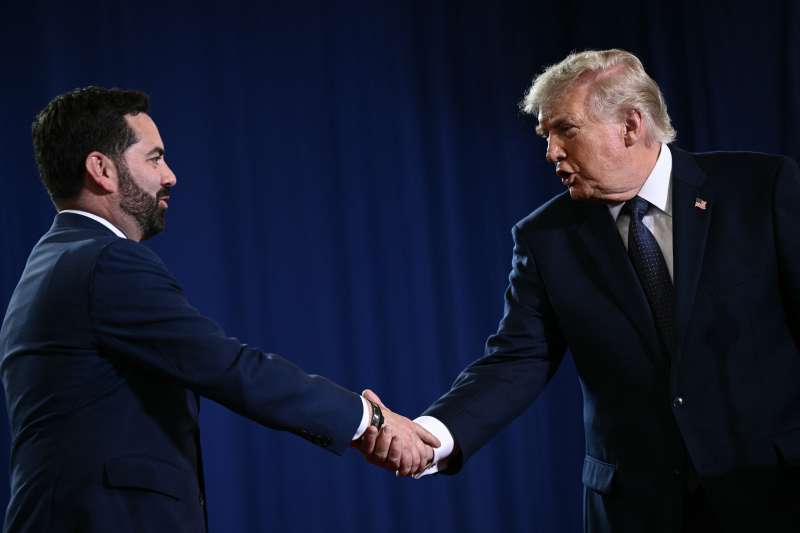
Trump has called the economy a success. On Friday, he traveled to Rockland Community College in Suffern for an official White House event alongside Lawler—the first visit by a sitting president to Rockland County since Gerald Ford in 1976.
Though the event was billed around the economy and the recently expanded state and local tax deduction, Trump spent much of his time going on tangents about voter ID, crime, transgender women in sports, and his new nickname for the opposition party, “Dumocrats,” before eventually circling back to the tax law he signed last year.
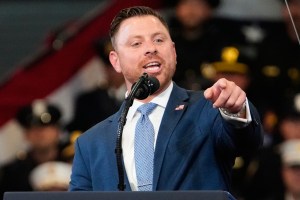
He called Lawler “fantastic” and praised him as a “pain in the ass” for badgering the administration to expand the State and Local Tax (SALT) deduction—which the new law quadrupled, from $10,000 to $40,000. Lawler took the stage wearing a red ball cap emblazoned with “Mr. SALT.”
Outside the venue, demonstrators gathered to protest the visit.
“Nothing says ‘I don’t understand my district’ quite like Mike Lawler bringing Donald Trump to NY-17 to tout a disastrous economy that’s crushing working families at every turn,” said Riya Vashi, a spokesperson for the Democratic Congressional Campaign Committee.
Lawler has repeatedly voted to preserve Trump’s tariff regime, including a February 2026 vote against terminating the national emergency that imposed tariffs on Canadian goods. At a CNN town hall in April 2025, he defended the administration’s trade agenda, saying “a tax bill, deregulation, increasing domestic production of energy, all of that is going to reduce the overall cost of living in the United States.”
More recently, he told CNN that higher prices from the Iran war were “absolutely worth it”—even after running a 2024 campaign ad complaining gas prices had “gone through the roof.”
For business owners in and around his district, that reassurance has proven cold comfort.
‘It doesn’t take much’
At Mimi’s Coffee House in Mount Kisco, owner Selamawit “Mimi” Wieland-Tesfaye watched the price of a 25-pound box of tomatoes climb from just below $30 to over $80 in a matter of months. Chocolate powder is up 20%. Coffee prices jumped 10% in October—part of a national 20%+ spike driven by Trump’s Brazil tariffs—with another 5% increase her roaster is holding in reserve.
Every delivery, from milk to linens, now comes with a separate “fuel charge” line item she didn’t see a year ago.
Gas in Rockland County hit more than $4.70 per gallon this week. according to AAA — up more than $1.50 from before the US and Israel attacked Iran in February. Rockland County legislators, responding to the spike, passed a sales tax cap on gas above $3 per gallon set to take effect June 1.
“In the last three to five months, all the stuff I buy has gotten up by at least 10 to 12%,” Wieland-Tesfaye said.
She raised her menu prices by 15 to 25 cents at the start of the year. She refuses to do it again, even as her costs continue climbing. To make up the difference, she’s cut payroll and is working more hours herself.
About 20 miles south in Sleepy Hollow, Transom Books owner Chris Steib offered the clearest articulation of why even businesses that don’t directly import are getting crushed.
“We are at the very, very end of an extremely long supply chain,” Steib said. “Literally anything in that supply chain can make my product more expensive and harder to sell and harder to get. It doesn’t take much.”
Books themselves are generally exempt from tariffs as informational materials. But paper isn’t. Neither are the bookmarks, tote bags, greeting cards, and British-printed special editions Steib uses to set his shop apart. A Mina Lima edition of a classic that cost him $34 last year now runs $40. When Trump first announced sweeping tariffs in April 2025, Steib panic-bought enough imported special editions to fill five full shelves, convinced he had no other way to predict what they’d cost.
“I’m working 20% harder to make 10 or 15% less money,” he said.
‘I’ve never met him’
Financial woes aside, the small business owners share one more grievance: the congressman elected to represent them has been absent.
“I’ve never met him, or he’s never come to my shop to talk to me and ask me how these things affect me,” Wieland-Tesfaye said. “They typically don’t really come and talk to us, especially if they think we’re not on their political ticket line.”
Galen, who serves as an elected trustee in Dobbs Ferry, connected the damage to her own shop to the broader crisis Lawler’s votes are reinforcing.
“There’s plenty of folks in my district and also in his district that are just suffering horrendously from the cost of groceries and the cost of housing,” Galen said. “Those of us who are involved locally are trying whatever we can to support mutual aid, support food pantries in the face of SNAP cuts. The headwinds when the people at the top are doing everything they can to make it as difficult as possible and as painful as possible, with zero regard to the human impact… it’s cruel.”
Rockland County Legislator Dana Stilley made the same point at a press conference Thursday on the eve of Trump’s visit, citing local economic struggles and the president’s recent comment that he wasn’t thinking about Americans’ rising costs “even a little bit.”
In February, the US Supreme Court struck down most of Trump’s tariffs, ruling they exceeded his authority under a 1977 emergency powers law. But Trump quickly imposed a new 10% tariff under separate authority, and owners say they don’t expect to recover what they’ve already paid. The uncertainty that drove their losses has not lifted.
“Less investment in my own business, less growth, fewer employees who were able to earn wages for my business,” Galen said. “It’s a tough time to feel like investing in business in the United States is a good use of funds at the moment, which is pretty much the opposite of what you would think the government would be working to encourage.”
Steib put it more simply.
“It doesn’t feel like we get the love,” he said.
Lawler faces a competitive re-election this November in a district the Cook Political Report rates a toss-up—one of only three GOP-held seats nationwide that voted for Kamala Harris in 2024. Five Democrats are competing in a June 23 primary for the chance to challenge him in the fall, led by three women: Army veteran and former Biden national security official Cait Conley, Rockland County Legislator Beth Davidson, and Tarrytown Village Trustee Effie Phillips-Staley.
Lawler’s office did not respond to Courier New York‘s request for comment.