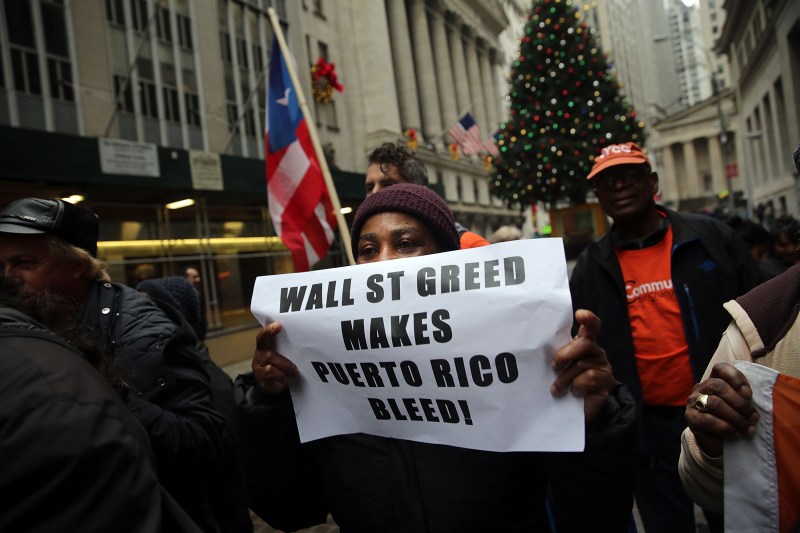
About half of Argentina’s population is using savings or borrowing money just to buy food. Nearly two-thirds have cut back on basic goods and services. In Puerto Rico, the worst may be legally over, when the island exited bankruptcy in 2022, but schools remain closed, the population keeps shrinking, and the electrical grid still fails.
Argentina and Puerto Rico, thousands of miles apart, grind under the weight of debt they cannot escape. It is, as Burkina Faso’s erstwhile president Thomas Sankara put it in 1987 and progressive movements still argue today, colonialism by another name.
The crises trace, in significant part, back to a single loophole in New York State law.
New York and London are the only two venues where most of the world’s sovereign debt is written and litigated. New York alone governs approximately 52% of sovereign debt contracts globally, making the city’s federal courthouses the arena where the economic fates of developing nations are decided.
A small group of Wall Street hedge funds, known as vulture funds, have spent two decades exploiting that position—buying distressed sovereign debt at pennies on the dollar, refusing to negotiate alongside other creditors, and suing countries for full repayment in New York courts. Nearly 70 countries, more than a third of the world, are currently in or at risk of debt distress.
“It’s a case study in most colleges now,” said Rob Solano, executive director of Churches United for Fair Housing (CUFFH). “What happened to Argentina is very similar to what is happening to Puerto Rico, what is happening in the Congo, what is happening all over the world.”
Solano has a way of making the cycle vivid. “A vulture fund eats at a Michelin restaurant,” he said. “Tips the waiter, who’s probably one of our members. That waiter is living in poverty, sends his money back home to his family. That family puts it into their country’s economy. And that economy uses it to pay back the vulture fund. It’s a cycle that never ends.”
With the state legislative session running through Friday, the bill now heads to the Assembly, where advocates are making a final push to bring it to the floor before time runs out.
A loophole built in Albany
For centuries, New York law incorporated the doctrine of champerty, which originated in Medieval English common law and bars investors from buying debt for the primary purpose of bringing a lawsuit to recover it.
That protection was gutted in 2004.
That same year, Albany passed an amendment to New York Judiciary Law § 489 that shielded large-scale commercial debt acquisitions exceeding $500,000 from the champerty defense. Vulture funds could now buy distressed sovereign debt at pennies on the dollar and sue countries for full repayment, plus interest, in New York courts.
Paul Singer, founder and co-CEO of Elliott Management, wrote the loophole into existence. In 1998, a federal judge threw Elliott out of court after it tried to buy distressed Peruvian bonds and sue for full repayment, ruling the practice champertous under New York law. Singer came to Albany, made campaign contributions, and got the law changed.
“It was flat-out corruption,” said Mike Kink, an attorney and executive director of the Strong Economy for All Coalition. “A billionaire hedge fund manager and his lobbyists cracked this open to create a business of hurting people in developing countries.”
The $500,000 threshold masqueraded as a protection for ordinary New Yorkers, as though it would shield consumers from having their credit card debt bought and litigated. For sovereign nations, it is a rounding error. Their debts run into the hundreds of millions and billions.
“That’s the point,” said Assemblymember Jessica González-Rojas (D-Queens), the Assembly sponsor of the current reform bill, whose mother is Puerto Rican. The limit was crafted to “carve a loophole to be able to continue to exploit and extract as much wealth from struggling nations as possible,” she added.
The consequences have been staggering and Elliott Management’s 15-year battle against Argentina is the most notorious example. The fund bought Argentine bonds at steep discounts, refused to participate in restructuring negotiations, and held out for full repayment in New York courts. The result was a $2.4 billion payout, representing a roughly 2,000% return on its investment. Opposition also comes from the Managed Funds Association, the hedge fund industry’s trade group, and the law firms that have made millions litigating these cases.
The damage compounds under the current law. Vulture funds exploit an old interest rate provision from the 1980s of 9% to pile additional debt onto countries as litigation drags on. Kink described it as “a really bad credit card forced on you involuntarily.” When countries lose in court, vulture funds collect before governments pay teachers, fund hospitals, or restore electricity after a hurricane.
The legislation now before Albany, known as the Champerty Fix Act—introduced as S1477A in the Senate by fellow Democrat Liz Krueger and A643A in the Assembly by González-Rojas—would restore the original champerty protection, making it illegal once again to buy any quantity of sovereign debt for the sole purpose of litigation.
It also reduces the punitive 1980s interest rate to one tied to market rates. Good-faith creditors who negotiate payment plans and work toward restructuring are explicitly exempted.
‘You’re sending them to die’
For Solano, the fight is inseparable from the people he organizes with every day. CUFFH’s membership is made up largely of immigrant New Yorkers whose families remain in the countries targeted by vulture funds. The champerty fight began when CUFFH started asking why so many of its members were fleeing their home countries — and tracing the answer back to debt.
“My parents came here from El Salvador,” Solano said. “My father was a chemical engineer. My mother was a beauty pageant winner. These were well-off people who came to America to sell hot dogs on the street. Why? Because there was no future for us there. And I learned as an adult that the debts these countries carry is a major reason why people leave — and why, once they’re here, they send every dollar they can back home.”
Those remittances flow back into local economies, which then use them, in part, to service debt held by the very funds whose investors dine at Michelin-starred restaurants in Manhattan.
Brooklyn City Council Member Alexa Avilés, who represents Red Hook, Sunset Park, and surrounding neighborhoods with large immigrant populations, described the toll in visceral terms. The austerity forced by debt extraction in Puerto Rico, she said, has created exactly that death spiral: “You go to the doctor, the lights go out, all the medicine goes bad, you gotta find another doctor. Come back in a couple months. The lights go out, the medicine goes bad. You’re stuck in this death spiral.”
Avilés offered a sharper term for the funds driving this: “vampire funds,” a description she said more accurately captures how they feed on countries already in crisis.
The stakes have sharpened under the Trump administration. As ICE deportation operations sweep through immigrant communities across New York, advocates warn that sending people back to countries further destabilized by Wall Street litigation amounts to a compounding injustice.
“You’re not sending them home to live. You’re sending them to die,” Solano said. “You’re sending them back to a place where they can’t prosper, where they can’t survive—and our New York law is part of what made that place unlivable.”
The final push
The New York State Senate passed the Champerty Fix Act Wednesday night, marking the third time it has cleared the chamber. The bill now heads to the Assembly, where it stalled in the Judiciary Committee in 2025 and never reached the floor. The Assembly is in session through Friday — their last window to act, according to Kink.
This year, advocates say the conditions are more favorable. The bill has 41 Assembly sponsors. Assembly Speaker Carl Heastie, who controls whether it comes to a vote, is “very engaged, asking questions,” according to Kink.
Support spans an unlikely coalition: countries that have faced vulture fund litigation firsthand, the IMF, the Vatican under both Pope Francis and Pope Leo XIV, and Greg Makoff, who authored Default, a book on the Argentine debt crisis. Even the broader financial industry, including banks, pension funds and mutual funds, has backed the reform, recognizing that vulture fund tactics harm other creditors.
“There’s a recognition of the human impact of this, particularly on poor people,” Kink said. “It’s something that can happen in Albany that would help millions of people all over the world — and it needs to happen in Albany, because the problem was created in Albany.”
Should the bill pass and be signed by Gov. Kathy Hochul, the effects would be immediate. Vulture funds would lose the legal footing to pursue this kind of litigation in New York courts, just as Judge Sweet ruled in 1998. Countries held hostage at restructuring negotiations would regain leverage. Hedge funds with legitimate long-term interests in sovereign debt would be pushed back toward the table.
“It will go back to the way it used to be,” Solano explained, “where you have to actually work with a country to figure out how to pay back the debt. Maybe instead of paying back $1 billion, you pay back $500 million—and the country keeps the rest to invest in its schools, its infrastructure, and its people.”
For the countries already saddled with debt, failure in Albany means more of the same—another year of austerity and instability with no end in sight.
“We’re just giving the Paul Singers of the world another year to go harder,” Solano said. “To fast-track court cases, to spiral these countries deeper into debt. Our moment is now.”