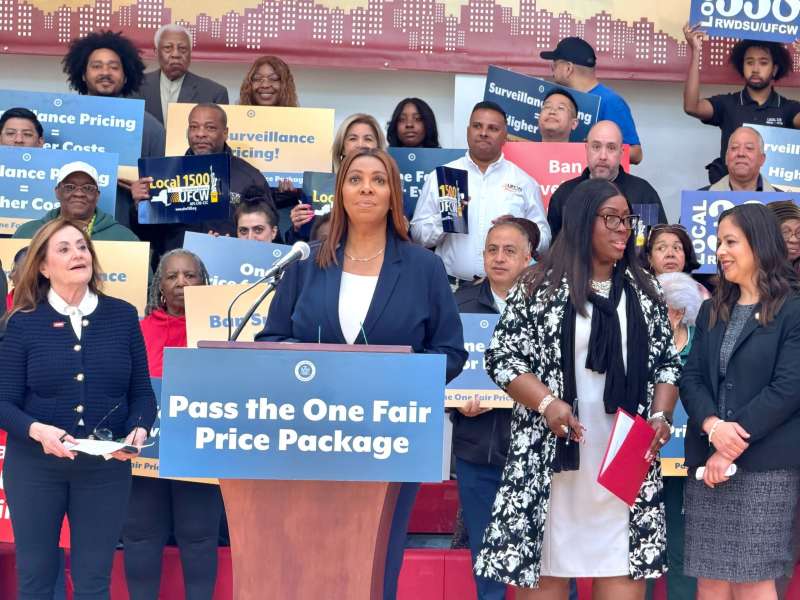
On Friday morning, New York Attorney General (AG) Letitia “Tish” James rallied in the South Bronx’s Justice Sonia Sotomayor Community Center—named for the borough’s most famous daughter—against a threat hitting local residents where they can least afford it.
In a borough already suffering a grocery access crisis, James came with a message: the algorithm knows you have no other option, and it’s charging you for it.
Surveillance pricing is the practice of using personal data—from browsing history and location to spending habits—to set individualized prices for each consumer. The goal is simple: charge you the highest price you will pay. Two neighbors can buy the same item at the same time and pay two different prices, based entirely on what an algorithm has learned about them.
Instacart, for example, used AI-driven surveillance pricing to charge different users varying prices for identical items, with discrepancies of up to 23%, according to a joint investigation by More Perfect Union, Consumer Reports, and the Groundwork Collaborative published in December 2025.
Around the same time, JetBlue sparked national outrage after its official social media account told a grieving customer—who had complained about a $230 overnight price spike while trying to book a flight to a funeral—to clear their cookies and use an incognito browser. JetBlue deleted the post, but not before it went viral as an accidental admission of the practice.
“These predatory pricing schemes use algorithms to analyze where you live, your spending habits, and even whether or not you’re in a hurry—all to determine the highest price that you will pay,” James told reporters on Friday. “Not a fair price. Not one price. Your highest price.”
The practice is not limited to online shopping. James said her office has evidence of surveillance pricing on electronic shelf labels in brick-and-mortar stores, meaning a price tag can change at the press of a button, based on who is standing in the aisle.
In response, James is pushing the One Fair Price Package, a pair of bills moving through the state legislature. The One Fair Price Act would ban surveillance pricing statewide, while the Protecting Consumers and Jobs from Discriminatory Pricing Act would ban electronic shelf labels and prohibit surveillance pricing specifically in grocery stores and pharmacies.
Together, the bills would also authorize the AG’s office and affected New Yorkers to bring civil cases for penalties and restitution.
Maryland became the first state to restrict surveillance pricing in April, although that law applies only to grocery stores and food delivery services.
New York’s One Fair Price Package would go further, banning the practice across all industries statewide, building on the Algorithmic Pricing Disclosure Act the state passed in November 2025, which required companies to disclose when they use personal data to set prices, but stopped short of banning the practice outright.
James was joined by Assemblymember Emérita Torres (D-Bronx), sponsor of the One Fair Price Act, State Senator Nathalia Fernandez (D-Bronx/Westchester), Bronx Borough President Vanessa Gibson, and NYC Council Member Amanda Farías (D-Bronx) of District 18.
“The One Fair Price Act package is about restoring fairness, transparency, and trust in our economy,” said Torres. “Families, especially in the Bronx, shouldn’t have to worry about this when they’re already struggling with rising costs. Surveillance pricing is a hidden, horrible practice that deepens inequities in boroughs like the Bronx and across the state of New York.”
Who gets hit hardest
The Bronx has a median household income of $46,040, according to US Census Bureau data. It is the only borough in New York City without a Trader Joe’s, despite Manhattan having 10 locations. While the borough sits adjacent to Hunts Point, the largest wholesale food distribution center in the country, supplying 25% of New York City’s produce, affordable grocery options are distributed unequally across the borough, and some residents must leave the borough entirely to access the food they need, according to reporting by the Bronx Times.
That structural vulnerability is what surveillance pricing exploits. Algorithms can identify when consumers have limited options—and in low-income neighborhoods where demand is where residents have no choice but to pay, they can maintain higher prices without losing customers. The less choice you have, the more you pay.
The elderly face a version of the same trap. AARP New York State Director Beth Finkel made the case Friday that older New Yorkers are captive consumers to e-commerce, as they have no alternative. Algorithms read that dependency and respond accordingly.
“Surveillance pricing robs consumers of the ability to comparison shop and obscures whether a price is fair,” said Beth Finkel, state director at AARP New York. “It puts older New Yorkers, people on fixed incomes, rural residents, and anyone who depends on online shopping at heightened risk.”
Other speakers argued that consumers should not have to wonder whether they are being charged more because of the name they have. In a majority-Latino borough where residents are already navigating a cost of living crisis, the possibility that algorithms could be compounding that burden drew sharp condemnation.
A statewide fight
The Bronx stop was the latest in a statewide push James has been waging for months. She first rallied for the package in Albany in March alongside state lawmakers, labor unions, and the AARP. Earlier this week, she took the fight to Syracuse. Friday’s rally brought her to one of the communities most vulnerable to the practice she is trying to ban.
Union labor was also a defining presence at the rally.
Members of UFCW Local 1500, RWDSU/UFCW Local 338, and UFCW Local 342 sat behind James as she spoke, holding signs reading “Surveillance Pricing is a Rip Off,” “Protect Older New Yorkers from Fraud,” and “One Fair Price for Everyone.”
James called union workers the backbone of the middle class and argued that surveillance pricing threatens them on two fronts: as workers whose jobs are being replaced by electronic shelf label technology, and as consumers being squeezed at the checkout.
“All they have to do now is simply press a button, and in a matter of a second, that price is gonna change,” said Deborah Wright, political director of RWDSU, which represents retail, food processing, and warehouse workers across the US and Canada.
James said she expects the legislature to act before the session closes.
If the bills do pass, enforcement would fall to her office.
“In most of the cases, it empowers litigation and authorization to basically enforce the law and impose penalties,” James told reporters. “It’s important that we have a unit in our office that tracks the number of complaints we receive from constituents each and every day—and as we receive complaints, we would launch an investigation into anyone who has engaged in violating the law.”