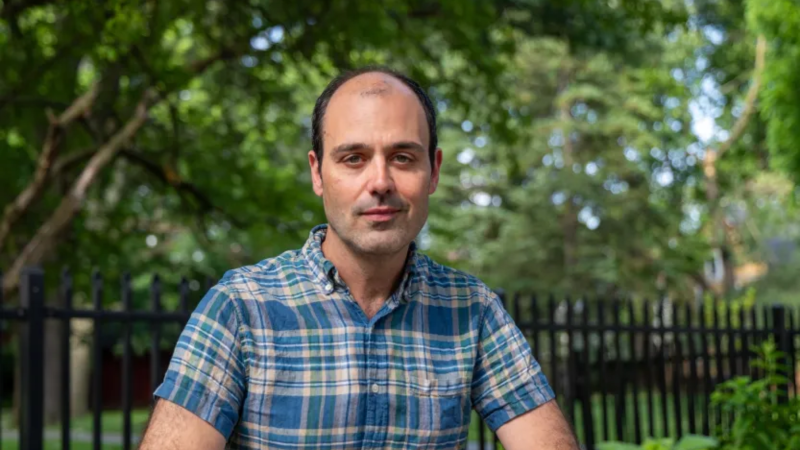
A Rochester, New York man sued the federal government Monday, accusing Homeland Security Investigations agents of violating his First Amendment rights after they tracked him down over an email he sent criticizing the leadership of US Immigration and Customs Enforcement (ICE).
On Monday, David Streever, a 45-year-old tech worker, filed the lawsuit in US District Court in Washington DC against Homeland Security Secretary Markwayne Mullin, acting ICE Director David Venturella, and five other federal officials, including three agents involved in the case. He is represented by the Foundation for Individual Rights and Expression (FIRE), a free speech advocacy group.
The case centers on a January email Streever sent to then-acting ICE Director Todd Lyons after federal agents fatally shot Renée Macklin Good and Alex Pretti in Minneapolis. Streever called Lyons a “monstrous human being” and predicted he would “go down in history as America’s Reinhard Heydrich, the butcher,” a reference to a Nazi official who helped orchestrate the Holocaust. He has said he wrote the email in a moment of anger and grief, never expecting anyone to read it, let alone act on it.
Five months later, HSI agents showed up at Streever’s Rochester home. He was out of the country on vacation with his 7-year-old daughter Helen. Two days after that, a third agent tracked him to a hotel near JFK Airport, hours after he landed, leaving a business card at the front desk. Neither Streever nor his wife had told anyone which hotel they were staying in.
The agents left a warning notice stating Streever “may be in violation of federal law” for threatening a federal official and instructing him to “discontinue” the conduct described.
Streever has refused to sign it.
Adam Steinbaugh, a senior attorney with FIRE, told NPR the email was clearly protected speech, not a threat. “A threat is a serious expression of an intent to commit unlawful violence. That’s not what this was at all,” he said. Steinbaugh added that Streever was “criticizing the director of ICE and appealing to his conscience.” Steinbaugh also said the five-month gap between the email and the agents’ visit undermines any claim it was treated as a credible threat.
Streever is not the only person federal agents have visited over similar posts. The two agents who went to his home also visited Paigelynne Gonyea, 40, a Syracuse poll worker, that same day, over a January Instagram post about the Minneapolis shooting. Gonyea has said the post referenced Jonathan Ross, the officer who shot and killed Good, using information already public at the time. DHS has said a different post attributed to Gonyea contained Ross’s home address, calling it evidence of “doxxing.” Gonyea has declined to sign the agency’s notice and told The New York Times she believes the warning “was done as an intimidation tactic.”
The New York Civil Liberties Union said in a statement to CNN that ICE was tracking down people like Streever and Gonyea “for no reason but to try to intimidate anyone speaking out against ICE’s rampant abuses.”
Other civil liberties groups describe a broader pattern. Nathan Freed Wessler of the ACLU told NPR the pattern reflects federal agents “knocking on people’s doors to ask them questions about clearly constitutionally protected speech.” In an interview with the same outlet, Jeramie Scott of the Electronic Privacy Information Center said the resources devoted to tracking Streever appeared “more geared towards intimidation than actually any type of reasonable use of law enforcement resources.”
DHS declined to comment on the specific allegations in the lawsuit, telling NPR that it “does not comment on any ongoing investigations” and later added, “Any allegation DHS and its components are attempting to ‘squash’ free speech is categorically FALSE,” The department has said it investigates “all credible threats” against ICE personnel, including threats to the ICE director.
In a statement released Monday by FIRE, Streever said the ordeal has left him shaken but more determined to keep speaking out. “I haven’t done anything wrong,” he told his daughter after explaining why federal agents might be looking for her father.