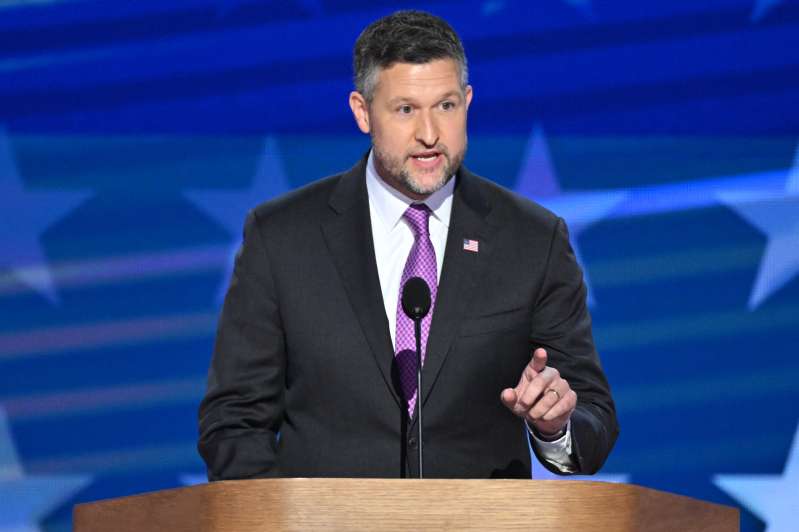
Rep. Pat Ryan (D-Hudson Valley) has a blunt message for constituents paying more because of President Donald Trump’s Iran war.
“It gives me no joy to say it, but what I say to them is, ‘You’ve been betrayed,’” Ryan told Courier New York, describing conversations with families across his rural 18th Congressional District who are paying more every time they fill up their tanks.
Gas prices have climbed 40% in the six months since the war began, according to Ryan, and families across the district have spent a combined $172 million more on gas, or roughly $646 per household. For a district where the average commute runs 40 minutes or longer, Ryan said, that cost is a daily reminder.
“It’s not just gas,” he said. “It’s fertilizers.” Much of the world’s fertilizer supply moves through the Strait of Hormuz, which has been disrupted since the war began, driving up costs for the district’s farms. Diesel prices, he added, are the highest they have ever been.
Why winter could get more expensive
The strain is about to deepen heading into winter. Heating oil, a fuel chemically similar to diesel that more than 4.7 million mostly Northeastern US households rely on, is up roughly 60% since the war began, according to The New York Times. In New York, the average price hit $6.14 a gallon the week of Sept. 14, up from $3.70 a year earlier, according to the state’s Energy Research and Development Authority. Large parts of NY-18, the district Ryan represents, fall outside the natural gas pipeline network that serves denser areas of the state, leaving many households dependent on oil heat as temperatures drop.
Ryan noted that roughly 30,000 of his constituents voted for both him and Trump in 2024. “They see through his lies,” he said. “They see that this war is a betrayal.”
Ryan’s opposition to the war has been consistent since it began. Politico reported in August that he had “fiercely opposed President Donald Trump’s decision to wage war in Iran” as part of a broader profile of his work on the House Armed Services Committee.
More than six months in, the war’s trajectory remains murky. Trump said this month he believes the US is “hopefully toward the end” of the conflict and claimed to have spoken directly with Iranian officials, according to Al Jazeera’s live coverage.
It’s worth weighing the president’s claims against his track record. Trump initially projected the war would last four to five weeks, according to PBS News, and a ceasefire memorandum of understanding he announced with Iran over the summer had collapsed by August, per Al Jazeera. All told, he has said the conflict was almost over at least 32 times, yet the war continues to rage.
Iran has sent conflicting signals of its own, with its foreign minister saying Tehran wants a diplomatic solution while a top security official has ruled out talks until its conditions are met. Direct U.S. strikes on Iranian territory have paused for more than a week, even as fighting has intensified in Yemen, according to military-tracking site GlobalSecurity.org.
The war has killed 18 U.S. service members and wounded hundreds more. It has cost the U.S. government roughly $38 billion directly, while consumer energy price spikes have added more than $100 billion in extra costs.
Ryan called the administration’s optimism a sign of insulation from the war’s toll. “Every once in a while, the mask slips off,” he said.
An Iraq War veteran, Ryan has cosponsored and voted for War Powers Resolutions six times to try to end the war. The House has passed three of those, though none have become law. A War Powers Resolution directing the president to end an ongoing conflict passing through either chamber is rare. It has happened only a handful of times in American history. Ryan has also introduced the No Funds for Iran War Act, which would block additional Pentagon funding for the conflict without formal congressional authorization. Republicans have not brought his funding bill to a floor vote.
“Don’t agonize—organize,” Ryan said, describing what he sees as the path forward. “This is a moment where we really have to be the broadest possible anti-war coalition.”
Who is going to win NY-18?
Ryan is seeking a third full term this November against Republican challenger Jackie Auringer, a Kingston native who helps lead her family’s construction firm, Urban Precast. Auringer has said her campaign centers on the cost of living, arguing that “when heating your home, fueling your car, or keeping the lights on becomes more expensive, everything else follows.”
She has also directly criticized Ryan’s approach to calling for the end of the war, despite arguing it should end. After Ryan confronted then-Defense Secretary Pete Hegseth at an April House Armed Services Committee hearing over the deaths of six soldiers and called for his resignation, Auringer accused Ryan of “partisan rhetoric,” saying “this is a moment for seriousness, not political theater,” though she said ending the war “will help stabilize global energy markets, bring down gas prices, and ease the financial pressure facing families across the Hudson Valley,” per the Daily Freeman.
A Ryan campaign spokesperson responded at the time that “it’s more important than ever for members of Congress to ask the hard questions of this administration.”
Two months later, responding to a ceasefire framework that ultimately collapsed, Auringer said she had “serious reservations” about the war from the start and that Americans had “paid for this conflict in lives, taxpayer dollars, and higher prices at the pump.”
As of mid-September, City & State’s prediction market gave Ryan a 92% chance of winning reelection to Auringer’s 8%, reflecting the Democratic lean of a district that has nonetheless produced several close races in recent cycles.