For more than 50 years, the Spofford Juvenile Detention Center cast a shadow over Hunts Point.
Plagued by allegations of abuse and staff misconduct, it became the most notorious youth jail in New York City before advocates forced its closure in 2011. The building came down. The block sat. And the neighborhood, one of the most food-insecure in the country, kept waiting.
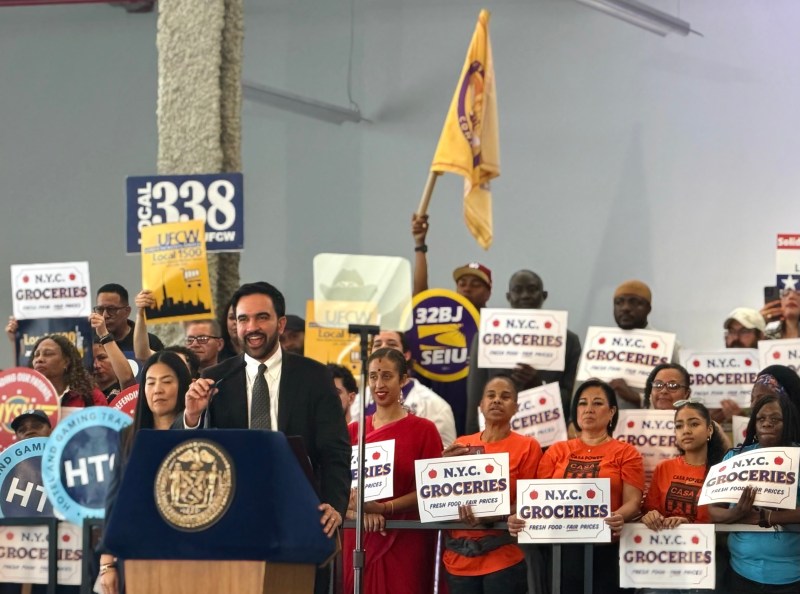
On Monday, New York City Mayor Zohran Mamdani announced that the Bronx site will become the home of NYC Grocery, the city’s first publicly operated grocery chain.
The 20,000-square-foot store is slated to open in 2027 at The Peninsula, a 740-unit affordable housing development now rising on the former Spofford site in Hunts Point. It is the first of five planned city-run stores, one per borough. Mamdani had previously announced a Manhattan location at La Marqueta in East Harlem, slated for 2029; the Bronx store will beat it to opening.
Mamdani did not shy away from the site’s history.
“This was a place of failure, where young, predominantly low-income New Yorkers were subjected to brutal physical conditions, human rights violations, and physical abuse,” he said at a press conference at the former Spofford site on Monday. “We are reclaiming that same site to tell a very different story.”
“Today, we are transforming a site once associated with pain, and trauma, and mass incarceration into a place that is rooted in community, in healing, in building, in opportunity, and community care,” Bronx Borough President Vanessa L. Gibson said.
A neighborhood the market left behind
The need in Hunts Point is hard to overstate. The neighborhood is home to 15,000 residents and has just one full-service supermarket within a quarter mile. The poverty rate sits at 36%, double the citywide rate. More than half of households relied on public assistance in the past year, according to Mamdani’s office. All of this exists in the shadow of one of the largest food distribution hubs in the world, which supplies the city with a quarter of its fresh produce, more than a third of its meat, and nearly half of its fish.
“Access to affordable, high-quality, and healthy food is a basic human right,” Gibson added. “Yet the cost of groceries continues to put healthy meals out of reach for far too many of our families across this borough.”
Mamdani framed the project as proof that government belongs in this fight, not just as a regulator or funder, but as an operator. He invoked Ronald Reagan’s famous quip that the nine most terrifying words in the English language are “I’m from the government, and I’m here to help.”
“I disagree,” Mamdani said. “I think nine more terrifying words are actually: ‘I worked all day and can’t feed my family.’”
The city plans to waive rent and taxes for all five stores so they can offer discounted prices, and has requested $70 million in capital funding from the City Council. The stores would require Council approval.
Organized labor turned out in force to support Mamdani’s announcement: the Service Employees International Union (SEIU), UNITE HERE Local 100, the Hotel Trades Council (HTC), the Retail, Wholesale and Department Store Union (RWDSU), Local 338 RWDSU, and the United Food and Commercial Workers (UFCW) Locals 1500 and 1342 were all represented at the press conference.
Mamdani called union density “the most effective tool at combating that inequality” and cast the city-run grocery store as government joining that fight directly. The store will create union jobs for local residents, Gibson added.
The opposition
Not everyone is on board. A coalition of small business owners and independent supermarket operators has been pushing back, arguing city-owned stores will undercut private competitors, the New York Times reported.
Frank Garcia, chairman of the Multicultural Business Coalition, is trying to raise $1 million to fight the plan and has not ruled out a lawsuit. A rally is planned at City Hall on May 29th, when the City Council is expected to hold a hearing on the Economic Development Corporation (EDC), which is overseeing the stores. City Council Speaker Julie Menin has stopped short of backing the plan, with her office saying she looks forward to “assessing its potential impacts on consumers and local small businesses, including bodegas.”
Maria Torres, president of the Point Community Development Corporation, said the store reflects years of community input. Neighbors “consistently requested a healthy foods supermarket” as part of the Peninsula planning process.
“The South Bronx deserves better,” Gibson said. “We are going to get better, and we’re going to keep raising the standards of what living, and affordability, and safety, and access to healthy food is all about.”
Three more city-owned grocery stores, in Brooklyn, Queens, and Staten Island, are still in the site selection phase.