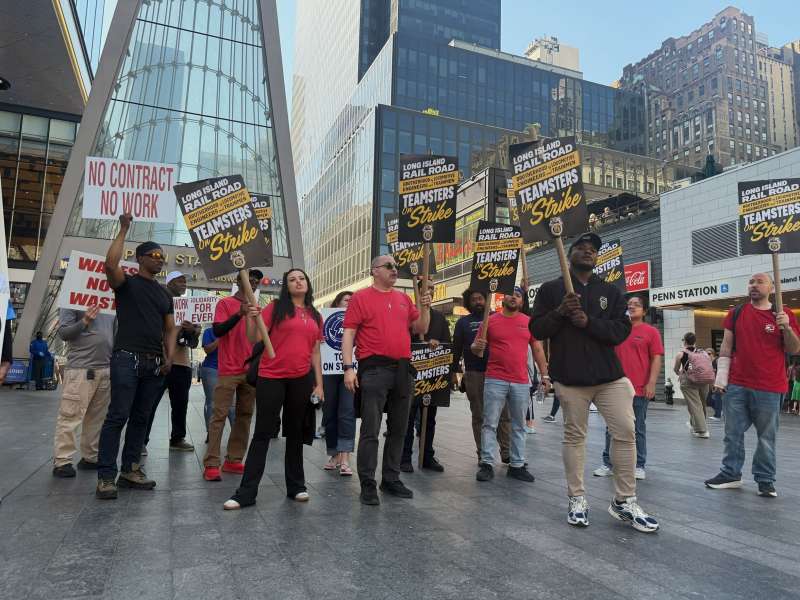
Early Saturday morning, 3,500 Long Island Rail Road workers walked off the job for the first time since 1994 in a strike that has halted service for nearly 300,000 daily commuters and thrown the region’s transit system into chaos.
As of Monday, the strike has entered its third day—though both sides have returned to the bargaining table.
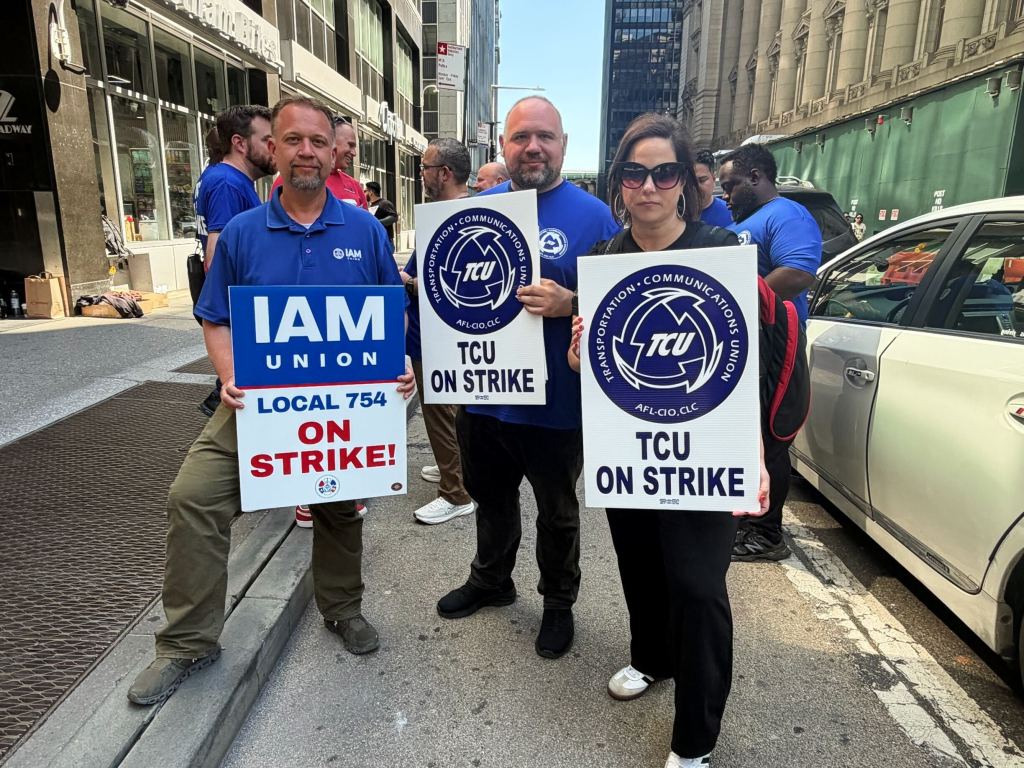
The strike, which began at 12:01 a.m., unites five unions under a single bargaining coalition: the Brotherhood of Railroad Signalmen (BRS), the Brotherhood of Locomotive Engineers and Trainmen (BLET), the Transportation Communications Union (TCU), the Brotherhood of Railroad Carmen (BRC), and the International Association of Sheet Metal, Air, Rail and Transportation Workers (SMART).
At the heart of the dispute is wages. Members of the five unions earned an average of $136,000 in cash compensation in 2025, according to MTA figures, but workers say those numbers are inflated by overtime and penalty pay, and that they have not received a raise since 2022, even as the cost of living in the New York region has surged.
The unions sought a retroactive 9.5% pay increase covering the last three years—the same deal the MTA recently offered several other transit unions—plus a 5% raise for 2026. Both sides had agreed on the retroactive piece; talks collapsed over that final year. The MTA countered with 3% for 2026 plus a lump-sum payment. By Friday afternoon, the two sides were roughly one percentage point apart. They still couldn’t close the gap, according to the Times.
Workers say the strike was years in the making, and thus, inevitable.
“We never really had a fair partner at the table,” Michael Sullivan, general chairman of the Brotherhood of Railroad Signalmen and the coalition’s lead negotiator, told Courier New York. “That’s why it dragged out for three years.”
Ian Parfrey, a locomotive engineer and 12-year Teamsters member, put the wage fight plainly.
“We started with an ask of four years and 16%,” he said. “We’ve come down to somewhere around 14 to 14 and a half, which were the emergency board recommendations. The MTA has been consistent in offering much less and demanding givebacks.”
The coalition twice requested Presidential Emergency Boards—panels of neutral arbitrators convened under the Railway Labor Act of 1926—to assess the dispute. Both times, the boards sided with the unions. The MTA was not bound by those recommendations and ignored them.
Sullivan said that pattern has become a feature of how management negotiates.
“When they win and we lose, they say, ‘You lost. Take your medicine,’” he said. “We win, they say, ‘It doesn’t count.’”
The MTA also pushed to eliminate certain work rules that can lead to extra pay, with the unions opposing such changes. According to the Times, one such rule requires that an engineer who switches from a diesel to an electric train mid-shift be compensated with two days’ pay; switching from passenger service to yard duty on the same day triggers a third. The MTA said those penalty payments added nearly 15% to the average engineer’s compensation in 2024.
Sullivan also pointed to concessions workers made during the pandemic as context for why they’re drawing a hard line now.
“We took some hits to do a favor to the company during COVID to keep the trains moving,” he told News 12. “We took some low deals with kind of a promise that in the future they would take care of us.”
James Ridley, a signalman and local chairman with BRS Local 56, said the MTA’s conduct at the bargaining table told its own story.
“What they tell the public is one thing, what they tell us is another thing,” he said. “When they come in the room, it’s a totally different organization.”
Matt Hollis, a 42-year-old TCU member, said the timeline speaks for itself. “We’ve been in negotiations close to four years with the MTA and Long Island Railroad,” he said. “We have exhausted the process under the Railway Labor Act.”
For many on the picket line, this is their first strike. For Sullivan, it is the culmination of a life spent in the labor movement. Raised in a union household, he remembers his father sitting him down at age 10 during an 11-day walkout.
“It’s been the honor of my life,” he said.
Hochul sides with the MTA, calls them back to the table
Workers were critical of Gov. Kathy Hochul, whose statement in response to the strike landed badly on the picket lines. Rather than calling on the MTA to return to the table, Hochul called the unions’ decision “reckless,” claiming their demands could raise fares by as much as 8% and risk tax hikes for Long Islanders.
She also blamed the Trump administration for cutting mediation short—though it was the unions themselves who twice requested the federal review panels that delayed a strike.
Hochul placed blame squarely on union leadership, saying, “Commuters are dealing with unnecessary dysfunction and thousands of union LIRR workers are being forced to go without a paycheck because of decisions made by a small group of union leaders.”
Ridley was direct. “I don’t think she has done enough,” he said. “I don’t think she’s concerned about our wellbeing and our families.”
Parfrey, who said he hadn’t read Hochul’s statement, was blunt: “If she had wanted to keep the trains running today, she could have put herself a little more forward in this process.”
By Sunday, Hochul had shifted her tone somewhat, extending what she called an “official invitation” for union leaders to return to the bargaining table and saying she believes a deal can still be reached. The National Mediation Board has since summoned both sides to a meeting in Manhattan to resume bargaining, The City reported.
The MTA did not respond to Courier New York’s request for comment.
Life on Long Island grinds to a halt
The LIRR is the busiest commuter railroad in North America, carrying roughly 270,000 passengers on a typical weekday. The impacts are already being felt across the region. For workers, Monday’s rush hour is the real test.
“Those [people] will be static,” Ridley said. “Some people will not be able to get to work. There are graduations people will find hard to attend. You will have gridlock. The MTA needs to understand—we’re not hurting the public. The MTA is hurting the public.”
The state comptroller’s office estimated the strike could cost the region $61 million a day in lost economic activity, according to the Times. The Long Island Association put that figure even higher, at $70 million daily.
The MTA has put together a limited contingency plan: free weekday shuttle buses will run during peak hours between six Long Island stations and two Queens subway stops—Howard Beach on the A line and Jamaica-179th Street on the F line. NICE Bus is also adding service on routes connecting to major transit hubs in Nassau County. But officials have been blunt that none of it comes close to replacing full rail service.
“These alternatives are not business as usual,” Hochul said Sunday.
Sullivan said the path forward is simple and entirely in the MTA’s hands: “They have my number,” he said. “They can invite me in and get a deal done.”