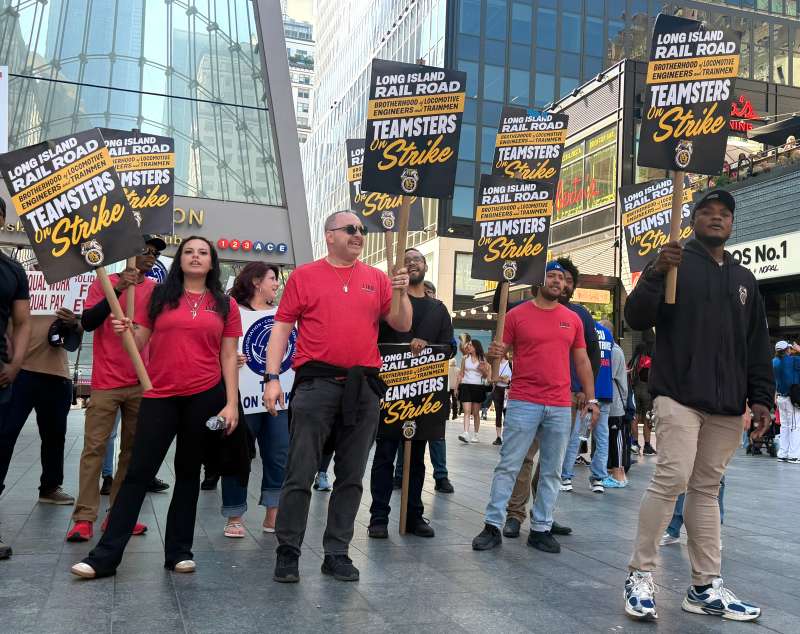
After three days on the picket line, Long Island Rail Road workers are heading back to work.
Gov. Kathy Hochul announced Monday evening that the MTA and the five striking unions had reached a tentative agreement, ending a historic work stoppage that brought the nation’s busiest commuter railroad to a standstill for the first time since 1994. Phased service is set to resume Tuesday at noon.
“Tonight, the MTA reached a fair deal with the five LIRR unions that delivers raises for workers while protecting riders and taxpayers,” Hochul said.
The full terms of the agreement have not been officially released. But according to Presidential Emergency Board (PEB) 254—which sided with workers and selected the unions’ final offer as the most reasonable—the deal is expected to include wage increases of 3% in each of the first two years, 3.5% in the third year, and 5% in the fourth year, as well as a $3,000 lump sum payment, and full retroactive pay.
Those were the same terms a federal board had recommended seven months earlier. The MTA declined to accept them—setting the stage for a strike.
The deal still needs to be ratified by rank-and-file members of all five unions. If rejected, the strike could resume.
The strike, which began at 12:01 a.m. Saturday, united five unions representing 3,500 workers—the Brotherhood of Railroad Signalmen (BRS), the Brotherhood of Locomotive Engineers and Trainmen (BLET), the Transportation Communications Union (TCU), the Brotherhood of Railroad Carmen (BRC), and the International Association of Sheet Metal, Air, Rail and Transportation Workers (SMART).
At its core, the dispute was over wages. Members of the five unions earned an average of $136,000 in cash compensation in 2025, according to MTA figures, but workers said they had not received a raise since 2022, even as the cost of living in the New York region had surged.
Two Presidential Emergency Boards sided with the unions during negotiations. The MTA ignored both.
The three-day stoppage is estimated to have cost the region between $61 million and $70 million per day in lost economic activity, according to the state comptroller’s office and the Long Island Association.
“Why did we have to strike to get it?” Ian Parfrey, a locomotive engineer and Teamsters member who picketed outside Penn Station Saturday, told Courier New York. “The MTA wouldn’t do it then.”