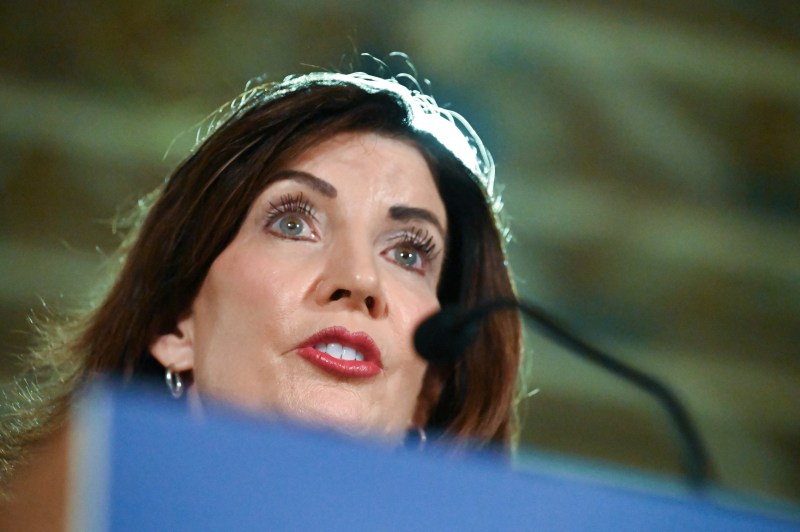
Gov. Kathy Hochul declared Thursday that New York lawmakers had reached a “general agreement” on a $268 billion Fiscal Year 2027 state budget, more than five weeks after the April 1 deadline.
Hochul said the deal delivers on affordability, pointing to major investments in child care, energy relief, immigration protections, and auto insurance reform.
“This budget includes sweeping changes to lower costs, enhance public safety, protect our communities from federal overreach and invest in the future of New York families,” Hochul said.
But the announcement was almost immediately disputed by one of Albany’s most powerful figures.
“There’s no budget deal,” Assembly Speaker Carl Heastie (D-Bronx) told reporters at the state Capitol shortly after Hochul’s announcement.
He said nearly 50 items remain unresolved, including the $268 billion total itself, and that Hochul had spoken “very prematurely.”
“Even on the policies that she put out there today, some of these things are still incomplete,” Heastie said. “We don’t even have final language on [the Climate Leadership and Community Protection Act].”
The CLCPA dispute has been one of the thorniest sticking points in negotiations. Hochul has pushed to roll back the law’s 2030 emissions targets, citing potential costs to ratepayers—a move environmental groups and a significant bloc of Democratic lawmakers have fiercely opposed.
If passed next week as expected, it would be the most delayed New York state budget since 2010, per Gothamist.
What’s in the deal
The budget includes several significant investments Hochul says will lower costs for working New Yorkers.
The state will commit $4.5 billion total to childcare and pre-K services, including free childcare capped at $15 a week for most families and funding to make universal pre-K available to all four-year-olds statewide by the 2028-29 school year.
On housing, the budget includes $250 million in affordable housing capital and SEQRA (State Environmental Quality Review Act) reforms to speed up construction by exempting certain projects from lengthy environmental review. A pied-à-terre tax on second homes worth $5 million or more is expected to generate $500 million annually to help close NYC’s estimated $5.4 billion budget deficit, per the New York Times—though Hochul admitted leaders still need “four or five more days” to release implementation details.
The budget also includes a one-time $1 billion energy rebate for utility-paying households, auto insurance reforms aimed at lowering premiums, an elimination of state income tax on tipped wages up to $25,000, and $1.5 billion in additional aid to New York City to help close its budget deficit.
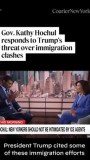
On immigration, the deal bans 287(g) cooperation agreements with ICE—formal partnerships that allow local law enforcement entities to peform specific immigration enforcement functions—and bars federal agents from entering schools, hospitals, and other sensitive locations without a judicial warrant.
Hochul’s climate retreat
The deal’s most consequential element may be its rollback of the state’s landmark 2019 Climate Leadership and Community Protection Act. The agreement pushes the state’s 2030 emissions target to a new 2040 interim goal—a 60% reduction from 1990 levels—with a 2028 deadline to implement necessary regulations, per City & State. A separate 85% reduction target by 2050 remains in place.
Hochul defended the move on affordability grounds, arguing the changes were necessary to avert a court-ordered timeline that she said would have driven energy costs even higher for New Yorkers.
“New York has led and will continue to lead on clean energy and climate. But reality is harsh,” she said Thursday at the state Capitol. “We cannot meet the current timelines without driving energy costs higher.”
The budget also increases the share of climate investment funding directed toward disadvantaged communities from 35% to 40%, according to a source with knowledge of the matter.
“This is what leadership looks like when you’re the one person in the state who looks at the reality of the world as it is,” Hochul said Thursday, when pressed by reporters on whether the rollback constituted a retreat from the state’s climate commitments.
Environmental groups pushed back hard, questioning whether Hochul even had legislative buy-in, given Heastie’s acknowledgment that CLCPA language isn’t finalized.
NY Renews executive director Stephan Edel called the announcement “an end-run around the people of New York and the State Legislature,” saying Hochul is attempting to make “profound, harmful changes to the trajectory of New York’s climate future behind closed doors, without public input.”
What else is missing
Beyond the climate rollback, advocates say the budget is notable for what it does not address.
The budget does not include any movement on tenant protections, good cause eviction, or rent stabilization. And with the Trump administration slashing federal Medicaid funding by $1 trillion, roughly 450,000 New Yorkers are set to lose healthcare coverage. The state budget offers no visible response.
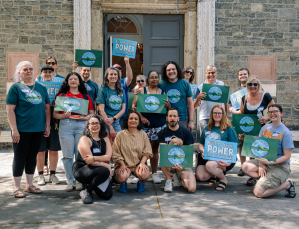
“We have yet to see details on how New York will close the budget gaps of cities across the state, raise progressive revenue, or stop New Yorkers from losing their healthcare coverage,” Working Families Party director Jasmine Gripper said in a statement shared with Courier New York.
Without state resources to compensate for federal spending cuts, everyday services are on the chopping block.
Hochul has previously acknowledged the limits of what the state can do. “No state can fully undo the damage in this bill or backfill cuts of this scale,” she said last summer.
Nevertheless, advocates say the budget doesn’t go far enough even within those constraints.
“If our kids are not gonna have jobs in the summer… our libraries won’t open on Saturdays. People will start missing their rent payments. People will go hungry. This is life and death for everyday New Yorkers,” Rob Solano, founder of Churches United for Fair Housing (CUFFH), said.
Gripper noted that revenue negotiations remain open, urging the Legislature to keep pushing for higher taxes on the rich to fund services. “This fight is not over,” she said.
“Hochul is trying to shove a deal down our throats with no new taxes on the rich besides the pied-à-terre tax, which only fills 10% of NYC’s deficit,” added Gustavo Gordillo, co-chair of NYC-DSA, in a statement.
A deliberate delay, some say
For advocates who spent months organizing around the budget, the five-week wait hasn’t only been frustrating.
“It feels intentional,” Solano told Courier New York. “The delay was intentional, to not give us enough time to mobilize between May and June, where we could have had all of April to mobilize around these campaigns.”
Good government group Reinvent Albany offered a structural explanation for why that might be.
“As long as the Governor does not pay a price with the public, late budgets increase her power and reduce the Legislature’s,” the group said in a statement.
The group noted that this year’s delay means the regular legislative session will be about half as long as originally scheduled—shrinking the window for public input and rank-and-file lawmakers to have a say.
The delay comes at a time when Hochul’s political standing has become more precarious. A Siena College Research Institute poll of 806 New York State voters released this week showed Hochul’s favorability at 41% positive and 46% negative, with job approval at 48% approving and 44% disapproving—her lowest ratings in a year.
The fight is not over, nor is the budget
Hochul’s office and legislative staff will now work to translate the agreement into nine separate bills for a vote, expected as soon as next week. But with Heastie sending rank-and-file members away from the Capitol on Thursday, that timeline is uncertain.
Hochul, for her part, seemed unbothered by the gaps.
“Lot of details I didn’t mention,” she told reporters Thursday. “It’s going to give you guys plenty of stories to write for the next few weeks.”
The Governor’s office did not respond to Courier New York’s request for comment by press time.