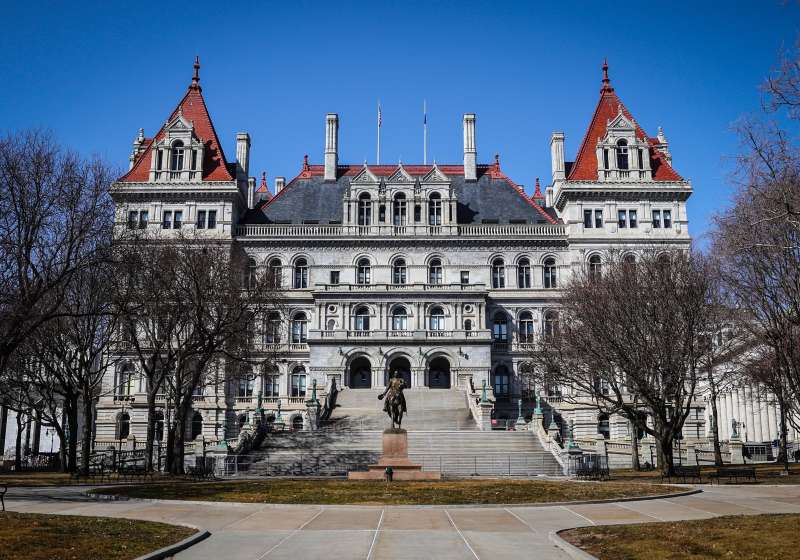
Four survivors of Jeffrey Epstein’s sex trafficking ring testified before the New York State Senate Codes Committee on Monday, and when they were done, lawmakers acted.
The committee advanced three bills that would establish new crimes for those who benefit from sex trafficking, allow survivors to sue the estates of deceased abusers for punitive damages, and make it easier for traumatized witnesses to testify without facing their accused abuser in court.
The hearing, chaired by state Senator Zellnor Myrie (D-Brooklyn), featured testimony from Carine Silva De Deus, Lara Blume McGee, Alexandra Golematis and Glendys Espinal, as well as Kathryn Robb, director of the Children’s Justice Campaign at Enough Abuse. It marked the first time Epstein survivors have spoken publicly before any state legislative body, according to a statement from Myrie’s office.
“I want my story today to not just be about what happened to me, but about something bigger and brighter, bringing light, justice and protection to others,” De Deus testified.
The centerpiece of the package is S.9960, the Trafficking Survivor Recovery and Accountability Act, introduced by Myrie. The bill would allow survivors to seek punitive damages from the estates of deceased abusers, sue their accomplices directly, extend the statute of limitations for victims, and establish new crimes for those who benefit from sex trafficking ventures.
The committee also advanced S.4406, introduced by Senator Rachel May (D-Syracuse), which would allow vulnerable sexual assault witnesses to testify via closed-circuit television, and S.6460-A, introduced by Senator Cordell Cleare (D-Manhattan), which would establish new crimes of sex trafficking of a vulnerable person and predatory sex trafficking.
“The Trafficking Survivor Recovery and Accountability Act, along with the other bills we advanced today, would provide important new tools for ensuring justice is served,” Myrie said in a news release. “I’m grateful for the brave survivors who spoke so powerfully today, and make this promise: New York will always have your back.”
Under current New York law, victims cannot seek punitive damages from a deceased person’s estate, the New York Times reported. S.9960 would also create a one-year lookback window for survivors to file civil claims outside the statute of limitations, similar to the Adult Survivors Act of 2022, which generated more than 3,000 lawsuits.
Epstein’s estate is valued at roughly $120 million, according to the Times, though advocates say that figure may be an undercount.
Winning punitive damages would not be automatic. Andrew Finkelstein, president of the New York State Trial Lawyers Association, noted that plaintiffs would still need to clear a high evidentiary bar.
“In New York, punitive damages are available in only exceptional cases,” he told the Times.
May said her bill was inspired by a case in Syracuse where a survivor was cross-examined by her accused abuser.
“Far too often, our system fails survivors, especially in court, where they may be forced to face the person who harmed them,” she said in Myrie’s news release. “It will help protect vulnerable survivors by allowing remote testimony in certain cases, giving them a path to justice without forcing them to go through additional trauma.”
Voices in the chamber
De Deus, now 42, said she was 17 and working as a masseuse when Epstein abused her. She testified before the New York City Council last year in support of a bill that would create a lookback window under the city’s Gender-Motivated Violence Act.
After the Council passed it, she sued the executors of Epstein’s estate, whose lawyers argued in court that only the state could implement such a statute. Monday’s Albany hearing was a direct outgrowth of that fight.
“It is still very hard to talk about, but I’m starting,” De Deus said in a recent interview with the Times.
McGee, a nonprofit executive based in Little Rock, Ark., began speaking publicly late last year about being groomed by Ghislaine Maxwell before Epstein abused her. She said she was an aspiring model in New York City when Maxwell brought her to his home.
“The second time I met him is when the abuse started,” she told The Times.
Jordan Merson, De Deus’ lawyer, said the legislation would help close a loophole that has worked in the estate’s favor. “It is not right that the Epstein estate and his enablers hide behind arguments around the statute of limitations and benefit from the fact it can take survivors a long time to come forward,” he told the Times.
Ahead of Monday’s hearing, McGee wrote on social media that silence was no longer an option. “We’re not just survivors; we’re warriors ready to shake the foundations of a broken system,” she said.
For more on Jeffrey Epstein and the broader cover-up, read The Cover-Up, Courier Newsroom’s investigation into the Epstein network inside and outside of government.