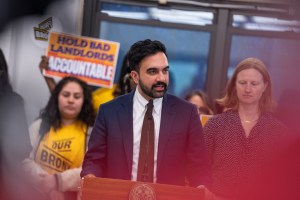
On the morning Brad Lander’s federal trial was supposed to begin before it was postponed, he showed up to 26 Federal Plaza anyway—to protect immigrants from ICE.
The former New York City Comptroller and congressional candidate in New York’s 10th congressional district had been preparing for months for his federal trial, originally scheduled for Monday. When prosecutors requested a postponement—to add a new witness whose name had not appeared on the government’s witness list—Lander’s calendar suddenly cleared.
He filled it the way he has filled most weeks over the past year: court-watching at the same Lower Manhattan federal building where he was arrested last fall.
As part of this effort, Lander and other volunteers have shown up to immigration proceedings to accompany immigrants, deter ICE agents from detaining them at the courthouse immediately after their immigration hearings, and connecting them to lawyers if they’re taken into custody.
“Today was supposed to be my trial,” Lander told Courier New York outside 26 Federal Plaza Monday morning. “But when my calendar got freed up, I thought it would be a good day to come back here and be one of the volunteers.”
The group started at 26 Federal Plaza before getting word that ICE agents had been spotted in the waiting room at 290 Broadway, the nearby immigration court building, and moved there. Inside 290 Broadway, volunteers from organizations including New Sanctuary Coalition fanned out to accompany immigrants through their proceedings—a tactic designed to deter ICE agents, who have spent the past year detaining people at the courthouse immediately after their hearings. The practice is technically legal, according to Peter Melck Kuttel, a detention specialist at St. Peter’s Church.
At one point, ICE agents gathered in the reception area near a man from Mauritania whose case Lander’s group was monitoring. The agents eventually left without detaining the man. His hearing, however, could not proceed: the court had no interpreter available for him. His case was rescheduled to July 20.
Perhaps the most crucial component of court-watching is connecting immigrants with attorneys.
The stakes for those without support are high. Among non-detained immigrants in deportation proceedings, 60% of those with lawyers win their cases—compared to just 17% of those without, according to the Vera Institute.
“In some cases, they get abducted,” Lander said of immigrants navigating the system without support. “Unless someone makes contact with them, gets to know them a little, gets their information—they can help them connect to a lawyer.”
A year of bearing witness
Lander said he started coming to 26 Federal Plaza last June, after hearing about Dylan Contreras, a Bronx high school student who was detained and spent nine months in ICE custody for, as Lander put it, “having done absolutely nothing wrong.”
What Lander has witnessed since has hardened his resolve. He described a woman who was eight months pregnant and whose husband was seized by ICE agents as they arrived for a court hearing. Their baby was born while he was in detention. He also described a teenager seeking Special Immigrant Juvenile status who arrived at court with his lawyer and left without him, spending months in custody before being released.
“To watch family separations and abductions by your own government of people who are doing exactly the right thing—showing up at their court hearing and explaining why they fear persecution,” Lander said. “It’s really enraging.”
He also pointed to a recent legal development he said vindicates the court-watchers’ concerns: in March, the US Attorney for the Southern District had to write a letter to a federal judge acknowledging that the memo ICE had used to justify courthouse arrests “does not and has never applied to immigration court.” More than a thousand people in New York alone had been swept up under that authority, according to ICE data.
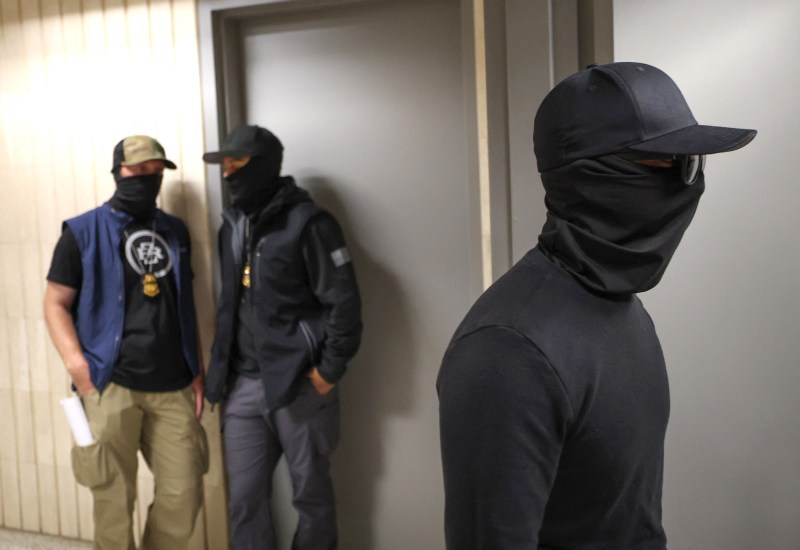
“Courts are supposed to be a place of sanctuary,” Lander said. “Why are they wearing masks in our courts? They’re agents of the federal government. They don’t wear badges. They don’t identify themselves. They don’t have judicial warrants.”
ICE agents do carry Form I-200 administrative warrants, but those are issued by ICE officials, not a judge or magistrate.
Choosing trial
Lander’s September arrest came after he arrived at 26 Federal Plaza with roughly 100 New Yorkers and nearly a dozen fellow elected officials to demand access to a makeshift detention facility on the building’s 10th floor.
Video obtained by The City showed men lying on foil blankets on the floor of a room with no furniture, sharing two toilets separated from their sleeping area by a waist-high wall. When Lander and the other lawmakers arrived, federal agents blocked the elevators. Lander and his peers were arrested on Class C federal misdemeanor charges of unreasonably obstructing use of a federal building.
Every other elected official arrested that day accepted a deal to have the charges dismissed. Lander refused. He said he didn’t believe he had done anything wrong, and that going to trial was the only way to force a public accounting of what ICE had been doing on that floor.
“The crime was not us trying to see the 10th floor detention facilities,” he said Monday. “The crimes are what ICE is doing.”
That trial is now scheduled for early June, just weeks before the June 23 Democratic primary in New York’s 10th Congressional District, where Lander is challenging incumbent Democrat Dan Goldman.
Lander drew a pointed contrast with his opponent: he traveled to Minneapolis after federal immigration agents killed Alex Pretti and Renée Nicole Good. Goldman did not make the trip.
“I would characterize his oversight function as strongly worded letters,” Lander said. “My oversight function is: show up with 100 of your neighbors, bear witness, accompany people, demand access. Stay until they give it to you—or they arrest you.”