Republican gubernatorial nominee Bruce Blakeman is standing by an AI-generated video attacking Gov. Kathy Hochul (D), calling it satire even as it draws renewed scrutiny under a 2024 state law meant to curb deceptive political ads. That law, nearly two years after it took effect, has never been tested in a New York courtroom.
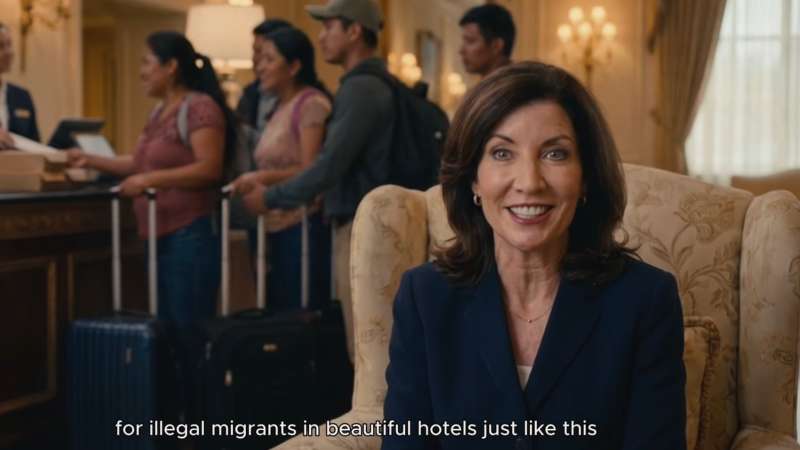
The digital ad uses a computer-generated likeness of Hochul to make it appear she is boasting about raising taxes, ending cash bail, providing “luxury accommodations” for undocumented immigrants, and making it too expensive for New Yorkers to drive or ride the subway.
The ad leans on ugly stereotypes to make its point. In one scene, an AI-generated Latino man offers the fabricated Hochul crack outside a police precinct as she credits her policies with ending cash bail, invoking the decades-old trope linking people of color to drug-related crimes. In another, she sits in a gilded hotel lobby crediting her administration with giving undocumented immigrants “luxury accommodations,” as AI-rendered migrants check in behind her with their luggage.
The ad does carry a disclaimer that states “This video includes AI-generated imagery,” although it appears only once, at the end of the minute-long spot, with small text, and uses different wording than the 2024 law specifies, which calls for videos to state “This video has been manipulated.”
In an interview on PIX11, Blakeman told anchor Dan Mannarino that AI is simply one tool in his campaign’s arsenal. “AI is very good at producing things that people want to watch, entertaining videos on important political issues,” he said. “Sometimes we use humor and satire, which has been used in politics since George Washington.”
Asked about putting fabricated words in Hochul’s mouth, Blakeman told Spectrum New NY1, “everybody knows that’s AI” and argued the practice is fine as long as the underlying political claims are accurate.
The Hochul campaign shot back, branding Blakeman “Bruce (Deep) Fakeman.”
“Sure, his name is on the ballot. But his grassroots support? Fake. His campaign ads? Fake. His claims about public safety in Nassau on his watch? Fake,” a campaign email said. “Unlike Bruce, we don’t need to make anything up.”
This is not the first Blakeman AI ad to draw fire. In May, his campaign posted a South Park-style video putting AI-cloned voices of Hochul and New York City Mayor Zohran Mamdani (D) in the mouths of a fictionalized town hall over green energy mandates. That video initially ran without a disclaimer; Blakeman’s campaign added one after City & State asked about it, while maintaining the satire exception in state law meant no disclaimer was legally required.
Blakeman is also not the only Republican using AI to needle Hochul. In May, President Donald Trump posted an AI-generated image on Truth Social showing himself dunking a basketball on Hochul, captioned “New York’s failed Governor who, if people are smart, will vote for Bruce Blakeman.”
An untested law
New York’s 2024 update to state election law requires a disclaimer on “materially deceptive media”—including AI-manipulated audio, video, or images of a candidate—with an exemption for parody or satire.
The closest test came in Oct. 2025, when Andrew Cuomo’s mayoral campaign posted an AI-generated ad depicting Mamdani releasing “criminals” from jail. The good-government group Common Cause NY said the ad violated the law and called for it to be enjoined.
Cuomo’s campaign deleted the ad minutes after posting it, and no court filing followed. Election attorney Sarah Steiner has said simply labeling something satire does not settle the question if an average viewer could mistake it for real footage.
“If you have to be that discerning to understand that it isn’t real, forget whether we’re calling it satire or not, that’s misleading,” Steiner told City & State in May. It would take a legal challenge for a judge to rule on whether either Blakeman video violates the law.
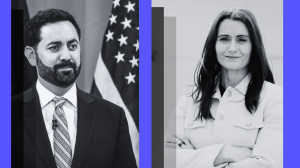
The legislative approach to the use of AI in politics is still moving. State lawmakers passed a broader measure, the Stop Deepfakes Act, sponsored by Assemblymember Alex Bores (D-Manhattan) and Sen. Andrew Gounardes (D-Brooklyn), which would require AI content creators to embed origin data in synthetic media. It cleared both chambers in early June and now awaits Hochul’s signature, which she has until Dec. 31 to provide. If she signs it, it will take 180 days to go into effect.
A tougher, Hochul-backed proposal that would have barred campaigns from using non-consensual AI images of candidates in the 90 days before an election did not advance this session, after civil liberties advocates—including former ACLU President Nadine Strossen, who called it “blatantly unconstitutional”—argued it violated the First Amendment, a claim bolstered when a federal court struck down a similar Hawaii law on free-speech grounds.
Blakeman’s campaign did not immediately respond to Courier New York’s request for comment.