An estimated 450,000 New Yorkers lost their health insurance Wednesday. Advocates warn it is only the first cut.
The coverage in question is the Essential Plan, a state program created to fill a gap in the American healthcare system. Medicaid, the federal-state insurance program for the poorest New Yorkers, covers those earning below $21,000 annually for a single adult. Private insurance, even with federal subsidies, remains out of reach for millions more.
The coverage in question is the Essential Plan, a state program created to fill a gap in the American healthcare system. Medicaid, the federal-state insurance program for the poorest New Yorkers, covers those earning below $21,000 annually for a single adult. Private insurance, even with federal subsidies, remains out of reach for millions more.
The Essential Plan was designed for the people caught in between: New Yorkers earning between $31,920 and $39,900 a year for a single-person household, too much to qualify for Medicaid, not enough to afford private coverage. It provided comprehensive health insurance with no monthly premiums and no deductibles.
DACA recipients earning above 138% of the federal poverty level—roughly $22,000 a year for a single adult—are also losing access to any NY State of Health program as of today, with limited exceptions for those who are pregnant or recently gave birth.
In 2024, New York expanded the program to cover that income band through federal funding. President Trump’s One Big Beautiful Bill Act eliminated it.
The state was left with no choice but to end coverage for those 450,000 New Yorkers, effective today. And it will get worse. H.R. 1’s rollbacks do not stop at the Essential Plan. Under its rolling provisions, an estimated 1.5 million additional New Yorkers—this time Medicaid enrollees, a largely separate population of even lower-income residents—are projected to lose coverage over the course of 2027. Taken together, nearly 2 million low-income New Yorkers stand to lose public health coverage because of a single piece of federal legislation.
The state was left with no choice but to end coverage for that income band, effective today.
“For folks who have ongoing chronic diseases, like diabetes and blood pressure, or if they’ve had a heart attack in the past and are getting follow-up care—all of those folks are going to not be able to see the physician that they’ve already been seeing,” explained Dr. Steven Auerbach, a retired pediatrician, medical epidemiologist, and board member of Physicians for a National Health Program NY Metro. “Many of them will simply not see any doctor, but just give up.”
“To be straightforward about it, this is going to kill people,” Auerbach said.
What to do right now
Losing Essential Plan coverage does not mean losing access to care entirely—but it requires action.
New Yorkers who lost coverage today have until Aug. 30 to enroll in a Qualified Health Plan through NY State of Health, the state’s insurance marketplace. Enrollees who sign up before the deadline can choose a start date of July 1 with retroactive coverage, meaning there will be no gap in coverage regardless of when they enroll within the window.
Tax credits are available to help offset costs, though unlike the Essential Plan, Qualified Health Plans come with monthly premiums, which come out to an average of around $220 a month for a silver-tier plan after credits, and deductibles.
NY State of Health has also published a fact sheet on free and low-cost care resources for New Yorkers who become uninsured, as well as continuity-of-care protections for those transitioning between plans.
The Healthcare Education Project has also built a tool to help New Yorkers find plans based on their individual situation.
For those who cannot afford a new plan, federally qualified health centers (FQHCs) are required to see patients regardless of insurance status, often on a sliding scale based on income.
One such option is Community Healthcare Network, which operates 14 federally qualified health centers across Brooklyn, the Bronx, Queens, and Manhattan. The network offers primary and preventive care, prenatal care, behavioral health, dental, optometry, and social services, among other programs.
For Hudson Valley and Long Island residents, Sun River Health operates more than 400 providers across 48 health centers in the region. Acacia Network, the largest Hispanic-led nonprofit in New York State, serves communities in the Bronx, Brooklyn, Manhattan, Queens, Albany, Buffalo, and Dunkirk. Upstate New Yorkers in the Capital Region can turn to Whitney M. Young Jr. Health Center, which has six locations across Albany, Troy, and Watervliet.
“FQHCs sometimes are like a best kept secret,” said Christine Rutkoski, vice president of development at Community Healthcare Network. “People don’t really know about that model and what we’re capable of doing.”
Rutkoski said the network is currently training staff to handle an influx of patients who may not know their options. “We’re worried about people maybe delaying care, or that this will discourage people from getting care because they don’t realize that they’re not going to be prevented from seeing one of our doctors if they don’t have insurance,” she said.
New Yorkers can find their nearest federally qualified health center using the Health Resources and Services Administration Health Center Finder at findahealthcenter.hrsa.gov.
Asked for his guidance to the hundreds of thousands losing coverage today, Auerbach said, “Show up to your physicians, clinics, and hospitals, and demand care. You deserve it. Regardless of whether or not you feel you have coverage, our system currently has ways to squeeze you in.”
The state’s response
In a statement to Courier New York, the NY State of Health said it began notifying all 450,000 affected enrollees by mail and email on April 1, with a second round of notices in early May and texts and emails on May 18. The enrollment window for new plans opened May 16.
“The Department is committed to supporting New Yorkers who have lost their Essential Plan coverage as a result of the impact of federal HR1 legislation,” the statement read. “This is a challenging time for those impacted by the new laws.”
The department declined to share how many of the 450,000 affected enrollees have signed up for new coverage, saying it “does not have enrollment data to share at this time.”
What the state did not address is whether New York could have done more to prevent the coverage loss in the first place. Auerbach said progressive Democrats in the state Legislature proposed alternatives that would have maintained coverage, but that Gov. Kathy Hochul (D) blocked them. Courier New York has not independently confirmed the specifics of what was proposed and declined. Hochul’s office did not respond to a request for comment.
The legislative debate
State Sen. Jeremy Cooney (D) has introduced the Health Equity, Affordability, and Reform Act (HEARA), which would allow New Yorkers to buy into the Essential Plan as a state-level backstop. Cooney’s office did not respond to a request for comment.
Auerbach was skeptical of that approach, though he acknowledged he was not familiar with HEARA’s specific details. “It sounds like the idea is, let’s get more people into a system that ultimately feeds corporate health insurance,” he said. “It’s the kind of fix that doesn’t fix.”
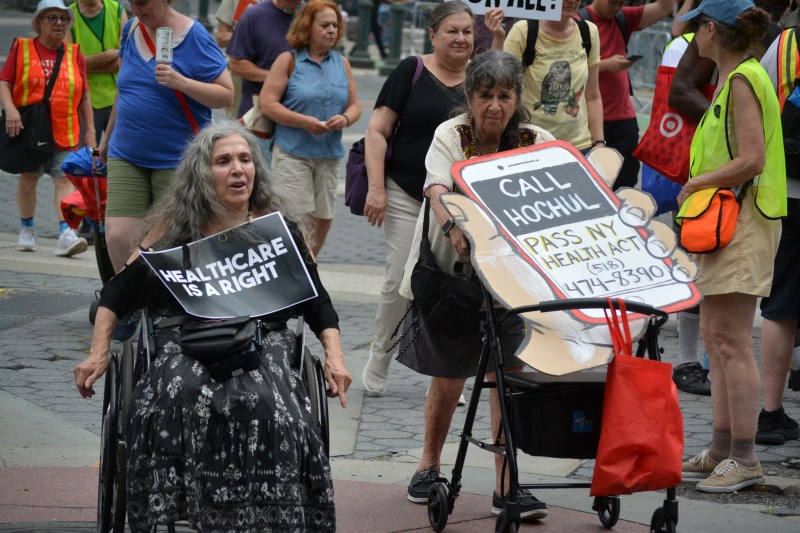
His preferred solution is the New York Health Act, which would create a universal, single-payer health coverage program for all New Yorkers regardless of income or immigration status, with no premiums, deductibles, or copays. The bill, sponsored by state Sen. Gustavo Rivera (D) and Assemblymember Amy Paulin (D), currently has majority co-sponsorship in both the state Assembly and Senate—but has stalled, with progressives pointing to legislative leadership and the governor as obstacles to its advancement.
“A Band-Aid has been torn off, and the gaping, separating wound is being allowed to fester more,” Auerbach said of the Essential Plan rollback. “As a single-payer advocate, none of this has to be.”
“People don’t realize this is the beginning of the awful, not the end of the awful,” Auerbach said. “The only thing that’s radical and extreme is that we don’t have universal healthcare.”
New Yorkers who are interested in learning more about the fight for the New York Health Act can find resources at nyhcampaign.org and pnhpnymetro.org.