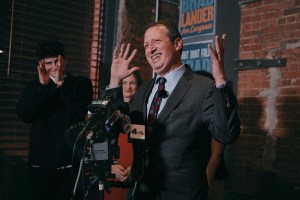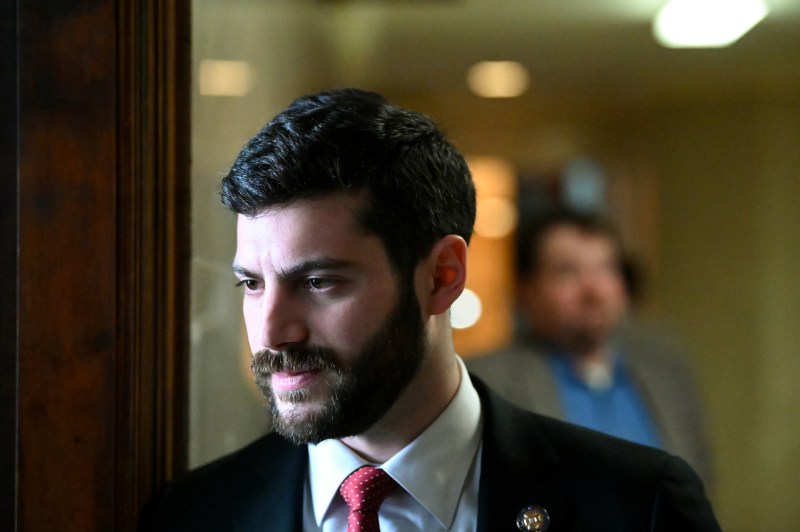
Alex Bores was on his couch, killing time before his anniversary dinner, when his phone rang.
The caller had a scoop: Leading the Future, a newly formed super PAC backed by some of the biggest names in Silicon Valley, was naming him “oligarchy enemy number one.” They were going to spend millions to keep him out of Congress.
“What do you think of that?” the caller asked.
Bores, a fifth-generation New Yorker, computer scientist, and state assemblymember from Manhattan’s Upper East Side, had been in the race to replace retiring Rep. Jerry Nadler for roughly three weeks. He was, by his own admission, not yet a household name.
That was Nov. 16. By Dec. 4, Leading the Future had told the New York Times it planned to spend at least $10 million against him.
Since then, that number has ballooned to $140 million raised, with nearly $2 million in attack ads targeting Bores specifically. Today, he is the only candidate in the country that Leading the Future is actively opposing.
“They’re the ones that really made this a fight over whether AI can be regulated whatsoever,” Bores told Courier New York.
The seat
Nadler has represented New York’s 12th Congressional District for more than three decades. He was first elected in 1992, survived redistricting, outlasted rivals, and became one of the most recognizable figures in the House Democratic caucus — the man who chaired the Judiciary Committee during two Trump impeachments, who fought for LGBTQ rights before it was mainstream, who was, for a generation of Manhattan Democrats, simply the congressman. When he announced last year that he would not seek reelection, it was the first time the seat had been open since the early Clinton administration.
That kind of vacancy doesn’t come around often. NY-12, which stretches from the Upper East Side down through Midtown, is one of the most reliably Democratic districts in the country and one of the most coveted open seats in the 2026 cycle. The winner will inherit a platform, a bully pulpit, and a perch in the middle of the nation’s media capital.
Nearly a dozen Democrats have entered the race to claim it. Assemblymember Micah Lasher, Nadler’s hand-picked protégé from the Upper West Side, has the retiring congressman’s endorsement and the backing of the Democratic establishment. Jack Schlossberg, grandson of JFK and a social media phenomenon, is running a campaign built as much on Kennedy mystique and viral posts as on policy. George Conway, the former Republican and prominent Trump critic, has framed his entire candidacy around opposing the president. Nancy Pelosi has endorsed Schlossberg. Bloomberg’s money is behind Lasher.
And then there’s Bores, who has drawn fire from a different direction entirely.
The race behind the race
Think Big, a pro-AI PAC and affiliate of the larger Leading the Future super PAC, has made Bores its primary target. Its backers include some of the most powerful figures in the AI industry—among them Andreessen Horowitz co-founders Marc Andreessen and Ben Horowitz, and Greg Brockman, president of OpenAI, who Bores notes was Donald Trump’s single largest megadonor in the last campaign finance filing.
Their beef with Bores centers around the RAISE Act—the Responsible AI Safety and Education Act—a law Bores co-authored that imposes safety requirements on advanced AI systems and is widely considered the strongest of its kind in the country. For the industry figures backing Think Big, a Bores seat in Congress means that law has a champion in Washington, and potentially a federal version on the horizon. That prospect is apparently worth $140 million to stop.
What makes this unusual, even by the standards of 2026’s money-drenched political environment, is the architecture behind it. Leading the Future was modeled deliberately on Fairshake, the crypto super PAC that spent at least $260 million in the 2024 cycle and successfully kneecapped several progressive candidates. It employs the same political strategist—Josh Vlasto, a Democratic operative who previously worked for Andrew Cuomo and Chuck Schumer—and operates the same playbook: flood the zone early, define the target before they can define themselves, and make the spending so overwhelming that the message becomes the story.
Except this time, the playbook is not working as intended.
The attack that keeps backfiring
Think Big’s ads don’t mention AI. Instead, they lambast Bores for his time at Palantir, the data analytics company that holds contracts with US Immigration and Customs Enforcement. The ads claim he made hundreds of thousands of dollars “building and selling the tech for ICE” which prompted Bores to send a cease-and-desist letter.
Ask Bores why the ads avoid their actual argument, and he doesn’t hesitate. “Because they know I’m right,” he said. “To say that the fastest moving and most powerful technology of our lifetime should have no regulation is a laughable statement. If they just put that out as an ad, it would basically be an in-kind contribution to my campaign.”
Bores worked at Palantir from roughly 2014 to 2019—a period that overlaps with the company’s ICE contract. However, he maintains he never worked on that project.
The original contract, he explains, was with Homeland Security Investigations and focused on anti-human trafficking and anti-drug work. When Trump came into office and pushed to redirect that software toward deportation operations, Bores says internal debates broke out. On his own project—a Department of Justice contract—he personally blocked the use of immigration-related data. When Palantir executives decided to renew the ICE contract without guardrails, he made plans to leave.
“They made clear internally to us that they were going to renew the contract without putting in any guardrails,” he said. “And at that point I made plans to quit.”
Think Big’s latest ad calls this a convenient story. Bores describes it as “another of their hallucinations and lies,” and notes that multiple current Palantir employees backed his account as far back as his 2022 Assembly race.
There is also the matter of Joe Lonsdale. Palantir’s co-founder is a reported backer of the larger Leading the Future operation—meaning the man who built the company is funding the ads attacking Bores for working there. Vlasto has a technical defense: Lonsdale donated to American Mission PAC, the Republican-oriented affiliate of Leading the Future, rather than to Think Big, the Democratic-oriented group running the Bores ads.
What has happened instead is that the attacks have made Bores a household name.
Rep. Pat Ryan (D-Hudson Valley), the first sitting member of New York’s congressional delegation to endorse him, told Politico the spending is “10x backfiring.” Our Revolution, the Bernie Sanders-founded progressive group, came in behind him. The United Federation of Teachers (UFT) also endorsed him, making him the unanimous choice among the state’s educator unions.
“People are smart enough to understand that if people that rich and powerful are coming at him,” Ryan said, “he must be doing something right.”
The Anthropic question
The drama has prompted counter-narratives, too. Schlossberg has alleged on social media that Bores is funded by AI industry money. Vlasto, for his part, has said that anyone backing Bores “is either foolish or needs to do a quick Google search” about Anthropic’s involvement. The AI company funded Public First Action, a nonprofit that seeded two pro-Bores super PACs—including Jobs and Democracy PAC, which has spent $2.3 million supporting him in the primary.
Chris Larsen, a crypto billionaire who donated seven figures to Trump’s inauguration, has put up an additional $3.5 million behind Bores. By some measures, spending in support of Bores now outweighs the spending against him.
Lasher, in a statement to Courier New York, went further. “I am proud to be the only candidate in this race who has been standing up to big technology companies for a decade, the only one who has voted consistently to regulate AI, and the only one not backed by big AI companies or big crypto,” he said.
The public record offers some support for that claim. Bores was the lone Democrat to vote against a bill to regulate AI in lending in the Assembly Codes Committee—a bill co-sponsored by Lasher himself.
Bores pushed back when Courier raised it directly. Leading the Future, he says, named him enemy number one three weeks after he launched his campaign, then committed $10 million in spending against him two weeks after that. The pro-Bores outside groups formed in response, well after the target was already on his back.
“Their timeline that they keep saying is just false,” he said.
He also rejects the equivalence. The money opposing him, he argues, comes from a small group of tech billionaires who are also Trump megadonors— Andreessen and Horowitz donated $12 million to Trump’s super PAC MAGA Inc, and Brockman, per Bores, was Trump’s single largest individual donor in the last campaign finance filing.
“I’ve been proud to have support from employees at almost all of the companies who are actually building the technology and who know it desperately needs regulation,” he said.
Whether that distinction lands with voters is unclear. Lasher has proposed a federal data center moratorium and a national wage insurance program, and says he will push for all Americans to hold a financial stake in the AI companies that shape their lives.
Schlossberg, meanwhile, has proposed his own framework he calls JACK—Jobs, American national security, consumer financial protection, and kids—while arguing that regulators should be “disinterested,” not aligned, with one faction of the industry over another.
Civil rights attorney Laura Dunn has also included AI regulation in her platform.
The law they tried to kill
Before there were attack ads, there was a bill.
Co-authored by Bores and signed by Gov. Kathy Hochul, it is widely described as the strongest AI safety law in the country. It mandates independent safety testing of advanced AI systems and creates accountability mechanisms for AI systems that cause demonstrable harm.
Getting it signed was, by Bores’ account, a war of attrition. “There were multiple times in the process where I thought it was completely dead,” he said.
Money poured in to pressure Hochul to veto or water down the bill. And then Trump, having received substantial contributions from the same tech figures now funding Leading the Future, issued an executive order specifically targeting state-level AI regulation—naming the RAISE Act among the bills it sought to punish.
It didn’t work. “It is the only bill in the country that was targeted by that executive order that’s been enacted into law since that executive order came into effect,” Bores said.
He’s careful about what he says was left on the table, but will not detail the concessions. “There were parts of the bill I wish could have been even stronger,” he said. What he is clear about is the direction: the RAISE Act is a floor, not a ceiling, and he intends to push a federal version from Congress if elected.
21 days
With the June primary just weeks out, Bores was asked what he wants a progressive New Yorker who has never heard of him to understand about why he’s running.
His answer ranged wide, encapsulating housing, healthcare, child care, and the cost of living. He talked about passing 32 bills in the state legislature, roughly the same number Congress as a whole passed in 2023. He talked about being ranked by the Center for Effective Lawmaking as the most effective new legislator from New York City. He wants voters to know that he is not just the AI guy.
But he kept coming back to the same place. “This has become about more than just me and the member of Congress I will be,” he said. “It has become about the message that is sent to every other member of Congress, as to whether they can really stand up for all of us.”
Members of Congress, he said, are watching this race. They know their constituents want regulation. They’re trying to figure out whether it is safe to say so publicly. “They are just absolutely desperate to keep me out of Congress,” he said. “Because they view me as the biggest obstacle to their quest for unbridled control over the future of AI—and they’re right about that.”
If Leading the Future wins on June 23, those members will have their answer.
“If the super PAC wins,” Bores said, “It’ll just take a lot more courage for others in Congress to step up and take action here.”
He paused, then added: “I guarantee you, there will be another smear ad.”