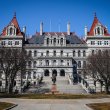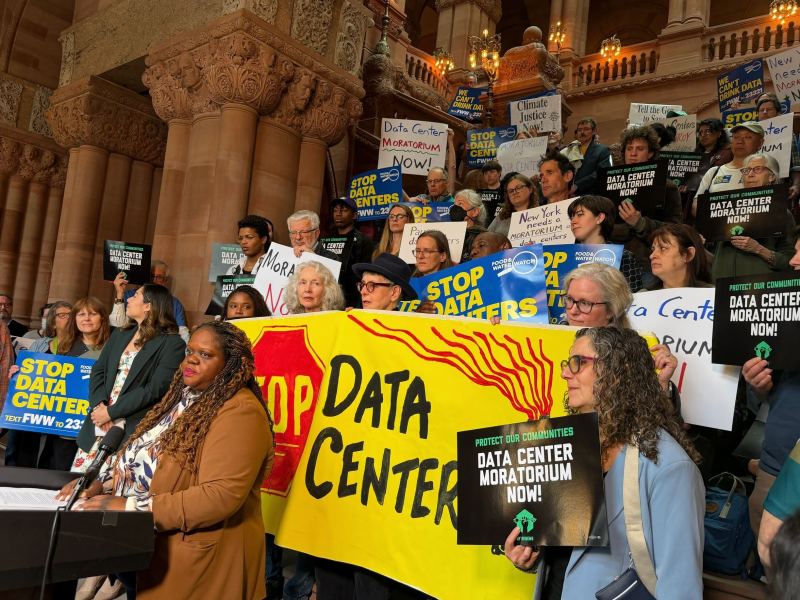
More than 100 New Yorkers packed the Million Dollar Staircase inside the New York State Capitol Wednesday to demand lawmakers pass a moratorium on new hyperscale data center construction in the state.
Democratic lawmakers, environmental advocates, faith leaders, small business owners and community members from across New York gathered in Albany to push for S.9144/A.10141, a bill that would impose a three-year pause on new data center development while state regulators study the industry’s effects on electricity rates, energy use, water resources, air quality, greenhouse gas emissions and electronic waste.
Nearly 150 organizations across New York have signed on in support of the bill, according to Food & Water Watch, which organized the effort.
Introduced by state Sen. Liz Krueger (D-Manhattan) and Assemblymember Anna Kelles (D-Ithaca), with Sen. Kristen Gonzalez (D-Queens) as co-sponsor, the bill would require the Department of Environmental Conservation and the Public Service Commission (PSC) to complete comprehensive studies before new construction permits are issued. Its supporters say the legislature has only weeks left in the session to act.
“New York is in an energy crisis,” Gonzalez told Courier New York. “We’re at the point where we cannot keep up with the current demand on our energy grid, and the PSC has said that we are on the brink of rolling blackouts.”
Large-scale data centers place enormous strain on an already overburdened electric grid. New York’s grid operator has estimated the state could face a shortage of roughly 1,600 megawatts of power by 2030, largely driven by surging demand from new large energy users like data centers. Data centers have also been shown to raise the cost of utilities for local residents—even as more than 1.3 million New York households are already behind on their utility bills.
Reverend Dr. Majadi Baruti, a climate justice organizer at People United For Sustainable Housing (PUSH) Buffalo, said working families in his city are already stretched thin.
“Right now, working families in Buffalo and across this beautiful state are already struggling with energy poverty,” he said. “Many of our households already spend far more than what is fair on their utility bills.”
Gonzalez, who represents Queens, Brooklyn, and Manhattan, pointed to the negative environmental impacts of data centers, saying the stakes are immediate and personal for her constituents. She pointed to Astoria’s “Asthma Alley,” Queensbridge, the largest public housing complex in North America, and Newtown Creek in northern Brooklyn, site of the largest underground oil spill in the country, where residents have faced generations of cancer and related illnesses.
“Every day that we don’t transition [to clean energy], they are literally getting sicker because of the pollution being caused to keep up with our demand,” Gonzalez added.
State Sen. Lea Webb (D-Binghamton), who represents the Southern Tier, said her region knows what it looks like when industry moves faster than regulation—and who ends up paying the price.
“Large AI corporations often target rural communities and communities of color who are desperate for economic development due to years of systemic under-investment,” she said. “I am proud to cosponsor this bill to pause the creation of new data centers so we can make sure our communities do not bear the impacts of the current AI bubble.”
New York’s data center creep
The urgency is visible across the state.
In Genesee County, Dallas-based Stream Data Centers is advancing Project Double Reed, a proposed 250-megawatt facility at the Science, Technology and Advanced Manufacturing Park—a project that would be built in wetlands immediately adjacent to the Tonawanda Reservation, home to the federally recognized Tonawanda Seneca Nation. The Sierra Club Atlantic Chapter has joined the Nation in challenging the development.
“No local agency could declare that there is no environmental impact for a facility the size of 15 football fields, built in wetlands, that borders a nationally recognized wilderness refuge on tribal lands,” said Roger Downs, conservation director of the Sierra Club Atlantic Chapter.
Along the Hudson, data center company DataBank’s plan to expand its Orangeburg campus was scaled back from 145,000 square feet to approximately 78,000 square feet following pressure from the Bi-State Datacenter Crisis Coalition, a community group fighting to protect the nearby Lake Tappan reservoir—a drinking water source for tens of thousands of New Jersey residents.
But the pushback hasn’t stopped the industry’s march into the area: a separate JPMorganChase data center expansion in Orangeburg received a nearly $77 million tax break from the Rockland County Industrial Development Agency in exchange for creating just one permanent job.
Following the rally, activists fanned out across the Capitol for lobby meetings with 50 legislative offices.
The legislative session is set to adjourn June 10.