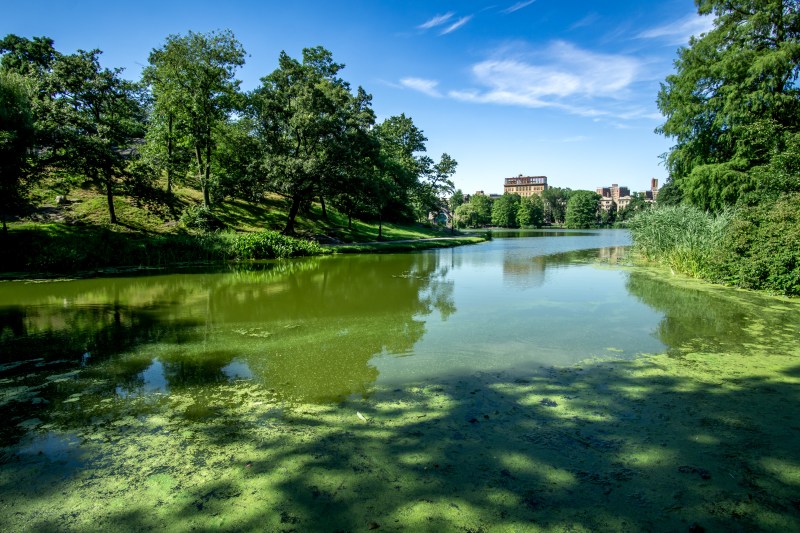
Construction crews are currently transforming Central Park’s Harlem Meer into a multi-pond stormwater system, as part of a $10 million state grant to reduce flooding in Central and East Harlem.
A few miles south in the Bronx, another $10 million is funding a project to reroute Tibbetts Brook and cut combined sewer overflows into the Harlem River by 228 million gallons annually. In Buffalo, workers are dismantling a century-old seawall along Lake Erie and naturalizing the shoreline to absorb wave energy before it can flood the neighborhood behind it.
These projects reflect what New York has been building since 2021, when the state began committing what would become $88.7 billion in clean energy and climate infrastructure spending —a figure spanning state budget allocations, federal grants, utility ratepayer programs, and the Regional Greenhouse Gas Initiative.
A major piece of that came in 2022, when voters approved the $4.2 billion Clean Water, Clean Air and Green Jobs Environmental Bond Act, a mandate to fund clean water, flood protection, open space conservation, and green jobs, with at least 35% of investments directed toward disadvantaged communities. Nearly $2.1 billion of Bond Act funding has already been committed.
But as that money flows into seawalls and solar farms, stormwater tunnels and EV charging stations, New York is now wrestling with the cost of its own ambition. After her own energy agency projected the cost of compliance could cost upstate households more than $4,000 a year, Gov. Kathy Hochul has proposed rewriting the state’s landmark climate law, the Climate Leadership and Community Protection Act (CLCPA).
Hochul has proposed rolling back the law’s 2030 emissions targets, citing the potential costs to New Yorkers, as well as shifting economic and geopolitical circumstances, and a federal government hostile to renewable energy, “So much has radically changed since the Climate Act was enacted, necessitating common-sense adjustments that keep us on our path to a greener future in a way that is affordable for New Yorkers,” Hochul wrote in a recent op-ed.
But Hochul’s proposed changes have been met with criticism from environmental advocates and some fellow Democrats, who have called for staying the course. And as state budget negotiations intensify, the fate of New York’s ambitious climate and clean energy investments are up in the air.
Progress on the ground
While the financial and political challenges are real, so too has been the progress.
The New York State Energy Research and Development Authority (NYSERDA) sits at the center of the state’s clean energy buildout, administering programs across the sector and acting as the operational engine for much of New York’s climate spending.
New York met its 2025 distributed solar goals one year early and is now ahead of schedule to reach 10 gigawatts of installed solar capacity. The state has surpassed its 2025 energy storage benchmark and is pushing toward a 6 GW goal for 2030.
Offshore wind has been a battleground. South Fork Wind, the nation’s first utility-scale offshore wind farm, came online in 2024 and now powers roughly 70,000 Long Island homes. Two more projects, Empire Wind and Sunrise Wind, are under construction. Both received federal stop-work orders from the Trump administration in December 2025, but court rulings cleared them to resume construction after the administration missed its final appeal deadline in April 2026. Empire Wind, if completed, is expected to power more than 500,000 homes in New York City.
Grid modernization is also underway. In June 2025, state regulators approved 29 urgent grid upgrade projects totaling roughly $636 million across Con Edison, National Grid, NYSEG, and RG&E. The Champlain Hudson Power Express, a transmission line championed by Hochul, is expected to come online this year, delivering hydroelectric power from Quebec directly to New York City.
NY Green Bank, a NYSERDA division, has committed more than $2.6 billion in financing transactions as of the end of 2025, according to sources with knowledge on the matter, with those deals expected to mobilize more than $10 billion in public and private capital for clean energy and sustainable infrastructure projects.
Spending billions, retreating on the deadline
New York’s investments have been shaped by the CLCPA, signed in 2019. The law requires the state to cut greenhouse gas emissions 40% below 1990 levels by 2030, reach an 85% reduction by 2050, and generate 70% of its energy from renewables by 2030—among the most ambitious targets in the country. To get there, the law required the state’s Department of Environmental Conservation (DEC) to finalize emissions regulations by January 2024.
It missed that deadline. In October 2025, the Albany County Supreme Court ruled in favor of advocates who sued to compel the state to issue those regulations, finding that DEC had violated the law. The court ordered DEC to finalize the rules by February 2026. The Hochul administration has since appealed.
Also in February, NYSERDA—the same agency at the center of the state’s climate spending—released a memo projecting that a cap-and-invest program to meet those targets could cost Upstate households more than $4,000 per year and New York City households $2,300 per year.
That analysis prompted Hochul to propose rolling back the law. Her proposal would delay the timeline for issuing emissions regulations to the end of 2030 and delay the target of cutting emissions 40% below 1990 levels to 2040 instead of 2030, while keeping the existing 2050 target. Her plan would also change the state’s emissions accounting methodology to align with standards used by other states, including California, Colorado, and Washington.
“Without a federal partner, there is only so much states can do on their own,” Hochul wrote in her op-ed.
She pointed to the Trump administration’s hostility toward offshore wind and its rollback of federal tax incentives as factors making the original timeline unachievable without crushing ratepayers. She also said post-COVID inflation and supply chain issues, the Trump administration’s tariffs, and the rises in gas prices due to Trump’s war on Iran had changed circumstances enough that adjustments needed to be made to the CLCPA to “protect New Yorkers’ pocketbooks.”
Environmental advocates, faith leaders, and scientists have pushed back, arguing the changes amount to a retreat at a critical moment.
“Our members across the Hudson Valley are wincing every time they have to fill up their tanks because of Trump’s illegal war in Iran,” Xaver Kandler, Political Director at For the Many, said in a statement in April. “Now, instead of accelerating our independence from volatile price spikes caused by fossil fuels, the Governor is trying to delay action to lower bills and climate emissions by strong-arming the legislature behind closed doors.”
Fellow Democrats have also criticized Hochul’s proposal, with 29 of 41 Democratic state senators writing a letter in March expressing their opposition to rolling back the law and criticizing the NYSERDA memo as being misleading.
The Hochul administration argues the proposed changes bring New York in line with other climate-leading states and that the law’s core 2050 emissions limits remain unchanged. Ken Lovett, senior communications advisor for energy and environment at the New York State Executive Chamber, echoed that framing.
“Despite a White House that views climate change as a hoax,” Lovett said, “Governor Hochul remains committed to her efforts to build stronger, cleaner, healthier, and more affordable communities.”
Who’s still left behind?
Even as funding flows, environmental justice advocates say the state’s investments are not reaching the communities that need them most.
Fossil fuel peaker plants, which fire up during peak electricity demand and are among the dirtiest power sources on the grid, were supposed to be phased out under the CLCPA. But according to the NYC Environmental Justice Alliance, the state is not on track. Several plants have been partially decommissioned, but others, from Kent Generating to Arthur Kill, appear likely to remain online past their 2030 and 2040 retirement deadlines. The alliance says the heaviest burden falls on neighborhoods in the South Bronx, Astoria, and Sunset Park—low-income communities of color along the city’s waterfront.
Daniel Chu, senior energy planner for the NYC Environmental Justice Alliance, says battery storage and renewable energy have been commercially viable alternatives to peaker plants for years.
“Battery energy storage systems are well-suited to address the intermittent demand that created peaker plants in the first place,” he said, “without polluting neighborhoods and endangering communities with gas pipelines and infrastructure.”
Instead, he argues, the state has failed to plan adequately for the transition—leaving the plants running and the burden concentrated in the same communities that were promised relief.
“The state needs a holistic approach, starting with Governor Hochul, to engage with communities to deliver the direct investment they need to deliver the benefits promised by the climate law,” Chu said.
“The state’s spending on climate suffers from a dearth of clear direction and accountability from the top down,” he added. “Other agencies seem to flout the law altogether.”
The legislative battle over the CLCPA changes is ongoing. The Hochul administration is pressing state lawmakers to adopt amendments as part of budget negotiations.
In the meantime, the projects grind forward. Sources familiar with the matter describe 2026 as a year of implementation—a shift from authorizing dollars to deploying them—while the state works to help local governments, particularly in disadvantaged communities, navigate the grant process.