As our understanding of intellectual and developmental disabilities (I/DD) continues to expand, so does the mission to provide fulfilling employment opportunities.
Such diagnoses typically occur up to age 18. Intellectual disabilities are characterized by differences in intellectual functioning or intelligence (including the ability to learn, reason, and problem-solve) and in adaptive behavior, such as everyday social and life skills.
Developmental disabilities encompass broader categories and may include the nervous and sensory systems, as well as metabolic and degenerative disorders.
While the definitions are important, they may vary depending on the information source. According to the National Institutes of Health, definitions and categories of I/DD may differ between the Individuals with Disabilities Education Act and the Social Security Administration, making it even more challenging for those seeking support.
Despite the red tape that comes with such far-reaching initiatives, New York State is making significant inroads in supporting its residents with I/DD.
A January 2026 report from New York State’s Office for People with Developmental Disabilities (OPWDD) indicated that its system, in partnership with over 400 nonprofit providers statewide, serves approximately 135,000 people—one of the largest in the nation.
Since 2019, the number of New Yorkers receiving services has increased by about 15,000, with spending increased by $1.8 billion.
OPWDD’s Home and Community-Based Services Waiver (a Medicaid funding mechanism) helps drive some of those resources into local communities, including over 800 day- and employment-related programs throughout New York State.
Here is a look at six New York-based companies and nonprofit organizations across a broad range of industries that are making a big impact, one job at a time.
Magnolia Bakery
Magnolia Bakery has embraced the sweet smell of success in more ways than one. Since its founding in 1996, customers have been lining up at the original Bleecker Street location for its famous red velvet cupcakes and banana pudding.
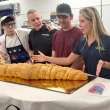
The bakery (now with over a dozen locations worldwide and a recent franchise expansion) has partnered with organizations like Goodwill to place employees with I/DD in its Long Island City production facility.
“This is something that is dear to CEO and Chief Baking Officer Bobbie Lloyd’s heart,” Lisa LaTorre, Head of Production, told the OPWDD.
LaTorre says the experience has helped managers better understand how different employees process information and learn tasks. With Magnolia Bakery expanding, its Long Island City facility stands as one example of what disability-inclusive hiring can look like as a company grows.
Spectrum Designs Foundation
Co-founders Patrick Bardsley, Stella Spanakos, and Nicole Sugrue founded Spectrum Designs in 2011 in a Long Island backyard barn. Their mission: to serve the community’s needs for custom-printed merchandise while also providing employment opportunities for those on the autism spectrum.
Within two years, they outgrew the barn, hired more staff, and moved into a larger space in Port Washington, and again in 2018. Its technology upgrades and on-site training opportunities have grown hand in hand. After an Instagram video went viral, Bardsley was invited to appear on The Kelly Clarkson Show, further boosting the company’s visibility.
Nearly 70% of Spectrum Designs’ employees are on the spectrum or neurodivergent. According to recent filings, the company earned $9.8 million in revenue in 2025, proving that inclusive hiring can be a major part of a sustainable business model.
Shake Shack
From its first location in New York City’s Madison Square Park to more than 700 locations worldwide, Shake Shack has reimagined the classic burger, fries, and milkshake combination with high-quality ingredients and a “Stand For Something Good” value system that permeates food production, community engagement, and diverse employment opportunities.
In the words of Shake Shack CEO Rob Lynch, the staff’s “energy, care, and commitment are the lifeblood of our company.” Words translate to action when it comes to Shake Shack’s hiring practices.
Shake Shack regularly partners with Jobpath’s Consortium for Customized Employment (CCE), a coalition of agencies, to place hundreds of job seekers with developmental disabilities. Since the partnership began in 2012, CCE and Shake Shack have secured 44 jobs across four boroughs, Long Island, and New Jersey.
John’s Crazy Socks
“It is not enough to just sell stuff,” says father and son entrepreneurs Mark and John Cronin. “Our mission, our values, and our business are personal. We do what matters.”
John’s Crazy Socks celebrates its 10th anniversary this December, proving that a great idea can turn into a multi-million dollar social enterprise. John, who has Down syndrome, was about to graduate high school when he told his father he wanted to go into business together. After a bit of brainstorming, the pair settled on fun socks, which had become John’s signature look.
Their first month earned more than $13,000 in revenue, and there’s been no looking back. Today, more than half of John’s Crazy Socks employees have differing abilities, and 5% of earnings are donated to the Special Olympics. To date, the company has donated more than $800,000 to charity partners.
Jawonio
One of the oldest organizations providing services to people with I/DD in New York State, Jawonio (an indigenous word for “independence”) has developed a range of lifespan services from early education to residential living and mental health care.
Among Jawonio’s offerings is its comprehensive employment initiative. Vocational assessment, communication coaching, and employment training set participants up for success. Two “boot camps”—retail and janitorial—focus on specific career pathways.
Jawonio also operates its own in-house cleaning service. Since its inception over 25 years ago, it has established itself as a reputable service for corporate, nonprofit, and government sites, securing over $6 million in contracts.
“All of our contracts offer the prevailing wage rate plus their supplemental wage,” says Michele Curtis, director of social enterprise and new business development. “So they’re really good-paying jobs, and it allows them to earn a paycheck and be a valued member of society.”
Explore & More, The Ralph C. Wilson, Jr. Children’s Museum
Since its founding in 1994, Explore & More has stayed true to its founding principle: that “play is essential to healthy brain development in children.”
In 2019, the museum moved to a 43,000-square-foot home at Canalside in downtown Buffalo, furthering its reach for visitors from across New York State, Pennsylvania, and southern Ontario.
As part of its mission, Explore & More’s play-based lessons include experiences for diverse learners, such as Play & Learn, a multisensory class for children aged 3 to 4 years, and Au-Some Evenings—monthly programming with themed activities and sensory exploration for children with autism and sensory processing needs.
The museum has also employed people with I/DD in facilities and operational roles.
“We are all about diversity, equity, and inclusion,” says chief operating officer Jerry Silvis. “Employing people with disabilities shows our audience that everyone can and will succeed if only given a chance.”
This article first appeared on Good Info News Wire and is republished here under a Creative Commons license.
READ MORE: Survey: Americans underestimate cost of child, senior care in New York